






Top 3 Restricted Area Treks In Nepal 2026/27
Nepal has 15 designated restricted trekking zones along its northern and western borders near Tibet. You cannot enter any of them without a Restricted Area Permit issued by the Department of Immigration, and you cannot apply for that permit yourself. It must come through a registered trekking agency, with a licensed guide assigned before the permit is processed. That structure is deliberate. These regions sit near politically sensitive border zones, hold Tibetan Buddhist cultures that have stayed intact precisely because access has been controlled, and carry ecological fragility that daily trekker caps are meant to protect.
As of March 2026, the two-person minimum that previously applied to all restricted area treks has been removed. Solo trekkers can now obtain a Restricted Area Permit without finding a second person to join. But the guide requirement stays. A licensed guide is mandatory by law on every restricted area route regardless of group size, trekker experience, or previous Himalayan history. Our team handles the full permit process before you arrive in Nepal.
We run three restricted area treks. The Upper Mustang Tea House Trek is 16 days from $1,619, reaching Lo Manthang, the ancient walled capital of the former Kingdom of Lo, at 3,810 metres. The Manaslu Circuit Trek is 14 days from $876, crossing Larkya La Pass at 5,106 metres around the world’s eighth highest peak. And the Manaslu Tsum Valley Trek is 19 days from $1,275, combining the Circuit with the hidden Buddhist Tsum Valley for a maximum altitude of 5,160 metres.
16 Days Upper Mustang Tea House Trek At $1,619
| Day | Destination | Altitude | Walking |
|---|---|---|---|
| 1 | Arrive Kathmandu | 1,350m | |
| 2 | Trek preparation in Kathmandu | 1,350m | |
| 3 | Drive Kathmandu to Pokhara | 820m | |
| 4 | Fly Pokhara to Jomsom, trek to Kagbeni | 2,800m | 3 to 4 hrs |
| 5 | Kagbeni to Chele | 3,050m | 5 to 6 hrs |
| 6 | Chele to Syangbochen | 3,475m | 6 to 7 hrs |
| 7 | Syangbochen to Ghami | 3,520m | 5 to 6 hrs |
| 8 | Ghami to Charang | 3,560m | 4 to 5 hrs |
| 9 | Charang to Lo Manthang | 3,810m | 4 to 5 hrs |
| 10 | Explore Lo Manthang | 3,810m | 2 to 3 hrs |
| 11 | Lo Manthang to Ghar Gompa | 3,930m | 5 to 6 hrs |
| 12 | Ghar Gompa to Ghiling | 3,570m | 5 to 6 hrs |
| 13 | Ghiling to Chele | 3,050m | 6 to 7 hrs |
| 14 | Chele to Jomsom | 2,800m | 6 to 7 hrs |
| 15 | Fly Jomsom to Pokhara | 820m | |
| 16 | Drive or fly to Kathmandu, depart | 1,350m |
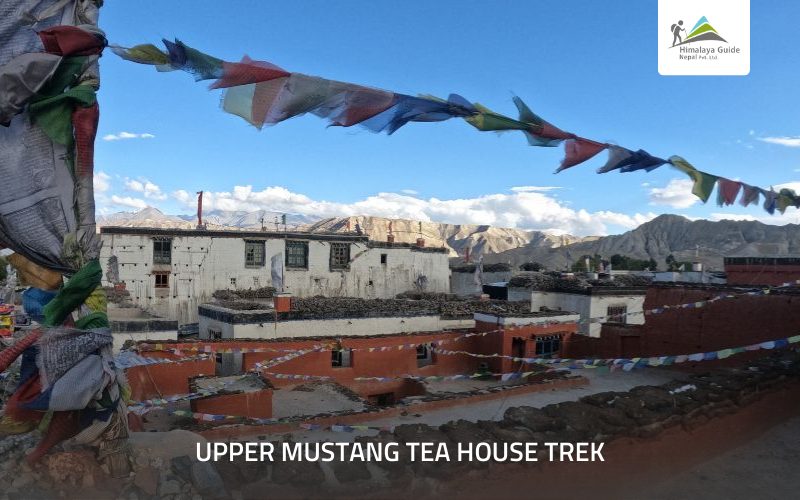
Upper Mustang was an independent kingdom called Lo for over 600 years, sharing more culture and language with Tibet than with Nepal. Nepal revoked its autonomy in 2008 but the region remained a restricted area, and that status is why it still looks the way it does. Lo Manthang, the walled capital founded by King Ame Pal in 1380 AD, sits at 3,810 metres surrounded by eroded clay cliffs and ancient sky caves that predate the monasteries built around them. The desert plateau landscape above Kagbeni is unlike anything else in the trekking world, flat and windswept at high altitude with white and ochre walls of medieval settlements rising from the rock. But the most remarkable thing about Upper Mustang is not any single sight. It is the completeness of a culture that was simply cut off from the changes that reached everywhere else.

And the permit for this Upper Mustang Tea House Trek route is the most expensive restricted area permit in Nepal at $500 per person for the first 10 days, with $50 per person per day after that, plus an ACAP permit at NPR 3,000. That cost is by design. It limits daily visitor numbers and funds the communities inside the restricted zone directly. Our team processes the permit before you leave Kathmandu and you carry originals because checkpoints on the route verify papers, not phone photos. Maximum altitude is 4,230 metres at Chogo La and Marang La. Moderate difficulty. Group size 2 to 10.
14 Days Manaslu Circuit Trek At $876
| Day | Destination | Altitude | Walking |
|---|---|---|---|
| 1 | Arrive Kathmandu | 1,350m | |
| 2 | Drive to Machha Khola | 869m | |
| 3 | Machha Khola to Jagat | 1,400m | 5 to 6 hrs |
| 4 | Jagat to Deng via Sirdibas | 1,804m | 5 to 6 hrs |
| 5 | Deng to Namrung | 2,660m | 6 to 7 hrs |
| 6 | Namrung to Lho | 3,180m | 4 to 5 hrs |
| 7 | Lho to Samagaun | 3,525m | 3 to 4 hrs |
| 8 | Acclimatization day in Samagaun | 3,525m | Optional hike |
| 9 | Samagaun to Samdo | 3,875m | 3 to 4 hrs |
| 10 | Samdo to Dharmasala | 4,460m | 3 to 4 hrs |
| 11 | Dharmasala to Bimthang via Larkya La | 3,630m | 8 to 9 hrs |
| 12 | Bimthang to Tilije | 2,300m | 5 to 6 hrs |
| 13 | Tilije to Dharapani | 1,960m | 4 to 5 hrs |
| 14 | Drive to Kathmandu | 1,350m |
The Manaslu Circuit circles Mount Manaslu at 8,163 metres, the eighth highest mountain on earth, and crosses Larkya La Pass at 5,106 metres on day eleven. About 50 to 80 trekkers walk this circuit on a peak season day. Everest Base Camp sees 400 or more. That difference is the restricted permit system working as intended, and the Tibetan Buddhist communities in the Nubri valley along the Budhi Gandaki gorge have stayed intact because of it. The trail through the lower gorge is rough and steep, teahouse infrastructure is basic compared to Everest and Annapurna, and the acclimatization day in Samagaun on day eight includes an optional hike toward Manaslu Base Camp with the full massif visible from the ridge.

Three permits are required: Manaslu Restricted Area Permit at $100 per person per week in peak season (September to November) or $75 per person per week in other months, Manaslu Conservation Area Permit at NPR 3,000, and Annapurna Conservation Area Permit at NPR 3,000 for the exit section through Dharapani. Total permit cost runs approximately $190 to $250 per person depending on season and trek duration. Our team handles all three.
19 Days Manaslu Tsum Valley Trek At $1,275
| Day | Destination | Altitude | Walking |
|---|---|---|---|
| 1 | Arrive Kathmandu | 1,350m | |
| 2 | Drive to Machha Khola | 869m | |
| 3 | Machha Khola to Jagat | 1,070m | 5 to 6 hrs |
| 4 | Jagat to Lokpa via Philim | 1,750m | 6 to 7 hrs |
| 5 | Lokpa to Chumling | 2,386m | 4 to 5 hrs |
| 6 | Chumling to Chhekampar | 3,010m | 5 to 6 hrs |
| 7 | Chhekampar to Nile | 3,361m | 4 to 5 hrs |
| 8 | Nile to Mu Gompa | 3,700m | 4 to 5 hrs |
| 9 | Mu Gompa to Samagaun | 3,525m | 6 to 7 hrs |
| 10 | Acclimatization in Samagaun | 3,525m | Optional hike |
| 11 | Samagaun to Samdo | 3,875m | 3 to 4 hrs |
| 12 | Samdo to Dharmasala | 4,460m | 3 to 4 hrs |
| 13 | Dharmasala to Bimthang via Larkya La Pass | 3,630m | 8 to 9 hrs |
| 14 | Bimthang to Tilije | 2,300m | 5 to 6 hrs |
| 15 | Tilije to Dharapani | 1,960m | 4 to 5 hrs |
| 16 | Drive to Kathmandu | 1,350m |
But the Manaslu Tsum Valley Trek is the most complete experience available in the Manaslu restricted zone, combining the hidden Buddhist Tsum Valley with the full Circuit including Larkya La Pass. Tsum means “vivid” in Tibetan. The valley was sealed from outside contact for most of its history and the culture inside it reflects that more clearly than almost anywhere else in Nepal.

Mu Gompa at 3,700 metres is the highest monastery in the valley. The trek reaches 5,160 metres at the pass on day thirteen after acclimatization in Samagaun. Four permits are required and our team handles all of them.
What Are The Permits Required For Restricted Area Treks In Nepal For 2026?
Every restricted area trek in Nepal requires a Restricted Area Permit issued by the Department of Immigration in Kathmandu. You cannot apply for it yourself. It must come through a registered trekking agency with a licensed guide assigned to your trek. The permit is tied to your passport number and verified at multiple checkpoints along each route, which check originals, not phone photos.
But permit fees vary by region. Upper Mustang costs $500 per person for the first 10 days, then $50 per person per day after that, plus ACAP at NPR 3,000. Manaslu costs $100 per person per week in peak season (September to November) or $75 per week in other months, plus MCAP at NPR 3,000 and ACAP at NPR 3,000 for the exit section. Tsum Valley adds a separate Tsum Valley RAP at $40 per person for the first 7 days in peak season or $30 off-peak, plus $7 per day. TIMS cards are still required for Manaslu routes as of 2026 and remain enforced at checkpoints on these trails. As of March 2026, the two-person minimum for restricted area permits has been removed. Solo trekkers can now obtain a RAP without finding a second person. But a licensed guide remains mandatory by law. Pre-arrival permit processing is now available using your visa number through a registered agency, which allows permits to be arranged before you land in Nepal. Our team starts the process as soon as your booking is confirmed.
Are There Beginner Friendly Restricted Area Treks In Nepal?
So the Tsum Valley Trek at 3,700 metres maximum altitude with no high pass crossing is the most accessible restricted area trek in Nepal. The terrain is moderate, daily walking is 4 to 6 hours, and the route stays below the altitude threshold where serious acclimatization problems begin for most healthy trekkers. But it is still a restricted area route through remote Himalayan terrain, and prior trekking experience in Nepal on a route like Langtang or Annapurna is worth having before you attempt it.
And Upper Mustang is moderate difficulty with a maximum altitude of 4,230 metres and a desert plateau landscape that is flatter than most Himalayan routes. The terrain change requires adjustment from anyone used to forest trekking because the Upper Mustang environment is dry, exposed, and carries significant temperature swings between midday heat and cold nights. It suits trekkers who have some Himalayan experience and good cardiovascular fitness, but not necessarily technical skills. The Manaslu Circuit and Manaslu Tsum Valley Trek are not for first-timers. Larkya La Pass at 5,106 to 5,160 metres is a long strenuous day at serious altitude and both routes require prior high-altitude experience. If you are considering Manaslu as your first Himalayan trek, talk to us first and we will be direct about whether it fits your current experience level.
What Makes Restricted Area Treks Different From Other Treks In Nepal?
But the difference is not just paperwork. Upper Mustang was a closed kingdom until 1992. Manaslu opened to trekkers in 1991. Tsum Valley opened even more recently. These regions were not just overlooked. They were deliberately protected from outside access, and that protection is why the Tibetan Buddhist culture inside them survived intact while the same culture gradually changed elsewhere under tourism pressure. Walking into Lo Manthang or through the Nubri valley on the Manaslu Circuit gives you access to something that Everest and Annapurna, for all their qualities, no longer fully provide.
And the mandatory guide is part of what makes that access responsible. On standard Nepal treks the guide is recommended. On restricted area routes the guide is a legal requirement and the permit system is built around guide registration, not trekker registration. Teahouse infrastructure on these routes is more basic than Everest or Annapurna. Checkpoints are strict. Daily trekker numbers are capped by permit volume. The cost is higher. And the experience that comes from those constraints is what trekkers who have done Everest and Annapurna and want something different are actually looking for. Restricted area treks are what Nepal’s most famous routes were before the roads and the crowds changed them. That window is still open. But it will not stay open indefinitely as infrastructure slowly reaches these valleys.
Practical Tips For 2026 Restricted Area Treks In Nepal From Local Guides
Book early and start the permit process immediately after booking. Restricted area permits require lead time, especially for Upper Mustang in peak season when permit slots fill. Our team begins the RAP application as soon as your dates are confirmed and can now process permits using your visa number before you arrive in Nepal. Carry permit originals in a waterproof pouch. Every checkpoint on every restricted area route checks originals and will not accept a photo on your phone. Travel insurance covering helicopter evacuation is not optional on any of these three routes.
And October and November are the best months across all three routes for clear skies and stable weather. Upper Mustang is the exception in monsoon season. Because it sits in a rain shadow north of the Annapurna range, it stays relatively dry from June to August and can be trekked when the standard Himalayan routes are rain-soaked. March to May is the second best window for all three. Avoid December to February on Manaslu routes because the Larkya La Pass becomes dangerous in winter. Carry cash because nothing above Jomsom on the Mustang route or Machha Khola on the Manaslu routes accepts card. Sleep with a sleeping bag rated to minus 10 to minus 15 degrees Celsius because teahouse rooms above 3,500 metres are never heated. Four to six weeks of uphill walking with a loaded pack before you leave home is the physical preparation, not flat cardio. Altitude sickness above 3,000 metres can affect anyone and the signs are persistent headache, nausea, and appetite loss that rest does not clear.


