The Gen Z movement, Nepal stabilized, and life returned to normal. All safe for your Travel in Nepal 2025.

Trip Facts

Country

Nepal

Difficulty

Strenuous

Best Season

March - May, Sep - Nov

Accommodation

Lodges / Teahouses

Region

Everest Trekking

Start / End Point

Kathmandu - Kathmandu

Max. Altitude

6,119 m

Group Size

1 - 10

Meals Included

B+L+D

Acclimatization

Namche Bazaar and Dingboche

Permits

Sagarmatha National Park Permit, Khumbu Pasang Lhamu Rural Municipality Entry Permit, and Lobuche Peak Climbing Permit

Duration

17 Days

Activity

Nepal Trekking

Distance

100-120KM

Lobuche Peak Climbing Overview

Lobuche Peak Climbing is one of the most popular climbing peaks in the Khumbu or Everest region of Nepal. The climb is ideal for adventure-loving individuals seeking a true mountaineering experience without requiring full expedition skills. For anyone ready to take their trekking to the next level, our 17 Days Lobuche Peak is for you. It combines a challenging ascent with awe-inspiring mountain views and scenery.

Starting from the thrilling flight to Lukla, you will follow the trail of Everest Base Camp up to Lobuche. The diverse trail takes you through the iconic Sherpa settlements, where you can peek into the local lifestyle and culture. From Monjo, you will enter the Sagarmatha National Park. The trail goes from subtropical forests of rhododendrons, oaks, and firs before gradually transitioning to alpine meadows. As you continue to ascend, the landscape becomes increasingly barren, and the vegetation becomes increasingly sparse. First, you will trek to Everest Base Camp (5,364 m) and the iconic vantage point of Kalapathar (5,555 m).

Next comes the exhilarating climb to the summit of the Lobuche Peak. Lobuche has two summits: Lobuche East (6,119 m) and Lobuche West (6,145 m). You will climb the Eastern peak, as the other is considered an expedition peak. You will trek to the Lobuche High Camp, from where your climb to the summit will start. From the base of Lobuche, the climbing route offers amazing views of the Gokyo Valley, its lakes, and the impressive Khumbu Glacier. You will start before sunrise, and the view of breathtaking mountains under the morning sun’s rays is pristine.

Lobuche Peak climbing in Nepal is the nearest trekking peak to the world’s tallest peak, Everest.Ā From the summit in a clear sky, you can have a fantastic view of Everest, Lhotse, Makalu, Cho Oyu, and other major peaks of the Mahalangur range. The time spent at the summit of this magical peak will remain with you forever. With the Himalaya Guide, have a hassle-free climb of Lobuche Peak. It is an extraordinary journey that rewards you with rich and immersive trek and climbing experiences in Nepal.

Highlights of Lobuche Peak Climbing

  • The journey combines trekking with a thrilling semi-technical ascent of a Himalayan peak in the heart of the Everest region.
  • Take an adventurous flight to one of the world’s most dangerous airports, the Tenzing-Hillary Airport in Lukla.
  • Enjoy traversing the tranquil route of the Everest region while observing the diverse Himalayan flora and fauna of Sagarmatha National Park.
  • Visit beautiful and vibrant Sherpa villages like Phakding, Namche Bazaar, Tengboche, Dingboche, Lobuche, and more.
  • Take a short hike to Khumjung Village and observe the mysterious Yeti scalp at Khumjung Monastery.
  • Trek on the classic trail to the iconic Everest Base Camp (5,364 m) and Kalapathar (5,555 m).
  • Overcome glaciers, snow bridges, hidden crevasses, and ice walls to reach the summit of Lobuche East Peak at 6,119 m.
  • Witness mesmerizing views of Mt. Everest (8,848.86 m), Mt. Lhotse (8,516 m), Mt. Cho Oyu (8,188 m), Mt. Makalu (8,485 m), and other high mountains.
  • Hike past ancient monasteries, gompas, mani walls, colorful prayer flags, and chortens.
  • Enjoy warm hospitality while staying at local teahouses and immersing yourself in the rich Sherpa culture.

Challenges During Lobuche Peak Climbing

Lobuche East Peak Climbing is a strenuous and semi-technical adventure that takes you deep into the Himalayas in eastern Nepal. During the journey to the summit of Lobuche Peak at an elevation of 6,119 m, you will come across various challenges that you need to prepare for. To overcome them, you will need excellent strength and determination.

The first challenge is the diverse trail and rough terrain that takes you to the Lobuche High Camp. There are many steep and narrow sections that will push the trekker’s physical strength, stamina, and endurance. The average trekking hours are 4 to 6 hours, depending on the day’s destination. From the high camp, you will have to navigate hidden crevasses, cross snow bridges, and hike on loose ice, rocks, and glaciers. These are technical sections that require basic mountain climbing skills and the use of gear. Moreover, the temperature drops below the freezing point as you push to the summit.

Another challenge you will come across during the Lobuche Peak Climb is the high altitude. The higher you go, the lower the oxygen level. It exposes you to the risk of altitude sickness, and acclimatization is a must. Despite acclimatization, trekkers may still experience symptoms of altitude sickness. The weather also starts to become unpredictable, and ascending to higher altitudes becomes more laborious.

Similarly, there is a lack of well-facilitated accommodations and medical facilities in higher areas. These challenges will not only push you physically but also mentally test you. Hence, you must understand these difficulties to prepare properly for the adventurous journey.

Outline Itinerary Of Lobuche Peak Climbing

Route End Elevation Elevation Gain/Loss Duration Distance
Day 1 Arrival in Tribhuvan International Airport, Kathmandu 1,350 m - - -
Day 2 Flight from Kathmandu to Ramechhap and Lukla (2,860 m), then trek to Phakding 2,610 m +510 m -250 m 25 mins (flight) 3-4 hrs ~7.5 KM
Day 3 Phakding to Namche Bazaar 3,440 m +830 m 6-7 hrs ~10-11 KM
Day 4 Acclimatization day in Namche Bazaar, then visit Khumjung Village (3,790 m) 3,440 m +350 m -350 m 4-5 hrs ~6-7 KM (round trip)
Day 5 Namche Bazaar to Tengboche 3,860 m +420 m 5-6 hrs ~9.5 KM
Day 6 Tengboche to Dingboche 4,410 m +550 m 5-6 hrs ~11 KM
Day 7 Acclimatization day in Dingboche, then hike to Nangkartshang (5,083 m) or Chhukung Ri (5,554 m) 4,410 m +600 or +1,140 m -600 or -1,140 m 4-6 hrs ~5-9 KM (round trip)
Day 8 Dingboche to Lobuche 4,310 m +530 m 5-6 hrs ~8-9 KM
Day 9 Lobuche to Gorakshep, hike to Everest Base Camp (5,364 m), then return to Gorakshep 5,140 m +424 m -224 m 7-8 hrs ~12-13 KM
Day 10 Hike to Kalapathar (5,555 m), then trek to Lobuche 4,940 m +415 m -655 m 6-7 hrs ~10-11 KM
Day 11 Lobuche to Lobuche High Camp 5,420 m +480 m 3-4 hrs ~3-4 KM
Day 12 Lobuche High Camp to Summit (6,119 m), then back to Lobuche High Camp 5,420 m +699 m -699 m 8-9 hrs ~6-7 KM
Day 13 Extra day - - - -
Day 14 Lobuche High Camp to Pheriche 4,270 m -1,150 m 6-7 hrs ~10-11 KM
Day 15 Pheriche to Namche Bazaar 3,440 m -830 m 6-7 hrs ~14-15 KM
Day 16 Namche Bazaar to Monjo to Lukla 2,860 m -580 m +150 m 6-7 hrs ~18-20 KM
Day 17 Lukla to Ramechhap flight, then drive to Kathmandu 1,350 m -1,510 m 25 mins (flight) 4-5 hrs (drive) ~132 KM (drive)
Download PDF download

Detailed Itinerary

Day 01 :

Arrival in Tribhuvan International Airport (TIA), Kathmandu

Highest Altitude

1350mtrs

Accommodation

Yes

Day 02 :

Flight from Kathmandu to Ramechhap and to Lukla, then trek to Phakding

Trek Distance

7.5 KM

Trek Duration

3 - 4 Hours

Highest Altitude

2,840 m

Meals

B+L+D

Accommodation

YES

Today, you will take a flight to Lukla early in the morning for clear weather. The guide will pick you up from the hotel, and you’ll head to TIA’s domestic terminal with your climbing team. From Kathmandu, you will fly to Ramechap airport. You will take a brief break and then fly to Lukla Airport from here.

After landing in Lukla (2,860 m), you will begin trekking, and your destination for the day is Phakding village. It’s a relatively easy segment, and a relaxed trail takes you to Phakding Village. You will pass small villages and prayer walls before gently descending through a pine forest. The Dudh Koshi River gradually comes into view, and you will cross your first suspension bridge on the way to Thado Koshi from Chheplung. The trail takes you alongside scenic riverbanks and through the forest to Phakding. You will rest at a local lodge in Phakding for the night.

Day 03 :

Phakding to Namche Bazaar

Trek Distance

10 - 11KM

Trek Duration

6 - 7 Hours

Highest Altitude

3440mtrs

Meals

B+L+D

Accommodation

Yes

You will start early at the Phakding valley and walk towards the Sherpa capital of Namche Bazar. The trail is smooth and uphill, passing by small and big settlements along the way. You will walk beside the Dudh Koshi River and cross multiple suspension bridges. Similarly, you will come across beautiful waterfalls before reaching Monjo. There is an entrance gate of Sagarmatha National Park in Monjo where you will have to register your permit. From here onwards, you will start trekking on the national park trail.

The trail descends towards Jorsalle and follows the river. Leaving Jorsalle behind, you will cross the famous Hillary Suspension Bridge, decorated with colorful prayer flags. Then, you will climb uphill on a steep path to Namche. It is a two-hour steep ascent and is also a demanding part of today’s trek. Nearing the village, you will get your first view of Mt. Everest from the trail. Namche Bazaar is also known as the Sherpa capital and the trading hub of the Khumbu region. You will spend the night at a lodge in Namche Bazaar.

Day 04 :

Acclimatization day in Namche Bazaar, then visit Khumjung Village

Trek Distance

6 - 7 KM

Trek Duration

4 - 5 Hours

Meals

B+L+D

Accommodation

Yes

You will have a rest and exploration break for better acclimatization at the higher elevation. There are many different short hiking destinations from Namche village that you can visit today. It is essential to stay active, as it helps your body adapt to the changing altitude and environment more effectively.

You will go for a hike to Khumjung village (3,790 m) from Namche after breakfast. As one of the major villages in the Khumbu region, Khumjung offers an excellent opportunity to learn about the local culture. You will visit the ancient Khumjung monastery, which is 400-500 years old and holds a mysterious Yeti scalp. Similarly, you will also see other attractions, such as the Hillary School and the Sherpa Museum, among others. After spending some time at Khumjung, you will hike back to Namche. You can attend the local market in the evening and view the lifestyle of people living in these areas. You will spend another night at a lodge in Namche.

Day 05 :

Namche Bazaar to Tengboche

Trek Distance

9.5KM

Trek Duration

5 - 6 Hours

Highest Altitude

3860mtrs

Meals

B+L+D

Accommodation

Yes

Enjoying a great sunrise view of the Himalayas at Namche, we will start the trek towards Tengboche today. Leaving Namche, you will have a gradual uphill walk to Tengboche. The views of Thamserku, Lhotse, Nuptse, and Everest are fantastic from this part of the trek. You will gradually ascend to Kyangjuma following a ridge trail. En route, you can also see numerous prayer flags, mani stones, and chortens. Then, the trail begins to descend steeply through forests of rhododendrons and pines towards Phunki Tenga. From Phunki Tenga, you must climb a steep 600-meter uphill to Tengboche.

You will trek for another two hours, and the landscape becomes more barren, opening to the Tengboche plateau. After reaching there, you will visit the Tengboche Monastery. It is the biggest and one of the most significant monasteries of the upper Khumbu region. In major festivals, locals gather and celebrate in the Monastery courtyard and premises. You can also witness the panoramic views of Everest, Ama Dablam, Nuptse, Thamserki, Kangtega, and more from Tengboche. You will enjoy a serene and spiritual atmosphere in the evening and stay overnight at a teahouse here.

Day 06 :

Tengboche to Dingboche

Trek Distance

11 km

Trek Duration

5-6 hrs

Highest Altitude

4410mtrs

Meals

B+L+D

Accommodation

Yes

We will start the day with a wonderful sunrise from the Tengboche Monastery over the Himalayas. After breakfast, you will start the trek towards Dingboche. It begins with a gentle downhill trek through forests of rhododendron and conifers. Along the way, you will pass by small villages and cross a suspension bridge over the Imja River. Then, the trail gradually goes uphill to Upper Pangboche. You will take a short break at Pangboche village. Pangboche is the last major settlement before the Ama Dablam Base Camp. Hence, you can enjoy a breathtaking view of Mount Ama Dablam.

After leaving Pangboche, you will start walking in a more barren landscape. En route, you will pass by small villages like Shomare and Orsho. The trail splits from Orsho, where one path takes you to Pheriche and the other to Dingboche. You will take the trail that takes you to Dingboche and begin ascending slowly. A few patches of barley fields surrounded by stone walls will mark your arrival at Dingboche. It is another crucial acclimatization stop for climbing Lobuch Peak.

Day 07 :

Acclimatization day in Dingboche/ hike to Nangkartshang or Chhukung Ri

Trek Distance

5-9 km

Trek Duration

4-6 hrs

Highest Altitude

4410mtrs

Meals

B+L+D

Accommodation

Yes

Today will be your second acclimatization and exploration day for the Lobuche Peak climbing. Dingboche, located at an elevation of 4,410 meters, is the strategically ideal destination for acclimatization. You will take a short hike around the village to improve your acclimatization. After breakfast, we will start the hike to Nangkartshang or Chhukung Ri.

Nangkartshang Peak sits at an elevation of 5,083 meters. The hike takes you to the ridge above Dingboche village. It is a challenging and steep hike but offers gorgeous views of Ama Dablam, Lhotse, Island Peak, and more. The round trip takes 4 to 6 hours. Chhukung Ri is located at a higher altitude than Nangkartshang Peak, which is 5,554 meters. The trail is also more strenuous and challenging. You can enjoy panoramic views of Ama Dablam, Lhotse, Makalu, and the Khumbu Glacier from the top of Chhukung Ri. The hike takes 6 to 8 hours for a round trip.

You will rest for the day in Dingboche after returning from the hike and spend the night at a teahouse in the village.

Day 08 :

Dingboche to Lobuche

Trek Distance

8-9 km

Trek Duration

7-8 hrs

Highest Altitude

4310mtrs

Meals

B+L+D

Accommodation

Yes

You will have a short trekking day today as you head to Lobuche. The trail gently ascends through the Imja Valley, following alongside the moraine of the Khumbu Glacier. You can witness stunning panoramic views of Ama Dablam, Lhotse, Taboche, and Cholatse while hiking. Then, you will pass Dugla (Thukla) at the end of the terminal moraine of Khumbu Glacier. From here, you must make a short and steep climb to Thukla Pass.

At the top of the pass lies the Everest Memorial Park. There are memorial stone mounds for legendary mountaineers Scott Fisher and Babu Chiri Sherpa (a 10-time Everest Summiteer), as well as many other mountaineers who lost their lives on Everest. The memorial ground is a haunting reminder of Everest’s cruelty. You will continue to ascend uphill along the glacier moraine. The terrain is also rough and rocky, which makes the climb more demanding.

Finally, you will rest your tired feet after reaching Lobuche in the afternoon. The village of Lobuche is small but offers stunning views of the snow-capped peaks of Pumori, Nuptse, and Lingtren. Tonight you will sleep at the village’s teahouse.

Day 09 :

Lobuche to Gorakshep, hike to Everest Base Camp, then return to Gorakshep

Trek Distance

12-13 km

Trek Duration

7-8 hrs

Highest Altitude

5140mtrs

Meals

B+L+D

Accommodation

Yes

After a hearty breakfast, be ready for a long and challenging trek day. From Lobuche, you will have a short hike to Gorakshep. The trail once again goes alongside the Khumbu Glacier moraine. Similarly, you will trek through glacial ridges and rocky, winding paths. Gorakshep is the last place with teahouses before the Everest Base Camp. After reaching the village, you will rest for a while and start the trek towards the Everest Base Camp.

It is the challenging part of today’s trek and provides a great warm-up section for the lower climbing parts of Lobuche Peak. You will reach Everest Base Camp after 2-3 hours of hiking on a winding trail on rugged terrain. The base camp is adorned with colorful prayer flags. During spring and autumn, you can see colorful tents of the Everest expedition teams. You can spend some time exploring around or taking photos before heading back to Gorakshep. You will spend the night at a teahouse in Gorakshep.

Day 10 :

Hike to Kalapathar, then trek down to Lobuche

Trek Distance

10-11 km

Trek Duration

6-7 hrs

Highest Altitude

4310mtrs

Meals

B+L+D

Accommodation

Yes

To acclimate and prepare better for the Lobuche Peak climbing, you will have another hiking day today. You will start before sunrise. From Lobuche, you will ascend to the popular viewpoint in the Himalayas, Kalapathar. The iconic viewpoint is one of the best places to photograph the mighty Everest and other majestic peaks. You will have to climb steeply on a rocky ridge while overcoming the cold wind in the dark. However, the climb is worth the effort as you can witness one of the most gorgeous sunrises. You will get one of the best 360-degree views of Mount Everest and other peaks like Pumori, Lhotse, Nuptse, and more.

After enjoying the beautiful sunrise and views, you will descend to Gorakshep. You will have breakfast and begin your descent to Lobuche. The trail is a relatively easy downhill climb along the glacier moraine. You will spend the night at a teahouse in Lobuche and start your preparations for the summit climb of Lobuche Peak.

Day 11 :

Lobuche to Lobuche High Camp

Trek Distance

3-4 km

Trek Duration

3-4 hrs

Highest Altitude

5420mtrs

Meals

B+L+D

Accommodation

Yes

From Lobuche, there are some challenging sections that you must cover to reach Lobuche High Camp. Before leaving Lobuche, you will once more check the gears and equipment and prepare for one last time before the climb. Right after leaving Lobuche village, the trail begins to ascend steeply towards the ridge. You must trek on rocky and loose scree as you continue uphill.

As you go higher, the trail starts to become more technical. To overcome these sections, you must follow your guide’s instructions. Nearing the high camp, the trail is mostly covered with snow. The Lobuche High Camp is situated directly below the glacier on a rocky terrace. You will set up camp, as there are no accommodations or rest for the day at High Camp. You stay overnight at a camp.

Day 12 :

Lobuche High Camp to Summit, then back to Lobuche High Camp

Trek Distance

6-7 km

Trek Duration

8-9 hrs

Highest Altitude

6119mtrs

Meals

B+L+D

Accommodation

Yes

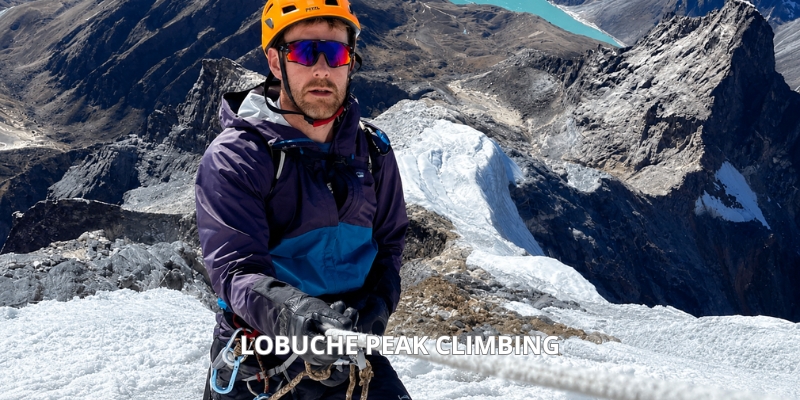
Finally, today is the day of summiting Lobuche East. You will wake up early, before dawn, and start the ascent. The reason behind the early start is to avoid the high winds of the afternoon. Midway to the climb, you will experience a beautiful sunrise lighting up the area. Following the guide’s lead, you will have a long ascent ahead of you. Upon reaching the glacier and snow ridge section, you will have to use mountaineering gear like crampons, a jumar, and a fixed rope. Similarly, you have to climb a steep slope of up to 45–55°.

After about 3-4 hours, you will reach the false summit of Lobuche. Most climbers might expect this part to be the top of Lobuche Peak and the return. However, the Lobuche East expedition is about a couple of hundred meters higher. After one and a half hours of a challenging uphill climb on the snow-covered peak, you will finally reach the Summit of Lobuche. You will spend some time, live in the moment, and take some photographs. The descending route is the same and requires the use of the gear. You will return to the high camp by late afternoon and spend the night there.

Day 13 :

Extra day

Meals

B+L+D

Accommodation

Yes

Today is separated as an extra day in case of bad weather, which might postpone the summit of Lobuche. The entire procedure to climb the peak will be completed today in the event of these scenarios. Otherwise, you will rest and explore the area in Lobuche High Camp.

Day 14 :

Lobuche High Camp to Pheriche

Trek Distance

10-11 km

Trek Duration

6-7 hrs

Highest Altitude

4270mtrs

Meals

B+L+D

Accommodation

Yes

From Lobuche High Camp, you will start the day with a fantastic sunrise view. After breakfast, you will start descending towards Pheriche. En route, you will stop briefly at Lobuche. You will descend on the familiar trail, passing by Thukla Pass, Dughla, and others. The trail continues downhill to the Pheriche Valley. Finally, you will arrive at Pheriche in the afternoon and spend the day resting here.

Day 15 :

Pheriche to Namche Bazaar

Trek Distance

14-15 km

Trek Duration

6-7 hrs

Highest Altitude

3440mtrs

Meals

B+L+D

Accommodation

Yes

From Pheriche, you will continue to descend to Namche. The path is mostly downhill, allowing you to enjoy the scenery throughout. It descends alongside the Imja River. You will also cover a significant distance, passing by major settlements along the way. The first stop is Tengboche. En route, you will pass by Phunki Tenga and Kyangjuma. Then, you will walk further to Namche Bazaar today. Enjoy the local culture and delicacies here and rest for the day. Tonight, you will spend the night at a lodge in Namche Bazar.

Day 16 :

Namche Bazaar to Monjo to Lukla

Trek Distance

18-20 km

Trek Duration

6-7 hrs

Highest Altitude

2840mtrs

Meals

B+L+D

Accommodation

Yes

As the last segment of the Lobuche peak climbing, you will trek from Namche to Lukla. Most of this scenic trek is through forests and ridges. En route, you will stop at the midway settlements for rest and lunch, and then reach Lukla in the afternoon. You can also head out to the local market here for some souvenirs from the Himalayas. You will rest overnight at a lodge in Lukla for the final night in the Everest region.

Day 17 :

Lukla to Ramechhap flight, then drive to Kathmandu

Drive Distance

132 km

Drive Duration

4-5 hrs

Highest Altitude

1350mtrs

Meals

B+L+D

From Lukla, you will take a morning flight to Ramechap. Once in Ramechap, you can choose between flying back or taking an adventurous hill-highway drive to Kathmandu. We will take you to your hotel upon arrival in Kathmandu. You can also join our other treks and tours if you wish to explore more.

As for your departure, we will pick you up and drive you to TIA a couple of hours before your flight back home. We hope you will return with unforgettable memories and an adventure of a lifetime from the Lobuche peak climb with Himalaya Guide Nepal.

Inclusion/Exclusion in Lobuche Peak Climbing

Cost Includes

  • International airport pick-up and drop-off service
  • 2 nights accommodation in Kathmandu on a BB Plan.
  • Kathmandu to Ramechhap drive, then Lukla by flight
  • Lukla to Ramechhap flight, then drive to Kathmandu
  • Both ways, Airport Tax.
  • Three meals a day (Breakfast, Lunch, and Dinner along the trek)
  • Lodge accommodation on the way (simple one)/in a tent
  • An experienced guide (including their salary, equipment, insurance, airfare, lodging, and food)
  • Garbage deposit for climbing
  • One Climbing Sherpa for Lobuche Peak climbing.
  • Climbing equipment: Ice hammer, Rope, Snow bar, Ice-screw
  • Climbing Sherpa equipment charge
  • All requiredĀ legal documentsĀ (Peak climbing permit, National park permit, and TIMS card)
  • All government taxes.
  • Lobuche Peak climbing map
  • Trekking duffle bag for trekkers.
  • First aid medical box with thermometer and oximeter.
  • Some fresh and dry fruits along the trek
  • A token of love from the company
  • Farewell lunch/dinner at a suitable time.

Complementary

  • Trekking and city map
  • Trekking duffle bag
  • First aid medical box
  • Some fresh and dry fruits along the trek
  • A token of love from the company
  • Farewell lunch and dinner in a suitable time

Cost Excludes

  • Extra night accommodation in Kathmandu
  • Travel insurance for your trip.
  • Porter service is available on guest request.
  • Hard and soft table drinks such as Coke, Mineral Water, Beer, etc
  • Personal expenses (laundry, bar bill, telephone, extra helper, battery charge, shower, and boiled water)
  • Personal climbing equipment
  • Personal guide if requested
  • Tips for guides and other staff.

Lobuche Peak Climbing Map

A trekking map is one of the crucial tools for high-altitude treks and climbing expeditions. It helps you navigate your way safely and enhances awareness. It also helps you identify key waypoints, such as villages, accommodations, rivers, bridges, monasteries, and other landmarks. Similarly, a map shows an altitude profile so that you can have a better understanding of the elevation gains.Ā For high-altitude climbs like Lobuche Peak, you will need a climbing map to ensure your journey is safe and to understand the challenges.

You will start your journey from Lukla, the gateway to Everest region treks. For the first part of the journey, you will trek on the classic trail to Everest Base Camp and then to Kalapathar. Then, you will head towards Lobuche village. The trail from here onwards takes you to Lobuche High Camp and then to the summit of Lobuche East.

Kathmandu → Ramechhap → LuklaĀ  → Phakding → Namche Bazaar → Tengboche → Dingboche → Lobuche → Gorakshep → Everest Base Camp → Gorakshep → Kalapathar → Lobuche →  Lobuche High Camp → Lobuche SummitĀ 

After conquering the summit of Lobuche East, you will descend back to Lobuche High Camp. You will head to Pheriche, from where you will trek on the familiar route back to Lukla.

Lobuche High Camp → Pheriche → Namche Bazaar → Monjo → Lukla → Ramechhap → Kathmandu

Lobuche Peak Climbing Map Image Link

Download PDF download

Departure

No departure dates available.

Private Trip

Prefer a more personal journey? Our private packages offer flexible dates, custom itineraries, and dedicated support—perfect for those seeking a tailored travel experience.

Lobuche Peak Climbing Trip Information

checked_bag

Necessary Permits For 17 Days Lobuche Peak Climbing

Lobuche Peak lies in the Sagarmatha National Park of the Everest region. You must obtain two trekking permits: the Khumbu Pasang Lhamu Rural Municipality Entry Permit and the Sagarmatha National Park Entry Permit. Similarly, trekkers must also get a climbing permit from the Nepal Mountaineering Association (NMA).

You can get the Khumbu Pasang Lhamu Rural Municipality Entry Permit at the Lukla entry point or in Kathmandu through your trek agency. The national park entry permit can also be attained in Kathmandu or at the entrance checkpoint in Monjo. Meanwhile, you can get the NMA peak climbing permit in Kathmandu via your trek agency. You can also get digital permits for Khumbu Pasang Lhamu Rural Municipality and Sagarmatha National Park.

The fees for the Khumbu Pasang Lhamu Rural Municipality Entry Permit are NPR 2,000 per person for the first four weeks and NPR 2,500 per person thereafter. Likewise, the cost of the Sagarmatha National Park Entry Permit is NPR 3,000 per person. The fees for the NMA climbing permit vary depending on the season. It’s USD 250 for Spring, USD 125 for Autumn, and USD 70 for Summer/Winter.

17 Days Lobuche Peak Route And Altitude Gain

Your Lobuche Peak ClimbingĀ 17Ā Days venture begins with a scenic flight to Lukla, either from Kathmandu or Manthali Airport in Ramechhap. Lukla is the gateway to the Everest region and is situated at an elevation of 2,860 m above sea level. You will start your trekking journey from here onwards, gradually gaining elevation. You will first head towards Phakding at 2,610 m, trekking alongside the Dudh Koshi River and through forests of conifers.

The trail starts to get steeper from here as you head to the Sherpa capital, Namche Bazaar, at 3,440 m above sea level. It is your first acclimatization stop. During your acclimatization day, you will take a short excursion to Khumjung village. The village sits at 3,790 m, which is slightly higher than Namche. You will return to Namche for an overnight stay. Next, you will trek through dense rhododendron forests to Tengboche. The beautiful village sits at an altitude of 3,860 m and is home to the largest monastery in the Everest region, the Tengboche Monastery.

As you continue to gain altitude, the landscape changes from dense subtropical forests to alpine meadows, becoming more barren. From Tengboche, the winding and demanding route takes you to Dingboche, which sits at 4,410 m elevation. The beautiful village is another crucial acclimatization stop for your Lobuche Peak Climb. During your acclimatization day, you will either hike to Nangkartshang Peak (5,803 m) or Chhukung Ri (5,550 m). Your next stop is Lobuche, at 4,310 m.

The route continues to take you higher, and you will reach Gorakshep at 5,164 m, the last stop before Everest Base Camp at 5,364 m. You will also take a hike to the base camp and return to Gorakshep. The route also takes you to another iconic spot in the Everest region, i.e., Kalapathar at 5,555 m, before descending to Lobuche. From here, you will begin your trek to Lobuche High Camp at 5,420 m. Finally, you will push to the Lobuche East Summit at 6,119 m. It is also the highest point of the Lobuche Peak Climbing journey.Ā 

Then, you will descend to Lobuche Base Camp and then to Pheriche at 4,270 m. The route becomes familiar again as you retrace your steps to Namche and Lukla. You will take a flight back to Ramechhap and then drive to the capital city, concluding the 17Ā Days Lobuche Peak Climbing adventure.

Can Beginners Take The 17 Days Lobuche Peak Climb?

Beginners with proper preparation, gear training, and acclimatization can undertake the 17-day Lobuche Peak Climb as part of their first Himalayan peak summit. They must also have extremely good physical health and fitness. The venture does not require prior mountaineering or climbing experience. However, having one is extremely helpful for this semi-technical climb.

Generally, the Lobuche Peak Climbing is much more suitable for those who have done multi-day treks, have basic mountaineering skills, or both. If you are an absolute beginner, the climb can be very demanding. You must understand the difficulty of the climb and its challenges. It is crucial to take a pre-climbing training course and build physical fitness and mental resilience for the journey.Ā 

Similarly, choose a government-registered and reliable trek agency that offers an expert climbing guide and logistical support.Ā As a beginner, an itinerary with adequate acclimatization is necessary to mitigate the risk of altitude sickness. Additionally, consider the best season (spring or autumn) with stable weather and moderate temperatures, which make the Lobuche climb a little more comfortable. The climb is definitely not a walk in the park, but with proper preparation and support, beginners can take part in the 17-day Lobuche Peak Climb.

Can You Climb Lobuche Peak In Winter?

You can climb Lobuche Peak in winter, but it is not recommended due to extreme weather conditions. Winter in the Himalayas can get harsh. It begins to snow in late November, gradually piling as the winter season progresses. As a result, it makes the trails in higher areas icy and slippery and even blocks high mountain passes.

Heavy snow hides the glacier crevasses, which makes navigation tricky and dangerous. It also reduces the visibility. Additionally, there is a high risk of avalanches, snowstorms, and blizzards while attempting the Lobuche Peak Climb in winter. High winds are common in the afternoon in the upper Everest region. However, in winter, the wind speed exceeds 60 km/h, and it is extremely cold. The temperature plunges below freezing, increasing the risk of hyperthermia and frostbite during peak climbing.

Likewise, the temperature at the summit can drop below -25 degrees Celsius. Lobuche Peak is a moderately technical climb, and the harsh weather and climatic conditions make it more challenging. Aside from the climbing difficulty, there are also logistical challenges that make winter an unfavorable time for climbing Lobuche Peak. The Lukla flight can be delayed or canceled due to weather conditions. Many accommodations in the higher areas may also close in winter.

The 17-day Lobuche Peak Climbing in winter is only suitable for experienced climbers. They must make the necessary physical and mental preparations. It is also crucial to pack proper winter gear and climbing equipment. Hiring a highly skilled guide and logistic support is also vital for climbing Lobuche Peak in winter.

Comparing Lobuche Peak Climbing With Island Peak Climbing And Mera Peak ClimbingĀ 

The Lobuche, Island, and Mera peaks are three of the most popular climbing peaks of the Everest region. Although they lie in the same region, there are vast differences between them. To provide you with a clearer picture, here is the comparison table:

Feature Lobuche Peak Climbing Island Peak Climbing Mera Peak Climbing
Region Everest region (near Lobuche village) Everest region (Imja Valley) Everest region (Barun sub-section of the Mahalangur Himalayan range)
Max Altitude 6,119 m 6,189 m 6,476 m
Duration 16-18 days 14-18 days 17-20 days
Total Distance 120-130 KM 120-130 KM 200 KM
Difficulty Strenuous with more technical sections Strenuous Plus with a moderate technical section Strenuous Plus, but the least technical among the three
Altitude Sickness Risk High High High
Crowd Level Moderate (less crowded than Island Peak) High (popular climbing peak) Moderate (less commercialized than Island Peak)
Accessibilty Flight to Lukla and trek via the Namche or Lobuche route Flight to Lukla and trek via the Namche or Chhukung route Flight to Lukla and trek via Zatra La
Best Views Mount Everest, Lhotse, Pumori, Ama Dablam, Nuptse, and glaciers Mount Everest, Lhotse, Ama Dablam, Nuptse, and glaciers Mount Everest, Lhotse, Makalu, Cho Oyu, and glaciers

FAQs For Lobuche Peak Climbing

Ready to Start
Your Adventure?

Join thousands of happy travelers who
Choose Himalayan Guide Nepal Pvt.Ltd..

Plan Your Trip