The Gen Z movement, Nepal stabilized, and life returned to normal. All safe for your Travel in Nepal 2025.

Trip Facts

Country

Nepal

Difficulty

Strenuous Plus

Best Season

March to early May & mid-September to mid-November

Accommodation

Tea House / Camping

Start / End Point

Kathmandu / Kathmandu

Max. Altitude

6,461 meters (Mera Peak Summit)

Group Size

2 - 10

Meals Included

B+L+D

Acclimatization

Tangnag

Permits

Sagarmatha National Park Entry Permit and Khumbu Pasang Lhamu Rural Municipality Entry Permit

Duration

17 Days

Activity

Peak Climbing

Mera Peak Climbing Overview

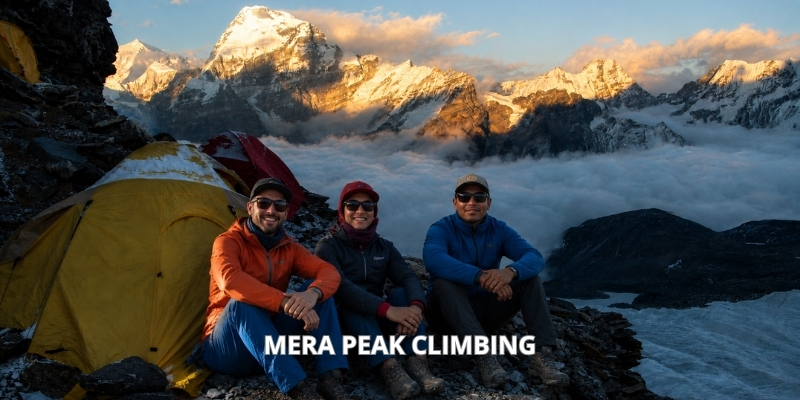
Did you know? Mera Peak Climbing is currently the highest trekking peak in Nepal, taking you to 6,476 meters. It is located in the remote Hinku Valley of the renowned Everest region. The Mera peak requires a challenging ascent and has three prominent faces: Mera North, Mera Central, and Mera South. You cross numerous crevasses and glaciers; hence, it is a thrilling adventure with panoramic views of the surrounding mountains.

The trek begins with an exciting flight to Lukla. Then, you enter mossy rhododendron woods and cross suspension bridges swaying above rushing glacial rivers. As you gain altitude, the air grows thinner, the sky gets bluer, and the landscape shifts to towering ice walls and endless glaciers. For most of the nights, you stay in teahouses. However, after Khare, you need to camp. From there on, your crew will prepare warm, energizing meals for you. Thus, camping makes you feel closer; you can share stories with your guide and fellow trekkers under the stars. Hence, it’s not just about the climb to Mera Peak. The trail itself becomes part of the journey, physically demanding, mentally grounding, and emotionally fulfilling.

Climbing the summit of Mera Peak offers breathtaking views of five 8,000-meter peaks: Everest, Lhotse, Makalu, Cho Oyu, and Kanchenjunga. With experienced guides and excellent service, this peak expedition promises a lifetime adventure in the Himalayas.

Highlights of Mera Peak Climbing

  • Climb Mera Peak, the highest trekking peak in Nepal, which features three main summits: Mera North (6,461m), Mera Central (6,476m), and Mera South (not commonly summited)
  • From the summit, enjoy breathtaking 360° views of five of the world’s tallest mountains: Everest (8,848m), Lhotse, Makalu, Cho Oyu, and Kanchenjunga.
  • Trek through remote valleys, alpine forests, and rugged glacier paths
    trail.
  • Spend 3–4 nights camping under the stars during the summit push. On other days, relax in welcoming teahouses along the route.
  • Feel the thrill of crunching snow beneath crampons as you approach the summit.
  • Smell the crisp pine-scented air of the Hinku Valley and smoke from yak dung fires in villages.
  • Enjoy the calming silence of the mountains, gently interrupted by flapping prayer flags and yak bells.
  • Taste traditional Sherpa and Rai meals like thukpa and yak butter tea.
  • Experience authentic mountain life and the culture of the Sherpa and Rai people in quiet highland villages.
  • Spot rare sightings of Himalayan wildlife like red pandas, Himalayan thar, and colorful pheasants along the trail.
  • Walk peaceful jungle trails with mossy trees, icy streams, and no pollution.

Who Can Participate in the 17 Days Mera Peak Climbing?

Anyone with good physical fitness, mental resilience, and a desire to conquer the mountain can participate in the Mera Peak Climbing. If you are in good health with the ability to handle the physical demands of trekking in high altitudes, you can participate in the climb. Similarly, the trek reached an elevation above 6,000 metres, so if you have prior experience with high-altitude trekking, you can go for Mera Peak climbing.

To participate in Mera Peak climbing, you don’t need to be a mountaineer, but you should be determined, have big dreams, and be ready to learn. You’ll walk for many days, carry your backpacks, and breathe thinner air as you climb. Therefore, if you are ready for all the challenges, you can undertake the Mera Peak Climbing.

Outline Itinerary For Mera Peak Climbing

Route End Elevation Elevation Gain/Loss Duration Distance
Day 01 Arrival in Kathmandu 1,350 m - - -
Day 02 Rest and Trip Preparation  1,350 m - - -
Day 03 Kathmandu to Lukla/Drive to Manthali, then fly to Lukla 2,840 m +1,490 m 30-minute flight/ 4-5 hrs drive and 20 minutes flight 130 km drive
Day 04 Lukla to Chutenga 3,350 m +510 m 5-6 hours 8 km
Day 05 Chutenga to Chetarwa 4,170 m +820 m 6-7 hours 10 km
Day 06 Chetarwa to Kothe 3,600 m -570 m 6-7 hours 12 km
Day 07 Kothe to Thangnag 4,356 m +756 m 4-5 hours 8 km
Day 08 Rest day in Thangnak- hike to Charpate Himal Glacier 4,358 m +142 m/ -142 m 3 hours (round trip) 4 km
Day 09 Thangnak to Khare Camp 5,045 m +687 m 3-4 hours 5.6 km
Day 10 Khare Camp to Mera Base Camp 5,350 m +305 m 3-4 hours 4 km
Day 11 Mera Base Camp to High Camp 5,780 m +430 m 4-5 hours 4 km
Day 12 High Camp to Mera Peak Summit Day to Khare Camp 5,045 m -1,416 m 10-12 hours 12-14 km
Day 13 Additional day - - - -
Day 14 Trek from Khare Camp to Kote 3,600 m -1,445 m 6-7 hours  15 km
Day 15 Trek from Kote to Chetarwa  4,170 m +570 m 5-6 hours  12 km
Day 16 Trek from Chetarwa to Lukla 2,840 m -1,330 m 6-7 hours  15 km
Day 17 Fly from Lukla to Kathmandu/Manthali by flight, then drive to Kathmandu 1,350 m -1,490 m 30-minute flight/ 4-5 hrs drive and 20 minutes flight 130 km drive
Download PDF download

Detailed Itinerary For Mera Peak Climbing

Day 01 :

Arrival day in Kathmandu

Accommodation

Hotel

Welcome to Nepal! Once you arrive at Tribhuvan International Airport (TIA), our staff will warmly welcome you and transfer you directly to your booked hotel. Check in and freshen up. After that, we’ll meet you for a detailed briefing about your upcoming Mera Peak expedition. We’ll go over the itinerary and prepare you for the challenges ahead. You may inquire about any questions you have. Then you’re free to do as you please.

Day 02 :

Rest and Trip preparation

Meals

B+L+D

Accommodation

Hotel

Day 03 :

Kathmandu to Lukla/Drive to Manthali, then fly to Lukla.

Drive Distance

130 km

Drive Duration

4-5 hrs

Place

Lukla

Meals

B+L+D

Accommodation

Hotel Comfort Inn or Ganesh Himal

The journey to Mera Peak Climb begins with a flight from either Kathmandu or Manthali to Lukla. If you are traveling during peak season, such as spring (March to May) and autumn (September to November), your flight is most likely to depart from Ramechhap’s Manthali Airport. In this situation, you must drive from Kathmandu to Manthali Airport in Ramechhap, which takes approximately 4-5 hours, and then take a 20-minute flight to Lukla. However, if you are traveling in the off-season, you’ll get a direct flight from Kathmandu, which takes 30 minutes to reach Lukla.

Once there, you can take a rest at the lodge. Then, go explore the local market, visit small shops, or simply enjoy the stunning mountain views. This day will help you adjust to the higher altitude and prepare mentally for the trek ahead. Rest well for the exciting trip to Mera Peak.

Day 04 :

Trek from Lukla to Chutanga

Trek Distance

8 km

Trek Duration

5-6 hrs

Place

Chutanga

Meals

B+L+D

Accommodation

Hotel Mera Lodge or Similar category

For the first day of trekking, we will trek to Chutanga after enjoying a hearty breakfast. The route for the Mera Peak climb begins with an uphill ascent from Lukla. There will be forests of rhododendron and pine, as well as open yak grazing lands. Then, we trek past small settlements and mountain pastures known as Kharkas to reach Chutanga at 3,020 meters. We stay overnight in a cozy lodge here, resting for the days ahead.

Day 05 :

Trek from Chutanga to Chetarwa

Trek Distance

10 km

Trek Duration

6-7 hrs

Place

Chetarwa

Meals

B+L+D

Accommodation

The Best Possible

From Chutanga, we continue our trek to Mera Peak through the beautiful Hinku Valley. We climb steadily to cross the Zatrwa La Pass (4,640 meters). Then, we walk a straight path for some time. We go upward through vibrant rhododendron forests. Next, we descend slightly through bamboo jungles and pass a secluded stone cave beside a river. After some more walking, we finally reach Chetarwa at 4,300 meters, where we stay overnight in a cozy lodge.

Day 04 :

Chetarwa to Kothe

Trek Distance

12 km

Trek Duration

6-7 hrs

Highest Altitude

3600 mtrs

Place

Kothe

Meals

B+L+D

Accommodation

Lama Hotel Lodge and Restaurant

Today, we resume our Mera Peak summit trek with a gentle descent. At first, we pass through narrow paths lined with bamboo and tall pine forests. We catch our first striking glimpse of the Mera Peak and the Hinku Valley below. Along the way, keep an eye out for mountain wildlife, such as Himalayan tahr, musk deer, Himalayan monal pheasants, and eagles, among the trees. We stop for a warm lunch at a cozy teahouse at Tashing Dingma. Afterwards, we continue trekking along the river ridge until we reach Kote for an overnight stay at a lodge.

Day 07 :

Trek from Kote to Tangnag

Trek Distance

8 km

Trek Duration

4-5 hrs

Place

Thagnag/Thaknak

Meals

B+L+D

Accommodation

Hotel Oxygen or Similar category

Leaving Kote, the trekking route follows the ridge above the Hinku Khola, with Mera Peak towering in the background. We stop for lunch at Gondishung, a summer herder settlement on the west bank of the Hinku Drangka. After lunch, we continue past the 200-year-old Lungsumgba Gompa, where you’ll see Mera Peak carved into a rock along with its climbing route. You can see trekkers stop here to offer incense and prayers for a successful summit. We’ll do the same, and a short walk further brings us to Thagnag. It is a summer grazing area with basic lodges and small shops. We spend the night here in a lodge.

Day 08 :

Rest day in Tangnag (Short Hike To Charpate Himal Glacier)

Trek Distance

4 km

Trek Duration

3 hrs

Place

Thagnag/Thaknak

Meals

B+L+D

Accommodation

Hotel Oxygen or Similar category

Today is reserved for acclimatization and side hikes in Tangnag. After breakfast, we take a 3-4 hour hike to the Charpate Himal Glacier, surrounded by dramatic peaks. To the north of Tangnag lies a massive moraine that holds a beautiful frozen lake called Sabal Tsho, one of the highlights of this day. From this spot, we’ll also get an excellent close-up view of Mera North. For those who feel spontaneous, you can climb to a cairn at 5,270 meters on the slopes of Kusum Kanguru (6,367 meters). It is both rewarding and beneficial for acclimatization. After exploring, we return to the lodge.

Day 09 :

Trek from Tangnag to Khare Camp

Trek Distance

5.6 km

Trek Duration

3-4 hrs

Place

Khare Camp

Meals

B+L+D

Accommodation

Mera Refugee Lodge

After breakfast, we trek toward Khare Camp (5,045 m). The Mera Peak trip route crosses the Dig Glacier and reaches Dig Kharka, where we’ll see stunning views of Charpate Himal. The trail then climbs over rocky moraines. After that, it passes by Hinku Nup and Shar Glaciers. As the altitude rises, the air gets thinner, and the path becomes steeper. We walk slowly, taking in the rugged beauty. By afternoon, we arrive at Khare, where we stay at a lodge and rest for the night.

Day 10 :

Trek from Khare Camp to Mera Base Camp

Trek Distance

4 km

Trek Duration

3-4 hrs

Place

Mera Base Camp

Meals

B+L+D

Accommodation

Tent

Today is a short but important day as we head to Mera Base Camp (5,350 m) via Mera La Pass (5,415 m). We make a steep ascent to the Mera Glacier, where we’ll see colorful prayer flags fluttering in the wind. We walk for about 30 minutes on ice, enjoying stunning views of Mera Peak along the way. After a short descent of around 100 meters, we reach the base camp. We set up tents here and rest for the night in preparation for the summit push.

Day 11 :

Trek from Mera Base Camp to High Camp

Trek Distance

4 km

Trek Duration

4-5 hrs

Highest Altitude

5780 mtrs

Place

High Camp

Meals

B+L+D

Accommodation

Tent

From Mera Base Camp (5,350 m), the trail climbs to High Camp (5,780 m). We make a gradual ascent over ice-covered terrain. We walk along breathtaking views of towering Himalayan giants like Mt. Everest (8,848 m), Lhotse (8,516 m), Cho Oyu (8,201 m), Kanchenjunga (8,596 m), and many other peaks. Then, we arrive at High Camp at the base of a large rocky cliff. It’s slightly sheltered and surprisingly warmer than expected at this altitude. From here, we can enjoy spectacular views of both sunrise and sunset. Tonight, we sleep in tents, preparing for the final summit push.

Day 12 :

Trek from Mera High Camp to the Summit, then trek to Khare Camp

Trek Distance

12-14 km

Trek Duration

10-12 hrs

Place

Khare Camp

Meals

B+L+D

Accommodation

Mera Refugee Lodge

Today is the most important and exciting day of the entire journey. We wake up around 2:00 a.m., gear up, and have a light breakfast before starting the climb. With headlamps on, we begin ascending slowly and steadily. If the weather is favorable, we reach the summit of Mera Peak (6,476 m) in 4 to 6 hours. The view from the top is unforgettable, a true Himalayan masterpiece. You’ll see Everest, Lhotse, Makalu, Cho Oyu, Kanchenjunga, Ama Dablam, Nuptse, Lobuche, and other snowy peaks stretching in every direction. All the effort fades in that one breathtaking moment.

After spending about 20-30 minutes at the summit, we begin descending back to Khare through High Camp. Then, we rest for the night after an incredible day.

Day 13 :

Additional day

Meals

B+L+D

Normally, the climb to Mera Peak summit doesn’t require an extra day at High Camp. We plan to reach the summit and start descending on the same day. However, mountain weather can be unpredictable. If the weather is poor or unsafe for the summit of Mera Peak, we may need to stay an additional night at High Camp. We will wait for conditions to improve. Safety always comes first on this expedition.

Day 14 :

Trek from Khare Camp to Kote

Trek Distance

15 km

Trek Duration

6-7 hrs

Place

Kote

Meals

B+L+D

Accommodation

The Best Possible

Now that we’ve conquered the great Mt. Mera summit, we start our trek back down through the beautiful Hinku Valley. The path leads us to Kote, where we stay at a lodge for the night. Relax and celebrate your achievement with your trekking group. Share stories, laughter, and the joy of completing this amazing climb. Enjoy a cozy evening by the campfire or under the open sky. After a day full of emotions and memories, rest deeply and recharge for the journey ahead.

Day 15 :

Trek from Kote to Chetarwa 

Trek Distance

12 km

Trek Duration

5-6 hrs

Place

Chetarwa

Meals

B+L+D

Accommodation

The Best Possible

We retrace our steps from Kote to Chetarwa, again climbing through the lush forest on the west side of the Hinku Valley. Surrounded by vibrant red rhododendron forests, it’s a pleasant walk along well-trodden Himalayan trails. On the way, we enjoy stunning views of the Mera peaks: Mera North, Mera Central, and Mera South, lying just below the Zatrwa La pass. We spend the night camping at Chetarwa, resting for the next day’s trek.

Day 16 :

Trek from Chetarwa to Lukla

Trek Distance

15 km

Trek Duration

6-7 hrs

Highest Altitude

2850 mtrs

Place

Lukla

Meals

B+L+D

Accommodation

Hotel Comfort Inn or Ganesh Himal

Today is the last day of our trek. We start by climbing a few hundred meters to Zatrwa La Pass via Chetarwa, the final climb of the trip. After reaching the top, we descend to Chutanga. From there, we continue our descent to Lukla village, where the trek officially comes to an end. In the evening, we celebrate with the team over a farewell dinner at a teahouse, sharing memories from the journey before resting for the night.

Day 17 :

Fly from Lukla to Kathmandu/Manthali by flight, then drive to Kathmandu.

Drive Distance

130 km

Drive Duration

4-5 hrs

Meals

B

This is our last morning in the mountains. Depending on our flight schedule and the travelling season, we head to Tenzing-Hillary Airport in Lukla and take the thrilling 30-minute flight to Kathmandu or Manthali airport. If you fly to Manthali airport, our representative will pick you up, drive you back to Kathmandu, and drop you off at your hotel. We hope you had a fantastic peak climbing experience with us. Namaste!

Tip: Book the left-side seats, which offer the best views of the Himalayan peaks, including Everest, from the plane. 

Inclusion/Exclusion in Mera Peak Climbing

Cost Includes

  • International airport pick-up and drop-off service
  • 2 nights’ accommodation in Kathmandu on a BB Plan.
  • Hotel to the airport by car.
  • Airport to hotel car.
  • Kathmandu to Lukla/Manthali by drive, then fly to Lukla.
  • Fly back to Ramechhap from Lukla and then drive to Kathmandu.
  • Both ways, Airport Tax.
  • Three meals a day (Breakfast, Lunch, and Dinner along the trek).
  • Lodge accommodation on the way (simple one)/the tent.
  • An experienced guide (including their salary, equipment, insurance, two-way airfare, lodging, and food).
  • Garbage deposit for climbing.
  • One Climbing Sherpa.
  • Climbing equipment: Ice hammer, Rope, Snow bar, Ice-screw.
  • Climbing Sherpa equipment charge.
  • All require legal documents (Peak climbing permit, National park permit, and TIMS card).
  • All taxes.
  • Trekking and city map.
  • First aid medical box.
  • Some fresh and dry fruits along the trek.
  • A token of love from the company.
  • Farewell lunch and dinner are suitable times.

Cost Excludes

  • Extra night accommodation in Kathmandu.
  • Travel insurance.
  • Hard and soft table drinks such as Coke, Mineral Water, Beer, etc.
  • Personal expenses (laundry, bar bill, telephone, extra helper, battery charge for the shower, and boiled water).
  • Personal climbing equipment
  • Personal guide if requested.
  • Tips for trip staff

Mera Peak Climb Route Map 

The Mera Peak Climb Route map serves as a visual guide for the expedition to Mera Peak. Himalaya Guide Nepal has carefully crafted the map, featuring a downloadable option with zoom-in and zoom-out capabilities. Similarly, climbers can use this map while navigating the terrain, as it has offline access. Additionally, the “Legend” is a prominent feature of the map that helps climbers easily interpret it.

The Legend of the map uses clear symbols to distinguish between camps, tea houses, peaks, and the trekking route, making the map easily understandable. An orange dot in a circle represents the starting and ending points of the trek, and a red dotted line indicates the flight route, as shown on the map. Similarly, a light blue solid line represents the trekking route that weaves through various waypoints, including Lukla, Chutanga, Kothe, Thangnak, Khare, and ultimately reaches Mera Base Camp and High Camp.

Furthermore, the route map to Mera Peak uses a light blue color with fully colored icons, representing the tops along the route where tea house accommodation is available, such as Kothe, Thangnak, and Khare. Additionally, an orange triangle represents the mountain peak on the climbing map, along with its corresponding elevation. The orange triangle represents major Himalayan summits visible along the route, including Mera Peak (6,461 m), Mt. Everest (8,848 m), Lhotse, Makalu, Cho Oyu, and Ama Dablam. 

Mera Peak Climbing Map Image Link

Download PDF download

Departure

No departure dates available.

Private Trip

Prefer a more personal journey? Our private packages offer flexible dates, custom itineraries, and dedicated support—perfect for those seeking a tailored travel experience.

Altitude in:
Download PDF download

More About Mera Peak

While climbers around the world know it as Mera Peak, the local communities often refer to it by a different name. In the Kulung Rai and Sherpa dialects, the mountain is called “Mira La” or “Mera La Ri.” Similarly, in some oral traditions, Mera isn’t just a peak; it’s a sentinel, a protector of the Hinku Valley, watching over both people and wildlife.

Mera Peak contains three main summits: Mera North (6,476 metres), Mera Central (6,461 metres), and Mera South (6,065 metres. The first ascent of Mera Central was on 20 May 1953, by Col. Jimmy Roberts and Sen Tenzing. Mera North is believed to have been first climbed in 1975 by French climbers Marcel Joly, G. Baus, and L. Honils. However, some sources state that the ascent was made on 29 October 1973 and that the climbers included L. Limarks, Ang Lhakpa, and two other Sherpas. Additionally, in 1986, Mal Duff and Ian Tattersall made the first ascent of the Southwest Column.

In 2015, after an earthquake devastated much of Nepal, Mera Peak experienced its calmest weather in decades. That year, climbers wrote about empty routes, how wild animals began to return to areas often frequented by hikers, and how nature seemed to be reclaiming parts of the mountain. One journal from 2015 noted: “It was the first time I saw a Himalayan bear. I was too surprised to take a photo. I think Mera wanted to show me it was healing.”

Furthermore, Mera is one of the few Himalayan peaks where you can camp at High Camp (5,800m) and see the entire sweep of the eastern Himalayas under a star-filled sky. Local astrologers and lamas visit this area not to climb, but to read the stars. Many spiritual seekers in Solukhumbu believe that the sky visible from the upper slopes of the mountain is clear. So, it serves as a celestial compass for locals, rather than just a viewing experience.

Challenges of Mera Peak Explained

The Mera Peak is generally considered moderately difficult (alpine PD). Although the trek is considered a non-technical peak compared to some of Nepal’s higher mountains, it presents its own set of challenges. When discussing the factors that make the trek challenging, the high altitude is always a primary concern. At elevations above 3,000 meters, the air becomes thinner, leading to the signs of acute mountain sickness (AMS).

Another challenge of the Mera Climb includes the physical demands, unpredictable weather, and the use of some basic mountaineering skills. Similarly, Mera Peak has one of the longest trekking approaches of any popular peak in Nepal. You’ll experience long, humid jungle walks, sudden altitude jumps, and damp, mossy forests, adding mental challenges.

Just before you reach Mera High Camp (around 5,800m), there’s a steep, exposed rocky section that becomes icy in the early morning and dangerously slushy in the afternoon. Likewise, the final climb on summit day is a long, deceptive snow slope. Additionally, the descent from High Camp to Khare is long and steep, causing twisted ankles, ice slips, and even snow blindness, all of which add to the challenges of the climbing expedition.

Acclimatization during the 17 days of Mera Peak Climbing

For a safe and successful journey to Mera Peak climbing, acclimatization and managing altitude gain are critical. The expedition takes place in high altitudes, so careful attention to altitude sickness and acclimatization procedures is essential. Our 17-day Mera Peak Climbing itinerary includes a day at Thangnak for acclimatization. On the day, you’ll follow the golden rule of “climb high, sleep low” as you’ll go for a day hike to Charpate Himal Glacier and descend to Thangnak for an overnight stay.

Acclimatization is your body’s natural process of adapting to the reduced oxygen levels at high altitudes. Without proper acclimatization, your risk of AMS (Acute Mountain Sickness), HAPE (High Altitude Pulmonary Edema), or HACE (High Altitude Cerebral Edema) increases. Although the trek package involves only one day for acclimatization, you can add another day if you feel the need for it. So, rather than focusing solely on reaching the summit, allow your body sufficient time to adjust to the changed temperature for a safe journey on Mera Peak by not skipping acclimatization days.

Comparing Mera Peak Climbing with Island Peak Climbing 

Aspects Mera Peak Climbing Island Peak Climbing
Location Barun sub-section of the Mahalangur Himalayan range in the Khumbu region of Nepal. Imja Valley in the Khumbu region of Nepal.
Summit Altitude 6,476 meters (21,247 ft) 6,189 meters (20,305 ft)
Difficulty Level Moderate to challenging More challenging due to a more technical section
Required Technical Skills Basic crampon and ice axe use Requires a fixed rope, a jumar, and an abseiling technique
Best For Beginners with good fitness Experienced trekkers
Climbing Terrain Gradual glacier ascent Rock, ice, crevasses, and a steep headwall near the summit
Main Route Usually via Zatra La Usually combined with the Everest Base Camp trek
Duration 17-20 days 14-18 days
Crowd Level Less crowded More crowded

FAQs For Mera Peak Climbing

Ready to Start
Your Adventure?

Join thousands of happy travelers who
Choose Himalayan Guide Nepal Pvt.Ltd..

Plan Your Trip