The Gen Z movement, Nepal stabilized, and life returned to normal. All safe for your Travel in Nepal 2025.

Trip Facts

Country

Nepal

Difficulty

Strenuous

Best Season

Sep-Nov/March-May

Accommodation

Lodges

Region

Annapurna Trekking

Start / End Point

Koto - Chame

Max. Altitude

5,306m

Group Size

2 - 10

Meals Included

B+L+D

Acclimatization

Phu Village

Permits

ACAP and Nar Phu Restricted Area Permit

Recommended For

Not beginner-friendly

Duration

13 Days

Activity

Nepal Trekking

Distance

70–80 km

Nar Phu Valley Trek Overview

Tired of mainstream Annapurna Base Camp and Everest Base Camp treks? Go for the Nar Phu Valley Trek in the remote Manang district. This valley was off-limits until 2002 due to border security concerns, as it lies very close to the Tibetan border. It remains a restricted area in Nepal, so you need to obtain a special permit and a licensed guide to trek here. As a result, it is relatively less crowded than other treks in the Annapurna region. Surrounded by peaks like Himlung Himal, Kang Garu, and Ratna Chuli, the valley offers an underrated trek.

Its trek route branches off the main Annapurna Circuit at Koto and follows the right bank of the Marshyangdi River. Along the way, you pass medieval villages, ancient chortens, and experience authentic Tibetan-influenced culture in the Nar and Phu regions. And the main highlight is crossing Kang La Pass at 5,306 m, which affords panoramic views of the Annapurna Himalayan ranges and Himlung. You can opt to continue north to Manang for Tilicho Lake and Thorong La before descending, if you want a longer and challenging expedition.

Nar Phu Valley Trek Highlights

  • Trek the off-beaten paths of the remote Nar and Phu Valley.
  • Watch the grand Annapurna II, Gangapurna, Tilicho Peak, Himlung, Kang Guru, Annapurna I and Machapuchhre (Fishtail).
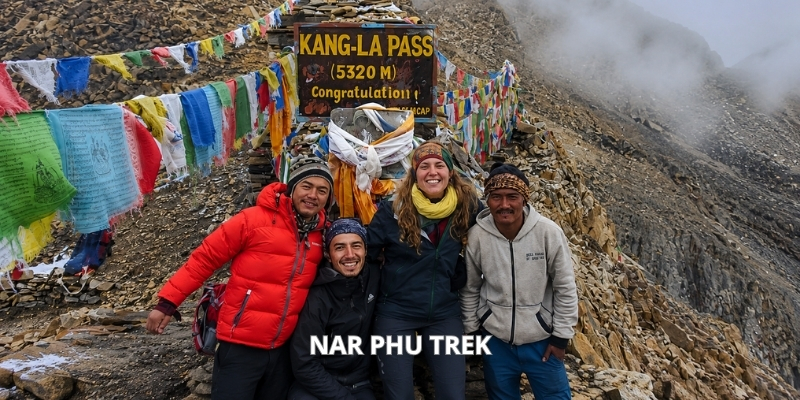
  • Cross the Kang La Pass, situated at 5,306m, the highest point of the trek.
  • Experience traditional Tibetan-influenced practices in Gurung and Lama communities in Ngawal (3,660 m), Phu
  • Village (4,080 m), and Nar Village (4,110 m).
  • Visit ancient monasteries perched on high ridges, including Phu Monastery (4,080 m).
  • Encounter unique alpine flora and fauna such as the Himalayan Tahr, blue sheep, Danfe (Himalayan Monal), and Snow Partridge.
  • Travel through diverse landscapes, from rhododendron forests down to lush river valleys.

Nar Phu Trek Outline Itinerary

Route End Elevation Elevation Gain/Loss Duration Distance
Day 01: Arrival in Kathmandu, Nepal (1,350 m)
Day 02: Drive from Kathmandu (1,350 m) to Besisahar (760 m) -590 m
Day 03: Drive from Besisahar (760 m) via Dharapani and Temang to Koto (2,600 m) +1,840 m
Day 04: Trek from Koto (2,600 m) via Singenge Dharmasala to Meta (3,560 m) +950 m 6 hrs 12 km
Day 05: Trek from Meta (3,560 m) via Kyang to Phu Village (4,080 m) +520 m 5 hrs 10 km
Day 06: Exploration day around Phu Village (4,080 m)
Day 07: Trek from Phu Village (4,080 m) via Kyang to Nar Phedi (3,490 m) -590 m 6 hrs 13 km
Day 08: Trek from Nar Phedi (3,490 m) via Yughat to Nar Village (4,110 m) +620 m 4 hrs 8 km
Day 09: Trek from Nar Village (4,110 m) over Kang La Pass (5,306 m) to Ngawal (3,660 m) +1,196 m 8 hrs 15 km
Day 10: Rest and exploration day in Ngawal Village (3,660 m) -1,646 m
Day 11: Trek from Ngawal (3,660 m) via Pisang and Dukur Pokhari to Chame (2,670 m) 6 hrs 12 km
Day 12: Drive from Chame (2,670 m) via Dharapani and Chamje to Besisahar (760 m) -990 m
Day 13: Drive from Besisahar (760 m) to Kathmandu (1,350 m) -1,910 m
+590 m
Download PDF download

Detailed Nar Phu Valley Trek Itinerary

Day 01: :

Arrival in Kathmandu, Nepal (1,350 m)

Drive Distance

~6 km

Drive Duration

~0.5 hrs

Place

Kathmandu

Meals

B+L+D

Accommodation

Lodge

Welcome to the land of the Himalayas! Our Himalaya Guide Nepal office staff will pick you up from the Tribhuvan International Airport (TIA). He’ll welcome you with a Khata (traditional scarf) and then transfer you to the hotel. Here you can get rest. You can stroll around the Thamel neighborhood later, explore the nearby cafés, or relax in your room. If time allows, you can visit the Swoyambhunath or Kathmandu Durbar Square (Basantapur) to enjoy the bustling streets of Kathmandu.

Day 02: :

Drive from Kathmandu (1,350 m) to Besisahar (760 m)

Drive Distance

200 km

Drive Duration

6 hrs

Highest Altitude

-590 m

Place

Besisahar

Meals

B+L+D

Accommodation

Lodges

You’ll leave Kathmandu early, either by a private car or a local bus. The road follows the Marshyangdi River, winding through small towns like Galchi and Dhading Besi. As you get near Besisahar, you’ll see terraced fields and green hillsides. Expect at least six hours of travel on paved roads, though they can be narrow and bumpy at times.

By mid‐afternoon, you’ll arrive in Besisahar, the gateway to the Annapurna region. After checking into your guesthouse, take a short walk through town. You can enjoy a cup of tea by the river where the Marsyangdi and Bhudi Gandaki rivers meet. Then relax and rest, because tomorrow you’ll head up to Koto and begin the trek into Nar Phu Valley.

Day 03: :

Drive from Besisahar (760 m) via Dharapani and Temang to Koto (2,600 m)

Drive Distance

110 km

Drive Duration

7 hrs

Highest Altitude

+1,840 m

Place

Koto

Meals

B+L+D

Accommodation

Lodges

After breakfast, you’ll climb up 1,840m from Besisahar over a 110 km jeep road. The route is rugged through Dharapani and Temang on the edges of the Marshyangdi River. Then, it follows steep curves. As you gain altitude, keep your camera ready for views of terraced hillsides filled with pine and rhododendron forests. This ride takes seven hours on rough, unpaved stretches, so settle in and enjoy the changing landscape.

By mid‐afternoon, you’ll reach Koto. It’s a quiet village perched at 2,600 m and the true gateway to Nar Phu Valley. First, we check into a teahouse, then you’ll be free. Take a moment to stroll through Koto’s stone alleys and meet local farmers tending barley fields. In the evening, enjoy a simple dinner of dal bhat and rest well. Tomorrow, you begin your first day of trekking toward Meta.

Day 04: :

Trek from Koto (2,600 m) via Singenge Dharmasala to Meta (3,560 m)

Trek Distance

12 km

Trek Duration

6 hrs

Highest Altitude

+950 m

Place

Meta

Meals

B+L+D

Accommodation

Lodges

Day 5 is finally the first day of our trip to the Nar Phu Valley trek. We show our restricted permit at the checkpoint in Koto before entering this area. The trail is very quiet in the jungle. We gradually rise 450m, then descend 20m, and finally ascend towards Meta. As you climb 530 m to Meta, the trees thin out, and you catch first crystal clear views of Annapurna II and Gangapurna towering above. Once you arrive at the teahouse, settle into a warm room and enjoy a hot cup of tea. We will take a rest here today.

Day 05: :

Trek from Meta (3,560 m) via Kyang to Phu Village (4,080 m)

Trek Distance

10 km

Trek Duration

5 hrs

Highest Altitude

+520 m

Place

Phu Village

Meals

B+L+D

Accommodation

Lodges

On the sixth day, you will have breakfast and carry a packed lunch. We walk 60m down to Jhuman first. Then we gradually move up for about three hours from Meta to Khyang. You can witness an awesome close-up mountain view of Pisang Peak, Annapurna II, Gyaji Kang, and Tilche Peak. We will energize ourselves with the packed lunch, then walk the last part of the day to Phu village. It takes around two to three hours to gradually climb to the top of the village. As we get closer, stone houses and the whitewashed walls of Tashi Lhakhang Gompa come into sight. You spend the night at the lodge.

Day 06: :

Exploration day around Phu Village (4,080 m)

Place

Phu Village

Meals

B+L+D

Accommodation

Lodges

Due to the long walk from Meta, we reserve a rest day for day seven. It’ll help you acclimate and avoid overexertion. You’ll have a hot breakfast in Phu village. After that, you can visit Tashi Lhakhang Gompa (4,150m). It will take 90 minutes for a round trip from our teahouse. As the gompa is raised to a height, you’ll be able to see the valley below with stone houses, hills, and even mountains surrounding it if the day is clear. You can take a look at the unique houses and how people of Phu village live. Then return to the hotel for lunch and dedicate the remainder of the day to rest.

Day 07: :

Trek from Phu Village (4,080 m) via Kyang to Nar Phedi (3,490 m)

Trek Distance

13 km

Trek Duration

6 hrs

Highest Altitude

-590 m

Place

Nar Phedi

Meals

B+L+D

Accommodation

Lodges

Today, the trail gradually descends to Nar Phedi, located at an elevation of 3,490m. You’ll see a variety of terrain: rocky slopes to high‐alpine meadows, along with small streams, and prayer flags. It takes approximately six hours, with no steep climbs. It’s just a gradual drop through juniper and rhododendron forests. You’ll arrive at Nar Phedi in the early afternoon. We’ll check in at a simple teahouse and have lunch.

Later in the afternoon, you can explore the nearby slopes. Here, you might spot Himalayan Monal or blue sheep grazing. You can hear the rush of the melting glacier streams below. Watch the sky light up as the sun rises above the distant peaks of Annapurna II and Gangapurna. Then return to Nar Phedi, take a rest, and fill yourself up with their comforting staple. Tomorrow you’ll climb again toward Nar Village, so rest well tonight.

Day 08: :

Trek from Nar Phedi (3,490 m) via Yughat to Nar Village (4,110 m)

Trek Distance

8 km

Trek Duration

4 hrs

Highest Altitude

+620 m

Place

Nar Village

Meals

B+L+D

Accommodation

Lodges

You start walking 620m up to Nar Village through a narrow gorge after breakfast. You see prayer-flagged cairns and yak pastures. It’ll be 2 hours of walking, then we will take a break for a picnic (packed). The guide will help you pick the perfect spot with sweeping views of Annapurna II and Gangapurna.

Trek for one to two hours again to reach Nar Village. You’ll reach there in the afternoon, so you may take a rest for a while. In the evening, wander through its stone-walled lanes and visit the Nar Phedi Monastery. Wear modest clothes when visiting here. You can see the locals working and children playing along the courtyard walls. Have a warm dinner and rest up for tomorrow’s big day over Kang La Pass.

Day 09: :

Trek from Nar Village (4,110 m) over Kang La Pass (5,306 m) to Ngawal (3,660 m)

Trek Distance

15 km

Trek Duration

8 hrs

Highest Altitude

+1,196 m

Place

Ngawal

Meals

B+L+D

Accommodation

Lodges

It is an adventure day for the whole trek as well as the highest pass of the trip, Kang La Pass (5,306m). We leave early in the morning at 6 a.m. and start moving upwards. After some walking, we will have breakfast in the nearby village, where we will also take a packed lunch. It’ll take five to six hours to arrive at Kang La Pass. Here, the pass rewards you with 360° views of Annapurna II, Tilicho, Himlung, and more.

After crossing the pass carefully, you need to descend towards Ngawal village. You might see a small, informal tea shop at Kangla Phedi, though it’s not open regularly. If you’re lucky, you can enjoy a warm drink before continuing the trek. By late afternoon, we reach the village and spend the night here.

Day 10: :

Rest and exploration day in Ngawal Village (3,660 m)

Highest Altitude

-1,646 m

Place

Ngawal

Meals

B+L+D

Accommodation

Lodges

This day is for rest and exploration in Ngawal. Taste a hot porridge or tsampa for breakfast first before venturing out. Visit the centuries-old Gyaji Monastery situated on a ridge above town. From here, the fluttering prayer flags frame views of snow-capped peaks. If you’re feeling restless, visit the nearby viewpoint where you can see the entire valley by the Marsyangdi River.

In the afternoon, interact with the locals over butter tea and tsampa, and learn about their daily life. You can hear the soft hum of mani wheels and watch goats grazing on terraced fields below. As evening falls, light butter lamps at the mani wall. For dinner, have a simple dal bhat.

Day 11: :

Trek from Ngawal (3,660 m) via Pisang and Dukur Pokhari to Chame (2,670 m)

Trek Distance

12 km

Trek Duration

6 hrs

Place

Chame

Meals

B+L+D

Accommodation

Lodges

On this day, you walk down to the main Annapurna Circuit trek route for 6 hours. You walk on open meadows filled with wildflowers before entering dense pine and rhododendron forests. You’ll pass the small Pisang village, where you can pause for a quick snack and admire the towering cliffs above. From Pisang, continue the trek past Dukur Pokhari. It’s a serene alpine pond on the way before the final descent into Chame, the administrative center of Manang District.

As you approach Chame, you can notice the air gets warmer and the landscape shifts from high-alpine barrens to lush river valleys. You may spot Himalayan wrens and Tibetan foxes near the pond. When you finally arrive, watch the colorful prayer flags flutter against palm-like walnut trees. Take rest overnight at a lodge in Chame.

Day 12: :

Drive from Chame (2,670 m) via Dharapani and Chamje to Besisahar (760 m)

Drive Distance

120 km

Drive Duration

6 hrs

Highest Altitude

-990 m

Place

Besisahar

Meals

B+L+D

Accommodation

Lodges

As per our trek itinerary, we catch a local jeep from Chame. The road winds steeply down through terraced fields in Dharapani, with cascading waterfalls and pine forests. You can see prayer flags waving over mountain streams along the way. Then, take a break at small tea stalls by the road for a quick cup of sweet milk tea. We reach Besisahar by mid-afternoon, giving you time to stroll through its busy bazaar. You may get fresh seasonal fruits, or relax by the riverside. Today marks the end of your journey. Enjoy the meal with your fellow trekkers, guide, and porter one last time.

Day 13: :

Drive from Besisahar (760 m) to Kathmandu (1,350 m)

Drive Distance

200 km

Drive Duration

6 hrs

Highest Altitude

-1,910 m

Place

Kathmandu

Meals

B+L+D

Accommodation

Lodges

You head back to Kathmandu by deluxe bus or a private vehicle today. We offer bookings for any of them according to your demand. As you ascend, the rural view will vanish, and you will see the city’s outskirts. It takes about 6 hours to reach Kathmandu, and you’ll be dropped off back at the hotel. Since it’s your last day in Nepal, take the evening to celebrate your adventure, perhaps explore Thamel’s vibrant streets, or enjoy a farewell dinner of dal bhat or momos.


Inclusion/Exclusion in Nar Phu Trek

Cost Includes

  • Pick-up and drop-off services.
  • 2 nights’ accommodation in Kathmandu on a BB Plan.
  • Hotel to the bus station.
  • Kathmandu to Besisahar by Bus.
  • Besisahar to Koto by local shared jeep.
  • All meals: Breakfast, Lunch, and Dinner during trekking.
  • All legal documents: ACAP, TIMS, and Nar Phu restricted permit.
  • Licensed trekking guide (Including Food, Accommodation, insurance, transportation, etc.).
  • Come to Besisahar by public jeep.
  • Besisahar to Kathmandu by public bus.
  • The bus station to the hotel drop-off.
  • All government taxes.
  • A token of love from the company.
  • A farewell dinner/lunch is a suitable time.

Cost Excludes

  • Extra night accommodation in Kathmandu.
  • Travel insurance in cases of trekking.
  • Hot and Cold drinks such as: Tea/Coffee, Coke, Mineral Water, Beer, etc.
  • Personal expenses (laundry, bar bill, telephone, extra helper, battery charge, shower, boiled water, and some donations).
  • Tips are expected.


Route Map

Nar Phu Trek Map Image Link

Download PDF download

Departure

13 Days

Trip Days

1 Dec, 2025

Start Monday

13 Dec, 2025

End Saturday

0

Pax Booked

20

Group Size

USD 835

Price

Booking Open

Status

Private Trip

Prefer a more personal journey? Our private packages offer flexible dates, custom itineraries, and dedicated support—perfect for those seeking a tailored travel experience.

Nar Phu Trek Trip Information

id_card

Nar Phu Trek Permits

Annapurna Conservation Area Permit (ACAP)

ACAP funds conservation efforts and supports local communities within the Annapurna Conservation Area. It is compulsory and you need to show it from the very start of your journey. It’ll be checked periodically from Besisahar through Koto and again after exiting Nar Phu, down to Chame.

Nar Phu Restricted-Area Permit (RAP)

Nar Phu Valley lies in a sensitive border zone, so the government controls access for security and environmental protection using this RAP. You present this permit at the checkpoint in Koto before entering the Nar and Phu valleys; it remains valid until you exit the valley around Chame.

Trekkers’ Information Management System (TIMS) Card (optional)

TIMS card helps Nepali authorities track and assist independent and group trekkers for safety and rescue coordination. If you plan to trek in the main Annapurna Circuit (e.g., after Chame), you’ll need a TIMS permit at the ACAP/TIMS counter in Besisahar or Pokhara.

Permit Applies To Cost Validity
Annapurna Conservation Area Permit (ACAP) Besisahar → Koto and exit via Chame NPR 3,000 per person (≈ USD 25) Unlimited days within the Annapurna Conservation Area
Nar Phu Restricted-Area Permit (RAP) Nar Phu and Phu Valley
  • Peak (Sep–Nov): USD 100 for the first 7 days
  • Off-peak (Dec–Aug): USD 75 for the first 7 days
  • Additional days: USD 15/day
Valid for the entire duration inside the restricted Nar Phu area
Trekkers’ Information Management System (TIMS) Card (optional) Beyond Nar Phu into the wider Annapurna Circuit
  • Individual: USD 20
  • Group: USD 10
Valid until completion of your trek in the Annapurna region
attach_money

Nar Phu Trek Cost

Traveling as a group on the Nar Phu Trek allows you to share fixed costs, such as guides, permits, and vehicle transfers. So the more people you bring, the lower the price per person. Our tiered pricing rewards larger groups with deeper discounts, making it easier and more affordable to plan an unforgettable high-altitude adventure together.

Nar Phu Trek Cost Breakdown

Category Includes Cost (USD)
Food All meals (Breakfast, Lunch & Dinner) during the 12 trekking days $200 (~$16.70/day)
Transport Kathmandu → Besisahar by bus
Besisahar → Koto by shared jeep
Chame → Besisahar by jeep
Besisahar → Kathmandu by bus
$50
Permit Annapurna Conservation Area Permit (ACAP)
TIMS card
Nar Phu Restricted-Area Permit
$130
Guide Licensed trekking guide (including their food, accommodation, insurance & in-country transport) $280 (~$20/day)
Accommodation Standard tea-house/lodge stays each night (13 nights) $135 (~$10/night)

Total per person: $795

Note:

  • Peak season (Sep–Nov) = USD 145 (ACAP 25 + RAP 100 + TIMS 20)
  • Off-peak (Dec–Aug) = USD 120 (ACAP 25 + RAP 75 + TIMS 20)
  • We list USD 130 as an average mid-point to keep the package price stable year-round.

Altitude Chart

Altitude in:
Download PDF download

Best Parts about Nar Phu Trek

  • As you step outside the Phu Village, you see prayer flags fluttering against a sky painted in pink and orange hues. You hear the distant murmur of monks chanting from the gompa. Take a sip of steaming butter tea while watching golden light fall over Himlung’s snowy slopes.
  • Midway up the trail from Koto to Meta, you can see an ibex goat leap across the rocky slope. You get to know the Khampa people, who are the descendants of Khampa warriors, settled in Nepal as refugees.
  • When you arrive in Nar Village at dusk, you’ll be greeted by the warm glow of oil lamps inside stone houses. Inside the courtyard, you will find families warming themselves by the fire. They make Tsampas (roasted barley flour) and eat it with butter tea, symbolizing unity.
  • On the day you cross Kang La Pass, you need to set out before sunrise. The path is steep and rocky, and with each step, you hear the crunch of frozen snow echo. As you reach the ridge, you’ll see Annapurna II and Tilicho Peak, reflecting the fiery orange of the rising sun. This is the best moment of the trek; it will surely make you feel closer to the sky.
  • While descending from Kang La into Ngawal, you walk a winding path through windswept fields with alpine blooms. You can smell the pine trees in the lower slopes and hear the yak bells tinkling below. As the stone houses of Ngawal come into view, you can finally relax, transitioning into a denser atmosphere.
  • In Ngawal’s village square, you can join villagers as they light butter lamps at dusk. The orange glow flickering on ancient Tibetan scripts carved into mani stones is a unique sight. The distant waterfall cools the air, and you can savor the sweet locally brewed millet beer to warm up.
  • On the way to Chame (2,670 m), the path takes you through pine and rhododendron forests filled with bird chirps. You can hear the Danfe (Himalayan Monal) with its metallic “toy trumpet” and see snow partridges on the slopes. When you finally reach Chame, the valley feels almost tropical compared to higher villages, where you can enjoy the warm air.

Can I combine the Nar Phu Trek with the Manaslu Circuit Trek?

Yes, Himalaya Guide Nepal allows you to customize your journey. If you want a longer trek, you may add the Manaslu Circuit to the Nar Phu Valley trek. Both treks traverse the upper Manang Valley, so it’s easy to transfer. You just need to take a drive to Machcha Khola on Day 13. Expect 10 additional trekking days to complete the full Manaslu Loop (Machha Khola → Jagat → Deng → Lho → Samagaon → Samdo → Larkya La → Bimtang → Dharapani), plus one day for transfers. Therefore, in total, there will be 22 days to complete the Nar Phu Valley and Manaslu Circuit Trek.

From Machha Khola, you will gradually hike through subtropical forests and Gurung villages. You will acclimatize in Samagaon, where you can take a side trip to Tilicho Lake, and then you will climb the high Larkya La pass. After that, you’ll descend through Tibetan-style villages and alpine meadows into the Marsyangdi valley. The highlights include beautiful views of Manaslu (8,163 m), the sacred Pungyen Gompa above Samagaon, and a peaceful riverside walk through bamboo forests. All in all, you get to visit two of Nepal’s most remote and culturally rich high-pass treks in one single journey.

Note: You’ll need to secure a separate Manaslu Restricted Area Permit for this combined trek, which can only be obtained in Kathmandu. Please inform us beforehand if you would like to add the Manaslu Circuit Trek. 

Weather and Temperature for Nar Phu Trek

Nar Phu Valley is situated in the Annapurna rain shadow. Hence, it has a relatively dry climate, with clear skies in spring and autumn, and only moderate monsoon showers, compared to the lower valleys. Like any other trek in Nepal, the peak seasons for the Nar Phu Trek are spring (March–May) and autumn (September–November). The days are pleasantly warm, and nights are cool but not freezing. Below is a quick rundown of weather and temperature by season:

Spring (March–May)

  • Weather Type: Stable and dry, clear skies with only occasional afternoon clouds by late May
  • Avg Day Temp: ~15 °C
  • Avg Night Temp: ~2.5 °C
  • Highlight: Rhododendrons bloom from mid-April and long daylight hours ideal for trekking and photos

Autumn (September–November)

  • Weather Type: Post-monsoon clarity, very dry with deep-blue skies and crisp air
  • Avg Day Temp: ~17 °C
  • Avg Night Temp: ~4.5 °C
  • Highlight: Sharpest mountain views and festivities season in villages

Monsoon (June–August)

  • Weather Type: Moderate afternoon showers, cloudy passes, lush green valley
  • Avg Day Temp: ~20 °C
  • Avg Night Temp: ~2.5 °C
  • Highlight: Fewer trekkers on the trail and emerald landscapes, though paths can be muddy

Winter (December–February)

  • Weather Type: Cold and dry, clear days with potential light snow at high camps
  • Avg Day Temp: ~10 °C
  • Avg Night Temp: ~–2.5 °C
  • Highlight: Snowy scenery and no crowds, but be ready for deep freezes above 4,000 m

Average Temperatures on Major Stops of Nar Phu Trek

Location Spring (Mar–May) Autumn (Sep–Nov) Monsoon (Jun–Aug) Winter (Dec–Feb)
Kathmandu (1,350 m) 15 / 5 °C 17 / 7 °C 20 / 10 °C 10 / 2 °C
Besisahar (760 m) 18 / 8 °C 20 / 10 °C 23 / 13 °C 12 / 5 °C
Koto (2,600 m) 12 / 0 °C 14 / 2 °C 17 / 5 °C 7 / –3 °C
Meta (3,560 m) 10 / –2 °C 12 / 0 °C 15 / 3 °C 5 / –7 °C
Phu Village (4,080 m) 8 / –5 °C 10 / –3 °C 13 / 0 °C 3 / –10 °C
Nar Village (4,110 m) 8 / –5 °C 10 / –3 °C 13 / 0 °C 3 / –10 °C
Kang La Pass (5,306 m) 5 / –8 °C 7 / –6 °C 10 / –3 °C 0 / –15 °C
Ngawal (3,660 m) 9 / –3 °C 11 / –1 °C 14 / 2 °C 4 / –8 °C
Chame (2,670 m) 13 / –1 °C 15 / 1 °C 18 / 4 °C 6 / –5 °C

Temperatures are approximate averages for daytime / nighttime in each season.

Nar Phu Trek for all Level of Trekkers

The Nar Phu Trek is rated moderate to challenging, thanks to its remote location, thin mountain air, and the high Kang La Pass at 5,306 m. You’ll spend many nights above 3,500 m, facing cold temperatures, strong winds, and steep ascents and descents on narrow trails and suspension bridges. Yet the trek’s gentle pacing, with built-in rest days in Phu Village and Ngawal, means it can suit trekkers from beginners to veterans. Your experience will depend on your fitness, preparation, and willingness to adapt to a simple teahouse life.

Nar Phu Trek for Beginner Trekkers

Even if you’ve never tackled a 5,000 m pass, you can complete this trek with solid preparation. Build up your stamina by hiking 10–15 km while carrying a 5 kg daypack. Consider hiring a porter to allow you to focus on breathing and enjoying the scenery. Plan an extra acclimatization night in Phu Village (4,080 m) or Ngawal (3,660 m) if you feel short of breath.

Be ready for basic lodges, bring a warm sleeping bag, and layers for cold nights. With good cardio fitness and a positive attitude, you’ll gain confidence crossing Kang La Pass and be rewarded by sweeping Himalayan vistas and warm village hospitality.

Nar Phu Trek for Intermediate Trekkers

Similarly, even if you’ve already tackled 4,000 m treks, you’ll not be bored on the Nar Phu trek. The trekking days are long (12–15 km) and at higher altitudes. The Kang La crossing demands 1,200 m of ascent in a single day, and you need to descend into Ngawal on the same day. The descent is tough on your legs as you walk down loose rocks.

This trek can be made shorter by skipping some rest days. Instead, you can add optional side hikes, such as a sunrise summit at the Pisang Peak viewpoints, a detour to Tashi Lhakhang Gompa (4,150 m), or a visit to the Five Lakes near Koto. These extras help build stamina without requiring technical mountaineering skills. Therefore, this trek serves as an ideal stepping stone for more advanced high-altitude adventures. Additionally, monsoon-season trekkers can also test wet-weather endurance on muddy trails.

Nar Phu Trek for Experienced Trekkers

For seasoned mountaineers who have completed treks such as Everest Base Camp or the Three Passes, Nar Phu offers a quieter and more remote alternative. You can extend the route to Tilicho Lake (4,919 m) or link directly into the Manaslu Circuit for two high-pass crossings (Kang La and Larkya La) in one seamless journey. Early-season snow on Kang La allows you to practice crampon use on firm snowfields without encountering actual glacial hazards.

This expedition offers unmatched solitude, cultural depth in the Nar and Phu villages, and 360° panoramas of the Annapurna and Manaslu peaks, perfect for veteran trekkers seeking authenticity and a quiet venture.

Major Stops Around Nar Phu Trek

Koto (2,600 m)

Nestled on the right bank of the Marshyangdi River, Koto is your starting point for the Nar Phu Valley Trek, where you’ll officially kick off your adventure and sort out any permits. Before diving into the restricted zone, you’ll need to present your paperwork and get the lowdown from your liaison officer. Koto’s cozy stone-and-wood teahouses look out over terraced barley fields that hug the steep hillsides. Plus, the riverside vibe gives you the soothing sounds of flowing water and a perfect chance to stretch your legs before tackling the serious climb up to Meta.

Meta (3,560 m)

Meta marks your first real high-camp stop beyond the forest line. As the trail ascends from Koto, you’ll pass through dense pine and rhododendron groves, eventually emerging onto open slopes that offer sweeping views of Annapurna II and Gangapurna towering overhead. Warm teahouse rooms in Meta are basic but comfortable, providing hot meals and crucial rest. During afternoon breaks, you can watch sunlight shift across glacier-fed peaks, and in the clear night sky, countless stars shine above the silhouette of the Himalaya.

Phu Village (4,080 m)

Located on a high plateau, Phu Village embodies traditional Tibetan-influenced architecture and culture. Characterized by thick-stone houses with carved wooden windows, the settlement clusters around the whitewashed Tashi Lhakhang Gompa at 4,150 m. This rest day offers gentle acclimatization walks to the monastery and surrounding mani walls, where prayer flags snap in the mountain breeze. Homestay-style teahouses serve butter tea and tsampa, and friendly locals, often clad in colorful woolen garments, share stories of seasonal festivals and yak-herding traditions.

Nar Phedi (3,490 m)

Nar Phedi is the valley’s serene gateway, where high alpine meadows and scattered rock cairns replace dense forest. After descending from Phu, you’ll feel the air grow slightly warmer and the terrain open into grass-covered slopes punctuated by prayer-flagged stones. Family-run tea houses here cater to trekkers with simple noodle soups and fresh yak butter tea. Birdsong and distant glacier streams provide a restful soundtrack, making Nar Phedi an ideal midpoint for hydration and wildlife spotting before you tackle the final ascent to Nar Village.

Nar Village (4,110 m)

Perched among rocky outcrops, Nar Village ranks among Nepal’s highest permanent settlements. Its narrow lanes wind past stone lodges, community mani walls, and the Satya Gumba monastery, whose red-and-white façade stands against the backdrop of snow-capped ridges. Yak herds graze nearby, and you may glimpse Himalayan Monal or blue sheep grazing on the slopes. As dusk falls, oil lamps illuminate village courtyards, and the aroma of dal bhat cooking drifts through the air, creating a warm, communal atmosphere amid the high-altitude chill.

Kang La Pass (5,306 m)

The pinnacle of the trek, Kang La Pass, demands an early start and nearly 1,200 m of steep, rocky climbing from Nar Village. At the summit, you’re rewarded with an unparalleled 360° panorama: Annapurna II’s ice seracs, Tilicho Peak’s sharp profile, and distant peaks like Himlung and Kang Garu. The pass crest often carries a layer of snow even in spring and autumn, making colorful prayer flags all the more vibrant against the stark landscape. Camaraderie among trekkers peaks here, as everyone shares in the triumph of reaching the summit.

Kang La Phedi (~5,050 m)

Just below the pass on the Ngawal side, Kang La Phedi provides a small, flat respite from the arduous ascent. Occasional local entrepreneurs set up simple tea stalls here, offering hot beverages and snacks—an unexpected luxury at this altitude. This spot also functions as a convenient high-camp campsite and a gathering point for porters and guides. From here, you’ll prepare yourself mentally and physically for the 1,400 m descent into Ngawal, watching cloud formations drift across distant peaks as you sip your tea.

Ngawal (3,660 m)

Ngawal, a picturesque Gurung village, sits on a verdant hillside overlooking the Marsyangdi River Valley. Its cluster of slate-roofed homes and centuries-old Gyaji Monastery offers cultural richness and panoramic mountain views. In the late afternoon, villagers light butter lamps at the mani wall, casting a warm glow on intricately carved stones. Teahouses serve local specialties like buckwheat pancakes and barley beer. Gentle side hikes to nearby viewpoints yield sweeping vistas of Annapurna I and II, as well as the terraced fields that define Ngawal’s agricultural heritage.

Pisang (~3,200 m)

Descending from Ngawal, the trail leads to Pisang, notable for its bamboo groves and terraced fields. The village’s tea houses provide a shaded rest spot where you can taste freshly baked flatbreads and sip milky chai. Towering cliffs frame Pisang, creating a dramatic backdrop for watching local farmers harvest potatoes and barley. Wildlife enthusiasts may spot Himalayan vultures riding thermal currents overhead or hear the metallic calls of Danfe (Himalayan Monal) echoing through the bamboo thickets lining the trail.

Dukur Pokhari (3,400 m)

Dukur Pokhari’s alpine pond offers one of the trek’s most serene settings. Encircled by jagged peaks and rust-colored moorlands, this small body of water mirrors the sky on calm mornings. The site is ideal for wildlife observation, as Tibetan foxes and snow partridges frequently visit the shore. Teahouse platforms near the pond invite trekkers to pause, take in the reflections of the surrounding peaks, and enjoy a simple lunch. The hush of this location contrasts sharply with busier villages, reinforcing the Nar Phu Valley’s remote character.

Chame (2,670 m)

As the administrative hub of the Manang District, Chame reunites trekkers with a busier, more developed valley atmosphere. Colorful prayer flags crisscross the main street, and shops offer trekking gear, snacks, and communications. Walnut and apricot trees shade teahouses, where you can sample local specialties like Khapse and Tongba. The sight of terraced maize fields sloping down to the Marsyangdi River signals your descent from the high Himalayas. Chame’s comfortable lodges and warm meals make it an inviting place to reflect on your journey before the final drive back to Kathmandu.

Comparing the Nar Phu Trek with Upper Mustang Trek and Upper Dolpo Trek

These three treks in Nepal’s dry areas provide a unique experience. They feature dry landscapes and clear skies instead of the usual green forests of the rainy season. Each trek has at least one high pass over 5,000 meters and requires special permits for some areas. Nar Phu is close to the Annapurna Circuit, Upper Mustang is in the rain-shadow of Tibet, and Upper Dolpo is beyond the Dhaulagiri mountains. These treks offer amazing mountain views, traditional villages influenced by Tibetan culture, and a chance to experience life in the Himalayas without the crowds.

Comparison according to aspects

Aspect Nar Phu Trek Upper Mustang Trek Upper Dolpo Trek
Duration 14 days 18–20 days 22–24 days
Highest Altitude Kang La Pass (5,306 m) Lo La (5,416 m)* or Lo Manthang (3,840 m) Shey La Pass (5,250 m)
Difficulty Moderate–challenging: single high-pass crossing, steady daily gains of 500–1,200 m Moderate: mostly lower-altitude walking with one or two high passes Challenging: multiple high-pass crossings and long, remote trails
Permits Required ACAP + Nar Phu Restricted-Area Permit ACAP + Mustang Restricted-Area Permit (≈ USD 500/week) ACAP + Dolpo Restricted-Area Permit (≈ USD 500–600/week)
Accommodation Tea-house lodges at every stop, with basic facilities Tea-houses and simple lodges in villages and Lo Manthang Mostly tea-houses in larger villages; camping in remote zones
Remoteness Remote but connected via Manang Valley roads Extremely remote, arid rain-shadow region One of Nepal’s most remote: few road crossings, limited services
Cultural Highlights Tibetan-influenced villages (Nar, Phu), monasteries Ancient walled city of Lo Manthang, Tibetan-style monasteries Traditional Bonpo/Tibetan villages, ancient gompas, royal Dolpo culture
Best Season Spring (Mar–May) & Autumn (Sep–Nov) Spring & Autumn; winter cold but clear; monsoon very dry Spring & Autumn; winter is very cold; monsoon trails are often blocked

Note: Lo La is an optional high pass (5,416 m) on extended itineraries; core Upper Mustang routes remain below 4,000 m.

Nar Phu Trek Frequently Asked Questions

Ready to Start
Your Adventure?

Join thousands of happy travelers who
Choose Himalayan Guide Nepal Pvt.Ltd..

Plan Your Trip