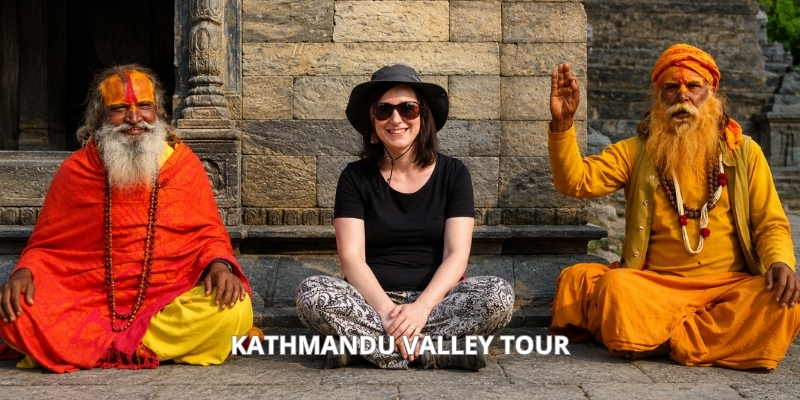
This is a day to visit full day Kathmandu Valley Sightseeing Kathmandu Durbar Square, Monkey Temple, Patan Durbar Square, Pashupatinath and Boudhanath tour and there are many other places to visit for the sightseeing tour in Nepal.
This area is best well-known as Kathmandu Durbar Square lies heart of the city and is locally called Hanuman Dhoka Palace Square very old seat of the Nepalese Royalty and is listed among eight Cultural World Heritage sites by UNESCO, which palace complex consists the variety of temples dedicated to different Hindu gods and goddess.
Kathmandu Durbar Square is a cluster of ancient temples, palaces, courtyards, and streets, and most of the buildings we can see date from the 15th to 18th centuries. The square is known to be the social, religious, and urban focal point of the Capital City.
Taleju Temple (which is the tallest and all structure built in 1549AD by King Mahendra Malla), Kal Bhairav (one of the largest stone idols in Kathmandu representing the terrifying aspects of Shiva), Jagannath Temple (known for fascinating erotic figures carved in the wooden struts eaves which are built in the 16th decade), Kasthamandap (it stands at the south-west corner of the Square and build from the single Sal tree), Kumari Ghar (House of living goddess, 17th decade Kumari Temple an example highly developed Nepalese temple craft), Museum and many more place to visit around there.
This is the place from where we view Kathmandu Valley perfectly also known as Monkey Temple. The 3000-year-old Buddhist stupa or chaitya is 3km to the west of Kathmandu and lies on a sacred hillock 75 meters above the valley. The main structure of the stupa consists of a solid hemisphere of brick supporting a conical spire which is surmounted by a pinnacle of gilded copper. The four-sided spire is painted with the all-seeing eyes of Lord Buddha.
Patan known as Lalitpur is the oldest town in the Kathmandu Valley. The local people call it Lalit Pura, ‘the beautiful city’. Patan is about 5km south of the capital city of Nepal and is the second largest city in the valley. The city stands on the raised ground across the river Bagmati from Kathmandu.
It was built in the region of King Vira Deva in 298 AD and is known for its ancient Buddhist shrines, stupas, and temples. In recent times it has also become famous for its excellent handicraft items and other souvenirs.
This temple is known as Hiranya Varna Mahavihar which was built by King Bhaskar Verma in the 12th decade, three-storied golden pagoda style the golden image of Lord Buddha is placed on a pedestal in the upper part of the vihara. There is also a huge prayer wheel in the pagoda. The walls of the temple are decorated with intricate designs.
This Buddhist monastery has a huge image of Lord Buddha beside several other artistic statuses.
This temple was built by King Jayasthiti Malla in 1392 AD; this is the oldest surviving temple in Patan. It is one of the 3 major temples that have five-tiered roofs. This Shiva temple is thronged with pilgrims during the Janai Purnima festival in July-August. In the center of the temple tank, there is a small shrine that has a beautiful gold and silver lingam.
The Krishan Mandir is known as the stone temple because made of stone, which was built by King Siddi Narasingh Malla in the 16th century. The temple shows the influences of Mughal architecture. It lies opposite the palace. The temple is in the form of a Shikara style. There are scenes from the Mahabaratha and Ramayana adorning the walls of this temple.
This red brick temple is dedicated to Lord Vishnu and is situated at the confluence of the Bagmati and Manahara rivers. The temple is renowned for its stone images as well as an imposing metal statue of a Garuda atop a stone monolith.
Asok Stupa was built in 250 BC by Emperor Asoka when he visited Patan. This is one of the four stupas built by Emperor Asoka.
The section of the palace around Keshav Narayan Chowk the former residence of the Malla King has been superbly renovated and houses one of the subcontinent’s finest Museum. The main attraction of the museum is an outstanding collection of cast-bronze and gilt copper work, mostly of Hindu and Buddhist deities. One gallery shows the stage involved in the production of hammered sheet metal relief design.
This palace was built by the Mallas during the different periods of their rule, the palaces consist of three main Chowks of the courtyard. The Mul Chowk or the central courtyard was constructed in 1666 AD for Srinivasa Malla and is the oldest.
This two-story palace was the residence of the Patan royal family. Two stone lions stand guard at the entrance. The Bidya Mandir, a small gilded shrine is located within the complex.
- Rato Machhindra Nath Temple.
It is a three-storeyed pagoda of the early 16th century. It stands in the middle of a square grassy courtyard. The red Machhendranath is an expression of God Lokeshwara or Shiva. Every year the god is taken out in a procession during May.
Once in 12 years, the chariot of the god is taken to a town called Bungamati which lies 5 km from Pata. Here is Machhendra`s second residence, where the god stays every sixth month of the year and many others too, for sightseeing.
This is the oldest Hindu temple dedicated to Lord Shiva and is situated on the sacred river Bagmati. It is built in the form of a two-tiered gilded pagoda and has huge silver doors that are richly carved. There are some erotic paintings on the walls.
Only Hindus are permitted to enter the main temple, one of the sacred temples. Tourists can see this temple from the eastern side of the river. There is the Bagmati River beside that river;, every day a dead body is burned in its place. I mean, there are different ranks among Hindus.
This octagonal-based stupa, inset with prayer wheels, is the largest of its kind in the world. It has four pairs of eyes in the four directions, which keep watching for righteous behavior.
This is 6km from the touristy area of Thamel. The side streets are full of maroon-robed monks, gleaming monastery roofs, and shop fronts full of monks.