Best Nepal Tour & Treks Packages for International Travelers

View Detail: Annapurna Tilicho Lake Trek – 19 Days
Tilicho Lake

19 Days

US$1095

Annapurna Tilicho Lake Trek – 19 Days

5.0 (4 Reviews)

Thorong La Pass (5,416 M)

The Annapurna Tilicho Lake Trek is a long, high-altitude journey that combines the classic Annapurna Circuit with a special side trip to Tilicho Lake. The trek starts in the lower foothills around Bulbule and follows the Marsyangdi River past waterfalls and villages like Tal as it climbs into the Manang region. One of the biggest highlights is Tilicho Lake, located at 4,919 M, known as one of the highest alpine lakes in the world. The trail slowly rises to help trekkers adjust to the altitude, passing from green forests and river valleys into the dry, windy landscapes of the high Himalayas near Tilicho Peak.

The trek then crosses the famous Thorong La Pass at 5,416 M, where trekkers enjoy wide views of the Annapurna and Dhaulagiri mountain ranges. After the pass, the trail enters the Mustang region and visits the sacred pilgrimage site of Muktinath Temple. From there, the route continues down through the deep Kali Gandaki valley to the natural hot springs at Tatopani. The final part of the trek passes through traditional Gurung and Magar villages such as Shikha and Ghorepani and ends with a sunrise view from Poon Hill. This journey offers a complete experience of Nepal’s mountains, culture, and diverse landscapes.

View Trip Detail
View Detail: Bungee Jump in Pokhara
Bungee Jump in Pokhara

1 Days

US$70

Bungee Jump in Pokhara

1,200m

Bungee jumping has swiftly gained popularity in Nepal, especially among thrill-seekers who love the rush. The Bungee Jump in Pokhara is the area’s second adventure activity and a must-do for thrill-seekers traveling there. It differs from the original Bhote Kosi River. The bungy jumping site is situated in the city center, making it more accessible to tourists.

The Pokhara bungee jumping facility provides jumpers with a one-of-a-kind and amazing experience. It is located in a beautiful area with mesmerizing views of the valleys and mountains below. Modern technology was included in the Bungee jump tower’s design, which greatly increases jumpers’ safety. Jumpers may be sure of a safe and exciting experience with qualified guides and the newest safety gear.

Bungee jumping in Pokhara

Adventure seekers in Pokhara have access to a variety of thrilling activities in addition to the bungee jump. Popular in the area, paragliding offers breathtaking panoramas of the surroundings. The Annapurna Heli tour is a special method to see the Annapurna region. And gives tourists a chance to see the mountains from above. Another well-liked attraction is the Zip Flyer, which provides a fascinating and exhilarating way to get from the top of the hill to the bottom of the valley.

Visitors can rent mountain bikes and ride around the lovely countryside while stopping to take in the breathtaking vistas as they go, which is a popular way to explore the valley. The Pokhara Valley trip is a great opportunity to see the area and discover its rich culture and history for those who prefer a more relaxed pace.

The Himalayas may be seen from the air, which is a fantastic choice for tourists who want to see their beauty but don’t want to hike. It is a once-in-a-lifetime opportunity and provides a breathtaking perspective of the mountains. For those who wish to explore the highlands and take in the local culture, the Sarangkot day hike is a great choice.

Pokhara

Pokhara, the capital of Nepal’s tourist city, is generally a beautiful spot to visit. Travelers from Nepal who visit Pokhara seldom forget their experiences and frequently come back to relive them. It serves as both the starting point and the finish line of the walk through the Annapurna region. Pokhara is the ideal location for adventure seekers and those looking for a one-of-a-kind and unforgettable experience because there are so many activities to select from there.

View Trip Detail
View Detail: Everest Base Camp Helicopter Tour With Landing
Everest Base Camp Helicopter Tour With Landing

1 Days

US$1400

Everest Base Camp Helicopter Tour With Landing

Around 5,545 m

Alongside breathtaking glaciers and Sherpa villages, experience the majestic Everest without the need for a trek with our Everest Base Camp Helicopter Tour package. It is perfect for those short on time but high on wanderlust. Also referred to as the Everest Heli Tour, it offers front-row views of the world’s tallest mountain, Mount Everest (8,848.86m), along with iconic spots such as Lukla, Pheriche, Kalapatthar, and Everest Base Camp.

You fly over dramatic landscapes, glaciers, and Sherpa villages. Then, stop at the Everest View Hotel in Syangboche for a delicious breakfast alongside panoramic Himalayan views. This is the ultimate high-altitude experience for thrill-seekers, photographers, or anyone chasing Everest dreams. More importantly, this tour offers flexible booking options for your convenience, making it perfect for travelers with tight schedules.

Everest Base Camp helicopter tour to Lukla from Kathmandu

The journey to Everest Base Camp by helicopter starts with an early morning hotel pickup in Kathmandu. Then, you land at Lukla Airport (2,860m), famously known as the gateway to Everest. This short flight takes around 45 minutes and offers sweeping views of the Himalayan foothills.

Lukla is the first landing point for refueling and is a crucial stop for all EBC helicopter trips. From here, the helicopter continues its journey toward Pheriche, a key landing point before the final flight to Everest Base Camp. The change in aircraft at Lukla ensures safety and optimal altitude adjustment before flying higher into the Khumbu region.

Everest base camp helicopter tour with landing price

The cost of the Everest Base Camp Helicopter Tour with landing depends on whether you join a group (on a sharing basis) or book a private charter. Prices also vary slightly based on the season and availability.

  • Shared Flight: The price starts at $1,400 per person for a shared flight to Everest Base Camp. If you book for a group of 5, the total cost is $5,800, which brings the price down to $1,160 per person (discounted for the group).
  • Private Charter: A private helicopter charter ranges from $5,500 to $8,500, depending on the number of passengers (a maximum of 5 people).

The tour includes multiple landings: one for refueling at Lukla, one at Pheriche, and one at the Everest View Hotel for breakfast. You’ll get aerial views of Everest Base Camp and Kalapatthar. You get ample time to take photos and soak in the world’s most iconic mountain range during the helicopter flight to Everest.

Note 1: Helicopters are not permitted to land directly at Everest Base Camp due to safety and environmental concerns. The helicopter hovers near EBC and lands at Kalapatthar or Pheriche, depending on the weather and regulations.

Note 2: Prices may vary slightly during peak seasons (March to May and September to November) due to demand and availability.

View Trip Detail
View Detail: Everest Base Camp Luxury Trek
Everest Base Camp Luxury Trek

16 Days

US$3365

Everest Base Camp Luxury Trek

Kala Patthar (5,555 m)

Teahouses along the Everest Base Camp can be quite rustic, right? That’s exactly why we have also designed a luxurious escape in the Himalayas with our Everest Base Camp Luxury Trek. While authentic five-star lodges aren’t possible on the trail, we take you to the finest boutique lodges, each with private rooms, heated floors, hot showers, and cozy lounges. Plus, we offer personalized services from dedicated guides, porters, and chauffeured transfers. You’ll start each morning with a gourmet breakfast and unwind each evening by the fire, all without sacrificing the authentic mountain atmosphere.

Over two unforgettable weeks, you’ll follow the classic EBC path through Sagarmatha National Park with hassle-free charter flights to and from Lukla, gourmet-packed lunches for your daily hikes, and enriching cultural visits with Sherpa families. Before and after your trek, enjoy five-star hotel stays in Kathmandu to round out your journey. From sunrise on Kala Patthar to serene monastery visits, this trek blends rugged adventure with an elevated level of service and comfort.

View Trip Detail
View Detail: Everest Base Camp Trek by Drive from Salleri
Everest Base Camp Trek by Drive from Salleri

15 Days

US$1443

Everest Base Camp Trek by Drive from Salleri

5,555 m (Kalapatthar)

The Everest Base Camp Trek by drive is a unique and more adventurous way to traverse the foothills of the world’s highest mountain, Everest (8,848.86 meters). You will begin with a thrilling overland journey to Salleri from Kathmandu rather than taking a flight to Lukla. It offers a more authentic way to reach Everest Base Camp, as you will follow the footsteps of early Everest expedition pioneers.

The road connecting the capital city with Salleri is adventurous to say the least. You will drive on the winding highway, passing by beautiful Nepalese countryside, hills, and river banks. The road is not paved all the way, so you will drive on a bumpy and dusty off-road. It takes 8 to 9 hours of driving, but the long hours are worth it. The dramatic landscapes and scenery heighten the sense of adventure that awaits you.

From the quaint village of Salleri (2,350 meters), you will drive to Tham Danda or Thamdanda. From here, you will start your trekking journey to the base camp of Everest (5,364 meters) and Kalapatthar (5,545 meters). You will trek on less-frequented trails and pass by less-visited villages, such as Paiya, before joining the classic trail. From Monjo, you will enter the Sagarmatha National Park area. It takes you past notable Sherpa villages like Namche Bazaar, Tengboche, Dingboche, Lobuche, Gorakshep, and more.

En route, you will cross thrilling suspension bridges, dense forests, and diverse landscapes. The rustic teahouses along the way provide you with shelter and meals during the trek. Run by locals, they also offer insight into the local Sherpa culture, customs, and their unique way of life. The ancient monasteries, gompas, mani walls, and chortens along the trail provide insights into the region’s religion and heritage.

The 15 Days Everest Base Camp Trek by drive is an excellent adventure for those who want to experience authentic Himalayan trekking. You will be greeted with breathtaking mountain views, surreal scenery, and friendly locals. It is a rewarding venture that offers an extraordinary Everest region trekking journey into the heart of the Himalayas.

View Trip Detail
View Detail: Helicopter Rescue from ABC
Helicopter Rescue from ABC

Helicopter Rescue from ABC

4,130m

The Annapurna Region of Nepal, often known as a trekker’s heaven, offers many stunning hiking opportunities. This region is home to some of the most well-known treks in the world, including the Annapurna Base Camp Trek and the Annapurna Circuit Trek. The ABC Helicopter Rescue is mostly involved in these two locations. There are still lots of trekking choices available to you; those are the only two hikes. Trekking these routes is a popular way for people to enjoy the unadulterated beauty and adventure of the area.

In addition, the region is home to several of the highest mountains in the world, including Machhapuchhre, Dhaulagiri, Gangapurna, and Annapurna I.

Many travelers travel to this area to glimpse these peaks. Similarly, nothing compares to the area’s native flora and scenery. Richly verdant forests, endless rivers and streams, immaculate lakes, and profound valleys are all present. If you describe what it’s like to meander around the Annapurna Region, It will require some time. Each of the Annapurna Region Treks is remarkable, stunning, and captivating because of all these events.

However, trekking in the Annapurna Region is more difficult than you may imagine. Trekking in this area presents challenges like high altitude, steep terrain, severe weather, and more. Suppose you are trekking the Annapurna Circuit.

This is a strenuous hike that requires walking a minimum of 160 to 230 kilometers. You will ascend to extremely high heights along the trek, such as Thorong La Pass (5,416m). The terrain is steep and rugged as it continues, making hiking more difficult. You have to deal with mountain sickness in these circumstances. Avoiding contracting the sickness will be your top priority.

If you are trekking in the Annapurna Region, you might require a helicopter rescue! Yes, what you just read is true. Let’s talk about why Annapurna rehabilitation is necessary for you.

On treks, you never know when you can get altitude sickness or other mishaps. That’s why Himalayan Guide Nepal was founded to support you in times like these. You’ll need an immediate rescue under these conditions, and our secure helicopter rescue is here to assist.

Our aircraft team will respond to your rescue call as soon as possible using one of our helicopters to assist you in getting to a safer location.

Helicopter Rescue from ABC Package Includes: Services for Helicopter Evacuations:

Various helicopter companies/agencies offer rescue services to suffering climbers and trekkers in the Annapurna base camp trek and other nearby peaks. These services typically entail the deployment of helicopters that are prepared for high-altitude operations, along with skilled pilots who are knowledgeable about the local weather and topography.

Accord with Authorities and Advisors:

Coordination between the individuals in trouble, local authorities, and helicopter groups is necessary for helicopter rescues. In the course of rescue operations, guides and Sherpas who accompany climbers frequently serve a crucial role in easing communication and logistics.

Insurance and Cost:

Helicopter rescues from remote alpine locations such as Annapurna are frequently quite costly, often involving large amounts of money. Climbers and hikers must have appropriate travel insurance that covers rescue operations and emergency clinical evacuation.

View Trip Detail
View Detail: Helicopter Rescue from Gorakshep
Helicopter Rescue from Gorakshep

1 Days

Helicopter Rescue from Gorakshep

5,154 m (Gorakshep)

Are you considering hiking to the base of Everest but are worried about the difficulties and dangers? You can experience your adventure with safety and peace of mind when you purchase our “Helicopter Rescue from Gorakshep” package.

The closest stop to Everest Base Camp is Gorakshep or Gorak Shep, which is a famous stop in the Everest region. Unlike other communities in the Everest Region, Gorakshep is a unique settlement rising to a height of 5,154 meters. It resembles a seasonal village, with residents only settling during tolerable seasons like spring and autumn. Due to the intense rain and snowfall, rural life can be particularly challenging during the monsoon and winter. For this reason, the village has more inhabitants during the fall and spring, and fewer during the other seasons.

There are a good number of teahouses along the Everest Base Camp Trek route. These teahouses, or lodges, are managed by locals, mostly Sherpas, who supply food and accommodation to trekkers at Everest Base Camp. Trekkers from Lukla, Namche Bazaar, Tengboche, Pangboche, Dingboche, and Lobuche hike all the way to Gorakshep. The settlement is two to three hours distant from the Everest Base Camp.

Gorakshep is the final destination to reach if they choose to visit Kala Patthar (5,550 m) or any other nearby mountain passes. It is well-known for serving as a rest stop for climbers and descenders of Everest Base Camp. Since Gorakshep is a small settlement, there are basic accommodation options. Most lodges run on solar power, and internet access is also limited. You can take a comfortable break here, whether you are heading toward the base camp or retreating.

But Gorakshep is not an ideal place to be for those prone to altitude sickness. At a height of more than 5000 meters, this village’s oxygen content is significantly lower. Anybody trekking from the lower region is susceptible to the illness’s symptoms. In particular, inexperienced hikers are more susceptible to the sickness than seasoned ones. It is best to receive medical attention as soon as possible in the lower region if a person experiences any altitude-related illness.

A swift helicopter rescue is the only course of action in such a circumstance to provide immediate medical assistance. This is where our Helicopter Rescue from Gorakshep provides a life-saving evacuation. It is possible to do it from Gorakshep, as helicopters regularly land and operate from here.

View Trip Detail
View Detail: Helicopter Rescue from Langtang Valley
Helicopter Rescue from Langtang

Helicopter Rescue from Langtang Valley

4,100m

A great hike for those who are a little pressed for time or uneasy about embarking on one of our longer, higher-altitude trips. Even though it is shorter, the Langtang trip offers breathtaking landscapes and an intriguing culture that encapsulates the essence of hiking in the Himalayas.
From the Kathmandu Valley, this hike in the breathtaking Langtang Valley is the closest you can go to the enormous snow-capped mountains. The northern edge of Kathmandu, near the Tibetan border, is where the Langtang Valley begins. Langtang Lirung, the tallest peak in the region at 7,246 meters, dominates the valley. With some of the most breathtaking landscapes in the entire nation, this is an excellent beginning to trekking in Nepal.
Langtang, a region of Nepal in the Himalayas, borders Tibet and is situated north of the Kathmandu Valley. Additionally, Himalaya Guide Nepal offers helicopter rescue services from the Langtang Valley.

The Langtang National Park is located in this area. About 4,500 people live in the park, and many more depend on it for wood and firewood. Tamang people make up the majority of the population.
Hindus consider the Gosainkunda Lakes in the park to be sacred. In this area, August is the most popular month for pilgrimages. Kyanjin Gompa’s Buddhist monastery is yet another place of worship. Hiking, climbing, and white water rafting are popular tourist activities.

Trekking in the Langtang Valley is a fantastic option for experiencing high-mountain pastures, peak climbing, and breathtaking glacier views. Numerous sacred mountain lakes in the Gosainkunda region provide breathtaking views of the surrounding mountains and the lakeshore. Altitude sickness and other mountain illnesses also afflict a lot of hikers.

We can help you quickly and are simply a phone call away. We’ll finish our objective in under three hours. We will remove you from the situation and take them to the hospital as soon as we receive your permission. After evaluating the patient’s condition, we will select the best hospital. In the event of an emergency, we will promptly land our helicopter at the hospital to deliver prompt medical attention.

In the Langtang Region, we have enumerated several locations that are frequently utilized for rescue operations. Please take a look at these locations as they may be of assistance to you in an emergency.

Our Helicopter Rescue from Langtang Valley Package Includes: Emergency Evacuation Service:

In the time of altitude sickness, injury, or any other emergency, our dedicated helicopter rescue team will be at your service. Equipped with experience, our pilots and rescue personnel swiftly airlift you to the nearest medical facility for prompt treatment.

24/7 Services:

Our rescue team is available round-the-clock to respond to any emergencies or concerns you may have during your trek. Whether it’s monitoring your health, providing medical advice, or coordinating helicopter rescue operations, we’re here to ensure your safety every step of the way.

Insurance Protection:

Our Helicopter Rescue includes full insurance coverage for emergency evacuations and medical expenses. With our insurance policy, you can trek with confidence, knowing that you’re financially protected in case of unforeseen emergencies.

Experienced and Excellent Guides:

Our team of experienced, excellent guides actively recognizes the early signs of altitude sickness and other health issues. They’ll closely monitor your well-being throughout the trek and guide acclimatization, hydration, and safety protocols to minimize the risk of altitude-related illnesses.

View Trip Detail
View Detail: Helicopter Rescue from Manang
Helicopter Rescue from Manang

Helicopter Rescue from Manang

3,519m

Helicopter rescue from Manang, Nepal, is not uncommon, particularly within the context of trekkers and climbers going through altitude sickness, accidents, or different emergencies within the place.

Manang is a popular stopover for trekkers at the Annapurna Circuit, which is thought of for its beautiful landscapes however additionally for its tough terrain and high altitudes.

Helicopter rescues from Manang are commonly coordinated through nearby government, trekking groups, or rescue companies such as the Himalayan Rescue Association. When a rescue is necessary, a helicopter is dispatched to airlift the man or woman in want of assistance to a clinical facility or a safer area wherein they could acquire proper remedy.

These rescues are frequently tough because of the high altitudes and unpredictable climate situations in the Himalayan Region. Pilots should have sizeable skill and experience to navigate the mountainous terrain and properly execute the rescue operation.

The fee of a helicopter rescue in Nepal may be quite high, and it’s typically the responsibility of the person or their travel insurance to cover the costs. However, in some cases, rescue companies or the Nepali authorities may additionally offer assistance or subsidies to individuals in need.

It’s vital for trekkers and climbers journeying Manang and other remote areas in Nepal to be accurately organized and to have travel insurance that covers emergency clinical evacuation, including helicopter rescues, to make certain they can get hold of well-timed help if needed.

How Will Mission Carry Out

Prioritizing rescuing a group of hikers exposed on a trail without a permanent shelter, the rescue team moved to the rescuer. It carried out in-extremis planning with the Rescuer.

Using satellite communication gear that was previously provided, the rescuer will stay in regular communication with the exposed tourists. An emergency doctor was included in the planning and communication process to monitor their status and offer direction to the tourists while the rescue team planned a helicopter evacuation.

The first response rescue team set up shop in Manang, kept an eye on the weather from the ground, and helped arrange for the group’s entire helicopter extraction when there was a window of opportunity for the weather.

Challenges Faced by the rescuer

Hundreds of travelers are impacted at the same time and location by natural catastrophes and extreme weather. The infrastructure for transportation, communications, and the availability of rescue personnel are all severely strained by this.

Nepal’s weather is very dynamic and subject to sudden changes for the better or worse.

Because of its isolated location, the Manang region of Nepal can only be reached quickly by rotary-wing aircraft, leaving passengers vulnerable to severe weather.

Securing helicopter transportation for large-scale events can be difficult due to its average payload limit of 4–6 passengers, potential financial limits, and movement restrictions caused by fuel limitations.

View Trip Detail
View Detail: Helicopter Rescue from Manaslu
Helicopter Rescue from Manaslu

Helicopter Rescue from Manaslu

4,700m

At 8,163 meters (26,781 feet) above sea level, Manaslu is the eighth-highest peak in the world. It is situated in the Mansiri Himal, in the west-central region of Nepal, which is a component of the Nepalese Himalayas. The Sanskrit word Manasa, which means “intelligence” or “soul,” is the source of the name, which translates to “mountain of the soul.”The highest peak in the Gorkha District, Manaslu, is situated roughly 40 miles (64 km) east of Annapurna. From a distance, the mountain’s broad ridges and valley glaciers offer accessible routes in all directions, culminating in a summit that dominates the surrounding terrain and rises sharply to a summit that towers over it. Key information about helicopter rescue from the Manaslu package is provided here.

The Manaslu region offers many different options for trekking. The favorite Manaslu Circuit Trek course of 177 km (110 mi), skirts the Manaslu massif over the pass down to Annapurna. The Nepalese Government allowed trekking of the circuit only. The trail follows an early route across the Burhi Gandak River. En route, 10 peaks over 6,500 meters (21,300 ft) are visible, including a few over 7,000 meters (23,000 feet ). The maximum point reached along the trek route is the Larkya La at an altitude of 5,106 meters (16,752 feet ). As of May 2008, 297 times have been climbed.

The goal of the Manaslu Conservation Area’s establishment was to accomplish conservation and sustainable management. By the National Parks and Wildlife Conservation Act, the MCA declared itself to be such in December 1998, incorporating Manaslu inside. Trekkers refer to the mountain as Manaslu Himal since it allows for contact and offers vistas of the Himalayan highlands. The path is vulnerable to the effects of landfalls, monsoon rains, and landslides. It’s common to come across yaks, altitude sickness, and fatal hypothermia.

Many hikers become incapacitated due to altitude sickness or mountain sickness; yet, help is just a phone call away. We shall begin our task and bring a patient in less than three hours. We will relocate and acknowledge the patient as soon as we have permission to save them. After assessing the patient’s condition, we will select the appropriate hospital. We will quickly land a helicopter in the hospital so that we may begin treating patients. when a crisis occurs.

Important Info about Helicopter Rescue from Manaslu

Helicopter rescues from Manaslu, the 8th highest mountain in the world located in the Nepalese Himalayas, are regularly crucial due to the intense altitudes and treacherous situations that climbers and trekkers face. Here are a few critical points regarding helicopter rescues from Manaslu:

Altitude and Weather Challenges:

Manaslu reaches an elevation of 8,163 meters (26,781 feet), and the weather situations can change hastily, with excessive winds, snowstorms, and coffee visibility being not unusual. These factors could make it challenging for climbers and trekkers to securely descend in case of emergency.

Risk of Altitude Sickness and Injuries:

Altitude sickness, frostbite, exhaustion, and accidents are commonplace risks for the ones attempting to climb or trek around Manaslu. These conditions can become worse unexpectedly, necessitating prompt scientific attention and evacuation.

Helicopter Evacuation Services:

Several helicopter corporations in Nepal provide rescue services for climbers and trekkers in misery on Manaslu and different peaks in the vicinity. These services usually involve deploying helicopters ready for high-altitude operations and experienced pilots familiar with the terrain and weather patterns.
Coordination with Authorities and Guides:

Helicopter rescues require coordination among the distressed people, neighborhood authorities, trekking corporations, and helicopter organizations. Guides and Sherpas accompanying climbers often play an essential function in facilitating communique and logistics in the course of rescue operations.

Cost and Insurance: Helicopter rescues from faraway mountain places like Manaslu can be expensive, regularly costing heaps of bucks. Climbers and trekkers need to have suitable journey insurance protecting emergency clinical evacuation and rescue operations.

View Trip Detail
View Detail: Island Peak Climbing – 13 Days
Island Peak Climbing – 12 Days

13 Days

US$2250

Island Peak Climbing – 13 Days

6,189m

One of the best peak climbing journeys in the Everest Region is the Island Peak Climbing in 12 days you can finish the trek. This peak is in the Khumbu region of Nepal. This region is very famous for its trekking and climbing peaks. During this trek, you can experience different types of cultures and traditions of the region.
Nepal boasts eight of the world’s fourteen tallest peaks, making for an abundance of breathtaking alpine vistas. Along the way to Island Peak base camp, you will encounter hospitable Sherpas, stroll through charming towns, and take in a variety of customs and cultures. Other treasures found in the Sagarmatha National Park are its flora and animals.

The first leg of your Island Peak adventure is an early coach journey to Ramechhap, where you will board an “exciting” flight to Lukla (2,840m). The route then continues north along the Dudh Kosi to Namche Bazaar, the capital of the Sherpa people (3,440m).

Many suspension bridges—some more interesting than others—will be crossed throughout the route. We’ll stay in Namche for two nights to help with altitude acclimatization. Your next acclimatization stop, Dingboche, is a day’s drive from Namche. You will stop at the biggest and most magnificent Buddhist monastery in the area, Tengboche Monastery, along the route.

The route from Dingboche to Everest Base Camp passes via memorials for climbers lost on Everest and nearby peaks before circling over Pheriche to Dughla and then ascending to Lobuche (4,910m). After a quick day, you reach Gorakshep (5,140m), from whence you can ascend Kala Patthar (5,550m), the Everest viewpoint, and visit Everest Base Camp (5,364m). You can visit Himalaya Guide Nepal Pvt. Ltd. to gain more knowledge about the formidable peak and its ascent techniques.

Weather at this Climbing

Island Peak is located in the Nepali Himalayan Solu-Khumbu region, which is renowned for its unpredictable weather. The conditions for an Island Peak ascent are subject to change according to the season. The pre-monsoon season, which runs from March to May, has mild temperatures but can still be unpredictable due to high winds and snowfall. September through November, the post-monsoon season, brings lower temperatures and a greater chance of snowfall.

Island Peak Base Camp often experiences daytime highs of around freezing to ten degrees Celsius and nighttime lows of below freezing. The temperature will be substantially lower on the mountain, and the wind chill will make it feel even colder. It’s critical to be appropriately attired, equipped, and ready for any changes in the weather.

Highlights of Island Peak Climbing-13 Days
  • Island Peak Submit(Today is a very exciting journey. So, today we travel from Phortse Tenga, which is 3,680 meters high, and Dingboche is 4,410 meters high. We have gained 730 meters in altitude today. The hike from Phortse Tenga to Dingboche took us five hours, plus an additional hour for lunch./20,305 feet).
  • Scenic Views of Mountains and Flight to Lukla.
  • Exploration of Khumbu Region (Everest Region).
  • Visiting the Iconic Staging Point for the Everest Expedition.
  • Climbing Training and Adventure.
View Trip Detail
View Detail: Island Peak with Everest Three Passes Trek – 20 Days
Island Peak with Everest Three Passes Trek – 19 Days

20 Days

US$2510

Island Peak with Everest Three Passes Trek – 20 Days

6,189m

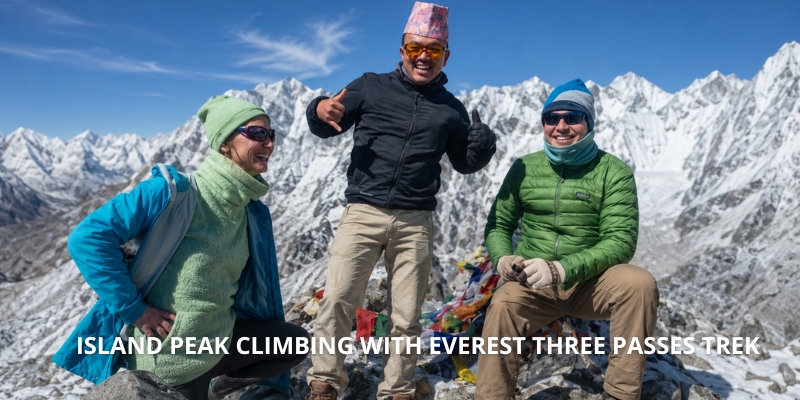
For adventurers dreaming about the ultimate Himalayan trip, the Island Peak with the Everest Three Passes Trek is a perfect venture. The trek combines high-altitude trekking with mountaineering. During the journey, you will cross three of the high mountain passes of Nepal: Renjo La Pass (5,446 m/17,520 ft), Cho La Pass (5,420 m/17,782 ft), and Kongma La Pass (5,535 m/18,159 ft), and summit the popular trekking peak, Island Peak (6,189 m).

The challenging Island Peak with Everest Three Passes Trek takes you to the heart of the Everest region. It takes you through dense rhododendron forests, alpine meadows, barren mountain paths, glaciers, and moraines. The journey also offers some of the finest views of mountains over 8,000 m and other iconic peaks, such as the Ama Dablam, Pumori, Cholatse, Khumbutse, Khalanga, Nuptse, and Lhotse. Similarly, you will pass by famous Sherpa settlements like Phakding, Monjo, Namche Bazaar, Tengboche, Dingboche, Chhukung, and more. En route, you will pass by numerous prayer wheels, flags, Buddhist monasteries, monuments, mani walls, and chortens.

The journey provides you with an opportunity to observe and immerse yourself in the distinctive customs and cultures of the Sherpa people. It also provides deeper insight into the unique Himalayan lifestyle. The trail enters Sagarmatha National Park from Monjo. It is the habitat of unique and rare wildlife like Musk deer, Himalayan tahr, blue sheep, blood pheasant, crimson-horned pheasant, yak, and more. If you are lucky, you may catch their sightings in their natural habitat, though the chances of seeing them are rare.

Rising above the Lhotse Glacier, Island Peak is a stunning mountain in the Chhukung Valley. Ascending the peak is challenging but extremely rewarding. As you stand on top of the peak’s summit, you have unparalleled views and a sense of achievement that will leave you awestruck. Conquering the three high passes is also an incredible feat in itself. The challenges, mesmerizing views, and rich cultural interactions make the Island Peak with Everest Three Passes Trek a unique and extraordinary venture.

At Himalaya Guide Nepal, we offer the finest rates and services for the Everest Three High Passes Trek, including the Island Peak climbing package. Our itinerary is created to fit our client’s requirements and preferences. Likewise, our staff of knowledgeable, experienced Sherpa Trekking Guides and Porters will assist you with every step of the journey. They will guide you, take care of your general needs, and make your trip unforgettable.

View Trip Detail

Nepal Tours and Treks for International Travelers

Most people contact us not knowing what Nepal actually offers. They say Everest. Then we ask how many days, and they say one week, and then the conversation changes completely.

Nepal has 8 of the world’s 14 highest peaks inside its borders. It also has jungle with rhinos and tigers in the south, seven UNESCO sites in Kathmandu Valley alone, and a lake city where the Annapurna range sits directly across the water. One country. Very different landscapes depending on where you go inside it.

Pricing also surprises people. A 3-day Kathmandu heritage tour is $150. The Annapurna Base Camp trek, 13 days with guide porter and all permits, is $670. A one-day Everest helicopter tour is $1,400. A 15-day tour covering heritage, mountains, and jungle is $1,475. Visa for 30 days costs $50 at Kathmandu airport on arrival, no pre-application needed for most countries.

Guide, porter, all permits, accommodation, airport transfers are included in every package. All paperwork handled before you arrive. Our people are also in Germany, Australia, USA, New Zealand, Spain, so someone near your time zone can answer before you book. WhatsApp +977 9851193013.

Top Nepal Tour Packages

No trekking days in these. Good for short stays, families, older travelers, or anyone who wants to see Nepal without walking trails.

1. Everest Base Camp Helicopter Tour – 1 Day | From $1,400

For the Everes Base Camp Helicopter Tour you leave Kathmandu early, probably 6 or 7 in the morning depending on flight slot. The flight to Kalapatthar takes about 45 minutes. First section below you is green terraced hills, then somewhere past Salleri the ground becomes rocky and you start seeing glacier. Kalapatthar itself sits at 5,545 metres. For reference, Mont Blanc in the Alps is 4,808 metres. You are higher than that when you land.

Everest summit is directly above from Kalapatthar. The view from there is actually better than from Base Camp itself because Base Camp is lower and surrounded by moraine. After landing you fly across to Syangboche at 3,962 metres, where Everest View Hotel serves breakfast. The entire Khumbu wall, Everest Lhotse Nuptse, is in the window while you eat. Back in Kathmandu by around 11.

Government rules do not allow helicopters to land at Base Camp environmental protection. So the landing is Kalapatthar or sometimes Pheriche if weather pushes it lower, both above 5,000 metres. Shared seat on group flight is $1,400. Private charter for five people runs $5,500 to $8,500 depending on month. October November March April May for clear conditions.

2. Kathmandu Valley Tour – 3 Days | From $150

The Kathmandu valley tour has seven separate UNESCO-listed sites. Not one area. Seven. Pashupatinath, Boudhanath, Swayambhunath, Bhaktapur Durbar Square, Patan Durbar Square, Changu Narayan, Changunarayan. Rome has one UNESCO zone. Paris has one. This valley has seven spread across maybe 30 kilometres.

Pashupatinath on the Bagmati River is a functioning Hindu temple complex, not a monument. Cremation happens there every morning on the ghats. Pilgrims from across South Asia come here. Boudhanath Stupa is 120 metres around the base and Tibetan Buddhist pilgrims circle it clockwise from before dawn, spinning prayer wheels as they walk. Bhaktapur is the one people usually remember longest. The old town is pedestrian, narrow streets, and the potters in Pottery Square are working the wheel the same way as when the palaces around them were built in the 14th century. Not performing for visitors. Working. Families live in those buildings.

Guide takes you through every site and explains meaning and history. Not just names and dates. Tour runs any time of year. Also works as opening or closing days before or after any trek.

3. Nepal Tour – 12 Days | From $970

Kathmandu is where most people start the Nepal Tour, three or four days for the old cities and temples. Then a short domestic flight to Pokhara. Pokhara feels nothing like Kathmandu. It is quieter and built around Phewa Lake. On a clear morning you can see Machapuchhre at 6,993 metres from the lakeside, and it looks much closer than it is, right across the water. Annapurna II, Annapurna III, Annapurna IV all visible from different parts of town depending on where you stand.

After Pokhara, south to Chitwan. The drive down from the hills takes a few hours and the temperature rises maybe 15 degrees by the time you reach the park. Flat land, subtropical, completely different feeling. Two nights in Chitwan for jungle safari. Then back to Kathmandu for the flight home.

Village stays with a Gurung family are inside the schedule, not optional. You eat the food they cook and see how the house works. October to November and March to May are best months because both mountain views in Pokhara and wildlife in Chitwan depend on dry clear conditions.

Top Nepal Trekking Packages

Walking six to eight hours per day, sleeping teahouses, eating dal bhat most nights. Cold mornings above 3,500 metres. The thing trekkers most underestimate is altitude. Not the distance. The distance is manageable. The air at 4,500 metres has around 60 percent of the oxygen available at sea level and your body takes days to adjust.

Everest region, Annapurna region, Manaslu. Three different places. Very different from each other in terrain, crowd level, cost, difficulty.

4. Everest Base Camp Trek – 13 Days | From $1,125

The Everest Base Camp Trail starts at Lukla, 2,860 metres. The airport runway at Lukla runs uphill at 12 degrees and ends at a rock wall on one side and a drop on the other. Planes land uphill, take off downhill. After Lukla you follow the Dudh Kosi river north through Phakding, across suspension bridges, up steep to Namche Bazaar at 3,440 metres. Namche is a proper trading town. Saturday market, Tibetan traders coming down from the border, bakeries, gear shops, coffee. Rest day in Namche is built into most itineraries to help with acclimatization.

From Namche the trail goes to Tengboche Monastery at 3,867 metres. Morning prayer is 6am. Sit at the back and watch if you are there. Everest and Lhotse visible through the monastery windows on clear days. Past Tengboche to Dingboche at 4,410 metres is where altitude becomes the main issue. Day seven roughly. Some trekkers get persistent headache there that water and rest do not fix. That is early altitude sickness and our guides are watching for it. They slow the pace, sometimes add a rest day. The people who don’t reach Base Camp almost always pushed too fast before Dingboche.

Kala Patthar at 5,555 metres is the high point for views. Everest south face clear from there without other peaks in the way. Base Camp at 5,364 metres is two more hours from Gorakshep. No ropes, no climbing, no technical gear. Just many walking hours and acclimatization days. Teahouses simple, thin mattress, basic food. $1,125 includes guide, porter, permits, all teahouse accommodation. October to November, March to May.

5. Annapurna Base Camp Trek – 13 Days | From $670

Annapurna Sanctuary aka Annapurna Base Camp is at 4,130 metres. The reason it feels different from EBC is the shape of it. At EBC you approach the mountains and stop at the edge of a glacier. At Annapurna Sanctuary the peaks surround you on nearly every side. Annapurna I is 8,091 metres. Annapurna South 7,219. Machapuchhre 6,993, which is a restricted peak, no one has ever summited it officially. Hiunchuli 6,441. They form a near-complete ring. You are inside, not in front.

Trail to get there goes through Modi Khola gorge which gets narrow and steep before opening into the sanctuary. Lower sections have rhododendron and bamboo forest, Gurung villages. Altitude stays below 4,200 metres the whole trip, which is easier to manage than EBC. $670 covers guide, porter, Annapurna Conservation Area permit, all other permits, and all teahouse accommodation. Also on the way back, Jhinu Danda has natural hot springs right at the river. After ten days trekking you sit in 40-degree water with Annapurna South above the tree line. October to November, March to May.

6. Manaslu Circuit Trek – 14 Days | From $876

Manaslu is 8,163 metres, eighth highest peak in the world. The Manaslu circuit route goes around it through a restricted zone. Restricted means you need a special permit on top of standard permits, and Nepal issues limited numbers of this permit each season. In peak season the Everest trail through Namche has several hundred trekkers per day. Manaslu Circuit same season has maybe 40 to 60. Often less. We arrange the restricted area permit as part of the package.

The trail crosses Larkya La Pass at 5,160 metres. The crossing itself takes six to eight hours and above 5,000 metres the wind can get strong depending on the day. The Burhi Gandaki gorge sections below are deep enough that parts of the trail get maybe two to three hours of direct sunlight per day. Monasteries on ridges above the trail, mani walls with carved stones along the path. Two villages near the Tibetan border, Samagaon and Samdo, have architecture and language that is more Tibetan than Nepali. The route is geographically close to Tibet and the culture reflects that. Route closed in monsoon season. October to November and March to May.

Top Nepal Adventure Packages

Longer or harder than standard routes. For people who have already done at least one major Himalayan trek.

7. Everest Base Camp Luxury Trek – 16 Days | From $3,265

The Everest base camp luxury trek is the same as standard EBC. Same path, same altitude, same acclimatization days, same views. The accommodation is completely different. Standard teahouses have foam mattresses maybe 5 centimetres thick, shared toilet blocks, and dining rooms that hold heat badly. Stone walls, windows that let cold in, sometimes you can see your breath at dinner. The luxury lodges at the same stops have private rooms with proper beds and duvets, hot showers that work, heated floors, and food cooked fresh. Not reheated. Charter flight takes you to Lukla directly from Kathmandu which means no 4am start for the Ramechhap shared flight. Dedicated guide and porter for all 16 days, not shared with other groups. October to November, March to May.

8. Island Peak Climbing – 13 Days | From $2,250

Island Peak Climbing is also called Imja Tse Climbing. It sits at 6,189 metres in the Khumbu region near EBC. Nepal Mountaineering Association classifies it as a trekking peak which simplifies the permit process compared to bigger mountains, but the actual climbing requires real technique. Crampons, fixed rope work, ice axe on the summit ridge. This is not hard mountaineering but it is not trekking either.

The package includes Everest region trekking through Namche, Tengboche, Dingboche, then Island Peak base camp at roughly 5,100 metres and a summit attempt. All technical gear provided, crampons harness ice axe. Certified climbing guides lead the summit day. Prior high altitude trekking experience needed before attempting this. Someone who has not been above 4,000 metres before will struggle above 6,000, sometimes seriously. The summit view faces directly toward Lhotse south face at 8,516 metres. March to May and October to November.

9. Annapurna Tilicho Lake Trek – 19 Days | From $1,285

Tilicho Lake is 4,919 metres. Depending on which geographical survey you trust it is either the highest or second highest lake in the world. Getting there requires a side trip off the main Annapurna Circuit, one full extra day up a moraine path and back. Most Circuit trekkers skip it because the route is already 17 or 18 days and one more hard day feels like too much. That is why the Tilicho trail sees far fewer people than the main route even in October.

After Tilicho the circuit goes to Thorong La Pass at 5,416 metres. Six to eight hours crossing, exposed above 5,200 metres in the early morning when it is coldest. Past the pass, descent to Muktinath Temple at 3,710 metres. Muktinath has 108 water spouts from a natural spring and pilgrims bathe under them. Both Hindu and Buddhist pilgrims come here. The site is over a thousand years old as an active pilgrimage place. Trek finishes at Poon Hill, 3,210 metres, sunrise view over Dhaulagiri 8,167 metres and Annapurna range, Machapuchhre, Nilgiri, all at once. 19 days, $1,285. October to November and March to May.

10. Chitwan Jungle Safari and Kathmandu Tour – 7 Days | From $425

Chitwan is at 200 metres elevation. Coming from Kathmandu at 1,400 metres the difference in air and temperature is noticeable as soon as you arrive. Subtropical, flat, UNESCO World Heritage Site since 1984. The one-horned rhinoceros population inside the park was under 100 animals in the 1960s. Government banned hunting, established the park boundary, brought in park rangers. Population is now above 700. That recovery took about 40 years.

Morning jeep safari finds rhinos in open grassland or at the Rapti River most mornings. Bengal tigers are harder because they stay in dense cover, but tracks show up on game drives regularly and sightings happen. Rapti River canoe in the afternoon, slow along the banks, marsh mugger crocodiles on the sand bars, fishing eagles above. The Kathmandu section covers main UNESCO heritage sites with a licensed guide. No altitude, no steep sections. October to February is best for wildlife because grass is cut short after monsoon and animals come to water in dry season.

How to Choose the Right Nepal Tour or Trek

Days, fitness, what you want to see. Those three. Someone new to altitude should not start with Manaslu. Someone with one week cannot do a 13-day trek.

Traveler Type Package Days Difficulty From
First trip to Nepal Kathmandu Valley Tour 3 Easy $150
Everest, one morning EBC Helicopter Tour 1 Easy $1,400
Wildlife, no altitude Chitwan and Kathmandu 7 Easy $425
First Himalayan trek Annapurna Base Camp Trek 13 Moderate $670
Classic mountain trail Everest Base Camp Trek 13 Challenging $1,125
Fewer people Manaslu Circuit Trek 14 Challenging $876
See all three regions Nepal Tour 15 Days 15 Easy $1,475
Comfort on EBC EBC Luxury Trek 16 Mod to Hard $3,265
Summit 6,000m peak Island Peak Climbing 13 Strenuous $2,250
Long high circuit Tilicho Lake Trek 19 Challenging $1,285

Send travel dates on WhatsApp. We tell you what fits.

Nepal Tour and Trek Costs for Foreign Travelers

$150 to $3,265. Wide range. The cost drivers are different for each package which is why the gap is that large. Kathmandu to Lukla domestic flight is around $150 to $200 per person each way and that is before one day of trekking starts. Restricted area permits like Manaslu add around $100 per person per week on top of standard permits. Better accommodation at each stop means $40 to $150 more per night compared to basic teahouse. Private charter to Lukla versus shared group flight is another large difference. And longer treks mean more guide and porter days at full daily rates.

Budget Duration What You Get From
Budget 1 to 5 days Day tours, safari, short activities $150
Mid-range 7 to 13 days Guided treks, cultural tours, safari $670
Premium 13 to 19 days EBC, Manaslu, Island Peak, long routes $1,285
Luxury 14 to 16 days Boutique lodges, charter flights, private guide $3,265

Every package from us includes licensed guide and porter, all accommodation, all permits, airport transfers, farewell dinner. Not included: international flights to Kathmandu, travel insurance, personal gear, guide and porter tips.

On insurance. Standard travel policies usually exclude helicopter evacuation from high altitude. You need one that specifically mentions high altitude rescue. Without that coverage, helicopter from 4,000 metres to Kathmandu hospital costs $3,000 to $6,000 out of pocket. We send recommended insurers to every client before they travel.

Best Time for Nepal Tours and Treks

October and November. Monsoon ends late September, sky clears fast. By mid-October trails are dry, mountain views are clear, and it is the best visibility of the year. Temperature at 3,500 metres is around 0 to 10 degrees Celsius in the day. Cold at night but manageable with the right gear. Peak season so teahouses on popular routes fill up and Manaslu permits sell out. Book 2 to 3 months ahead for October and November departures.

March to May also good. Warmer than autumn. Rhododendron blooms at 2,000 to 3,500 metres from late February through April, red and pink through the Annapurna and Langtang trail forests. High passes on Manaslu Circuit and Annapurna Circuit are usually clear of deep snow by mid-March. More daylight per day than autumn, which means more walking time before dark. Busier teahouses on Everest and Annapurna routes in spring.

December to February quiet, cheaper. Kathmandu tours run fine, Chitwan safari also good because dry season means animals near water. Annapurna Base Camp is possible with cold-weather sleeping bag and proper layers. Manaslu route closes completely in winter, teahouses shut, Larkya La Pass gets heavy snow.

June to September monsoon. Heavy rain daily, mountain views blocked most of the time, trails muddy, leeches on lower jungle sections. Do not come for mountain trekking in monsoon. Upper Mustang is the exception because it sits in a rain shadow north of Annapurna and stays relatively dry even June to August.

Nepal Visa and Entry

Visa on arrival at Tribhuvan International Airport Kathmandu. More than 100 nationalities eligible. Indian passport holders no visa needed. Some nationalities must apply at Nepal Embassy before travelling, check immigration.gov.np to confirm before booking.

Duration Cost
15 days $30 USD
30 days $50 USD
90 days $125 USD

Two passport photos and USD cash at the counter. Card machine available but cash is faster. Visa counter queue at Kathmandu airport takes 15 to 30 minutes depending on how many flights landed at the same time.

TIMS card, Sagarmatha National Park permit, Annapurna Conservation Area permit, restricted area permits, all separate from the entry visa, all required for trekking. We arrange every one of these before you land. You go to no permit office.

About Himalaya Guide Nepal

Nepal Tourism Board registered. TAAN member. Nepal Mountaineering Association listed. Reviews on Tripadvisor and Viator.

Chandra Gurung leads our Kathmandu team. He has been guiding on these routes since before most of the teahouses on the Everest trail had solar panels, so before around 2008 or 2009. He knows which lodges have reliable heating in winter, where altitude hits hardest on each specific route, and which trail sections were rebuilt differently after the flooding in 2023. That information does not come from reading. It comes from walking the routes repeatedly over many years.

Team in Germany, Australia, USA, New Zealand, Spain also. Stephan Gille covers European clients from Berlin. Skip Moss handles USA. Menios Constantinou in Sydney for Australia and New Zealand. Cesar Bautista in Madrid. You write at 10pm on a Tuesday from Hamburg and Stephan sees it before he sleeps. Answer in your time zone, not Kathmandu morning.

Any package can be adjusted. Fewer days, different accommodation, private group, Chitwan added at end of a trek. No planning charge for this. WhatsApp +977 9851193013 any day.

Frequently Asked Questions about Nepal Tours & Treks

What is good Nepal tour for first-time visitors?

How much does Nepal tour or trek cost?

Do I need visa for Nepal Travel?

When is best time for Nepal Visit?

How many days do I need for Nepal Tours & Treks?

Is Nepal safe for solo female traveler?

What is included on Nepal Tours & Treks?

Can I combine tour and trek?

Does Himalaya Guide Nepal do private tours?

Ready to Start
Your Adventure?

Join thousands of happy travelers who
Choose Himalaya Guide Nepal Pvt.Ltd.

Plan Your Trip