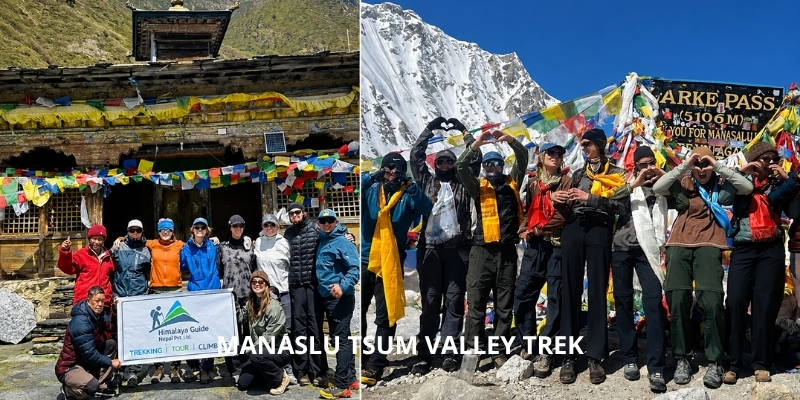
Looking for a peaceful trekking experience in Nepal that also hits you with a dopamine rush? Then the Manaslu Tsum Valley Trek is one of the best options you’ll get. Manaslu Tsum Valley trek is a newly emerging trekking route along the great Himalayan trail that combines Manaslu Circuit with Tsum Valley Trek, taking you to the remote Beyul Kyimolung, also known as the “Hidden Valley of Happiness”. You’ll get to meet and greet with a very unique Tibetan tribe here. They are called the Tsumbas.
This trek is a wonderful alternative to the Annapurna Circuit trek, as the Manaslu region is filled with tall snow-capped mountains. So, you get attractive views of Mount Manaslu (8,163 m), Himalchuli (7,893 m), Ngadi Chuli (Peak 29) (7,871 m), Shringi Himal (7,161 m), Himlung Himal (7,126 m), Ganesh Himal II (7,118 m), and Simnang Himal (6,251 m), and more. However, it requires special permits to enter, as you’ll trek through the Manaslu and Annapurna Conservation Areas, and the restricted Tsum Valley and Manaslu Circuit.
What You'll Remember at Manaslu Tsum Valley Trek
Explore the sacred and remote Beyul Kyimolung, the “Hidden Valley of Happiness”, home to indigenous Tsumbas.
Climb up the highest point of the trek, Larkya Pass (5,160 m), offering panoramic views of Manaslu, Himlung Himal, Cheo Himal, and Annapurna II.
Visit the Mu Gompa, the largest monastery in the valley, which preserves Tibetan Buddhist culture and art.
Observe the beautiful reflections of the mountain peaks and the surrounding landscape in the tranquil Birendra Glacial Lake near Samagaun.
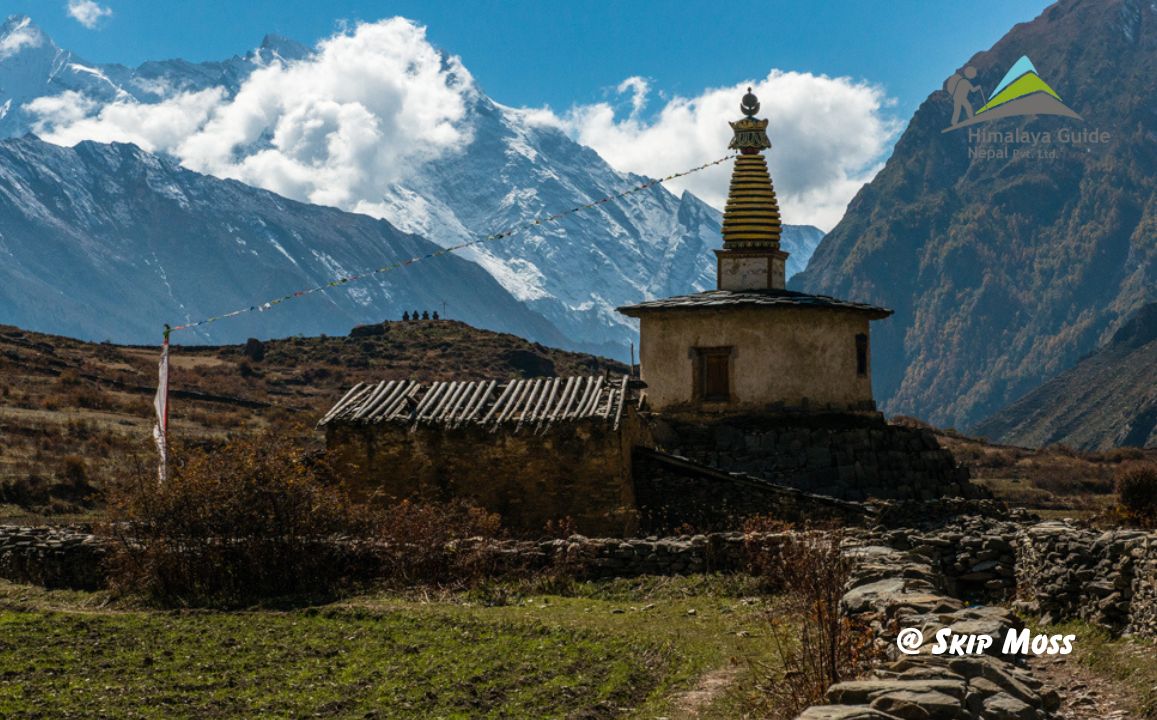
Witness ancient monasteries, chortens, mani walls, and prayer flags along the route.
Might spot wildlife like blue sheep, Himalayan tahr, and lammergeiers in the Manaslu Conservation Area.
Discover the Tsumba people and their unique way of life, language, and culture.
Trek through two restricted regions in one journey: the Manaslu Circuit and the Tsum Valley.
Cross Larkya La Pass (5,106 m), the highest and most exciting point of the trek, with views of Himlung Himal, Annapurna II, and the Manaslu range.
Walk through different landscapes of the Manaslu and Annapurna Conservation Area, including subtropical forests, bamboo, and rhododendron forests, deep gorges, alpine meadows, and yak pastures.
Outline Itinerary for Manaslu Tsum Valley Trek in a Table
Day
Activity
Ending Elevation
Time Taken
Distance
1
Arrival at Tribhuvan International Airport
1,350 m
–
–
2
Kathmandu to Machhakhola
869 m
8 hrs
160 km
3
Trek from Machhakhola via Khorlabensi & Tatopani to Dovan
1,070 m
5 hrs
10 km
4
Trek from Dovan via Jagat & Sirdibas to Philim
1,750 m
7 hrs
17 km
5
Trek from Philim via Ekle Bhatti & Lokpa to Chumling
2,386 m
8 hrs
13 km
6
Trek from Chumling via Renjam & Gho to Chhekam Paro
3,031 m
6 hrs
9 km
7
Trek from Chhekam Paro via Lamagaon & Chhule to Mu Gompa
3,700 m
7 hrs
16 km
8
Trek from Mu Gompa via Chhule & Pangdun to Rachen Gompa
3,240 m
5 hrs
8 km
9
Trek from Rachen Gompa via Lamagaon, Chhekam Paro & Gho to Chumling
2,386 m
7 hrs
13 km
10
Trek from Chumling via Lokpa to Pewa
1,750 m
7 hrs
18 km
11
Trek from Pewa via Deng, Rana & Bihi Phedi to Ghap
2,165 m
7 hrs
18 km
12
Trek from Ghap via Namrung & Lihi to Lho
3,180 m
7 hrs
16 km
13
Trek from Lho via Syala to Samagaun
3,525 m
6 hrs
17 km
14
Rest day in Samagaun
3,525 m
–
–
15
Trek from Samagaun to Samdo
3,875 m
4 hrs
8 km
16
Trek from Samdo via Larkya Bazaar to Dharamsala
4,460 m
4 hrs
12 km
17
Trek from Dharamsala over Larkya Pass to Bimthang
3,590 m
10 hrs
23 km
18
Trek from Bimthang via Yak Kharka, Karche & Gho to Tilije
2,300 m
8 hrs
26 km
19
Trek from Tilije via Dharapani to Besisahar to Kathmandu
760 m
Trek: 3 hrs Drive: 7 hrs
Trek: 8 km Drive: 225 km
Manaslu Tsum Valley Trek 19 Days Full Itinerary
Day 01: :
Arrival at Tribhuvan International Airport
Highest Altitude
1,350 m
Welcome to Nepal! Our representative will pick you up at Tribhuvan International Airport and drive you to your hotel. You can rest here for a while. Later in the afternoon, we’ll stop by to welcome you and brief you on the program. The evening is free: exchange money or withdraw Nepali cash for any extra trip costs, explore, or relax. You can go to Thamel for dinner. You will find everything from authentic dal-bhat to fast food, Chinese dishes, and Korean-style BBQ.
Day 02: :
Kathmandu (1,400 m) to Machhakhola (869 m)
Trek Distance
160 km
Trek Duration
8-10 hours
Highest Altitude
-531 m
Place
Machhakhola
Meals
B+L+D
Accommodation
Hotel Nirvana /Hotel EVEREST
The journey to the 19-day Manaslu Tsum Valley Trek begins today. The trip begins with a morning ride from Kathmandu to Machhakhola, the starting point of the Manaslu Trek route. The distance from Kathmandu to Machhakhola is around 160 km, but due to the rough and bumpy roads along the route, the drive takes 8 to 10 hours. The route passes through several stunning places, including Dhading, Arughat, and Sotikhola, before reaching today’s destination.
The first part of the drive is smooth on a blacktop road, but later turns into a dirt road with bumpy sections, especially after Arughat. Moreover, the rivers, green hills, local villages, waterfalls, and terraced farms along the way are stunning. Our day’s overnight and dinner point is at the lodge in Machhakhola.
Day 03: :
Trek from Machhakhola (869 m) - Khorla Besi to Jagat 1070M
Trek Distance
10 km
Trek Duration
5-6hours
Highest Altitude
+201 m
Meals
B+L+D
Accommodation
New Mongolian Cottage & Restaurant
Wake up to the chirping sound of birds and water flowing in the river. We’ll have our morning meal at the lodge we’ve stayed overnight and pack our backpacks to start the day’s trek. As the trek begins, we’ll follow the river upstream through subtropical forests and narrow gorges. Expect a mix of uphill climbs and downhill walks as the route winds through Sal and rhododendron forests. Along the way, we’ll cross several long suspension bridges and enjoy stunning views of terraced hillsides and peaks of Ganesh Himal and Shringi Himal in the distance.
Continuing the walk, we’ll pass through several traditional villages where we can rest and experience the local culture. The first major stop is Khorla Besi, a small Gurung village at around 970 m, reached after about 1.5 hours of trekking. Not far from Khorla Besi lies Tatopani, known for its soothing natural hot springs. It’s the perfect place to ease tired muscles while enjoying a relaxing soak in the mineral-rich water.
Continuing, the journey gets more adventurous as it enters narrow valleys and follows rocky paths toward Dovan. The village lies between the meeting points of two rivers and is a perfect place to stop for lunch and take a break. The final walk to Jagat from Dovan is one of the biggest challenges of the day as we have to take a steep 10 km ascent. The section features steep stone staircases, cliffside paths, and suspension bridges. After the ascent, we’ll get to Jagat, the gateway to the Manaslu trekking route. Here our permits will be checked, and after checking in, we’ll settle into the lodge. Day’s overnight stay and dinner are at Jagat.
Day 04: :
Jagat and Sirdibas to Philim (1,750 m) to Lokpa 1750M
Trek Distance
17 km
Trek Duration
7 hours
Highest Altitude
+680 m
Place
Jagat
Meals
B+L+D
Accommodation
Hotel Motherland Tsum
We’ll have a hearty morning meal at Jagat. After breakfast, the trek begins. Ten minutes farther, a suspension bridge over the Dudh Pokhari Khola leads to Salleri. Here, a short uphill walk rewards us with a postcard view of Sringi Himal (7,161 m). We travel over rolling hills to reach Sirdibas, cross another bridge, and then make a final 45-minute climb to arrive in Philim.
We follow a relatively flat path along a mountainside through Ekle Bhatti and the forest to a new suspension bridge. The left fork leads to Larkya Pass on the Manaslu Circuit; we stay to the right, heading toward the lower Tsum Valley. We stay in a lodge with great Himalayan views at Lokpa.
Day 05: :
Lokpa -Ghatte Khola to Chumling (2,386 m)
Trek Distance
13 km
Trek Duration
4-5 hours
Highest Altitude
+636 m
Place
Chumling
Meals
B+L+D
Accommodation
Tashi Delek Lobsang Lodge & Restaurant
The fifth day on the Tsum Valley Manaslu Trek is short but stunning, marking the true entry into the hidden Tsum Valley. From Lokpa, the route takes us down into the peaceful Shiar Khola Valley and passes through a dense forest of pine, juniper, and rhododendron trees. With no villages along the route, it’s a peaceful location where the sounds of birds, rustling leaves, and the flowing river replace the bustle of daily life.
After crossing a couple of suspension bridges over the Shiar Khola, we’ll make a steady ascent through a narrow gorge. As we reach Ghatte Khola, the pathway becomes gentler with easier walking. As we walk through the forest, we can catch glimpses of Shringi Himal. Nearing Ghatte Khola, the waterfall becomes our sound. The day’s final walk is relaxing.
As we get to Chumling, we’ll enter the lower Tsum Valley for the first time. With its stone-paved lanes and traditional Tibetan-style houses, the village showcases the region’s rich culture and mountain charm. Once we settle into our accommodation point, explore Chumling Gompa and the nearby Mani Dhungyur and Panago Gumba monasteries to experience the deep-rooted Buddhist culture of the valley. Overnight in Chumling.
Day 06: :
Trek from Chumling (2,386 m) via Renjam and Gho to Chhekam Paro (3,031 m)
Trek Distance
9 km
Trek Duration
6 hours
Highest Altitude
+645 m
Place
Chhekamparo/Zong
Meals
B+L+D
Accommodation
Karma Lodge
Crossing the suspension bridge at the corner of Chumling, the route goes through small villages and the rich farming land of maize and potatoes, as well as buckwheat. The houses are classic Tibetan with barricades of firewood and roof terraces along a mountainside route until we reach Renjam.
We will cross the Sarpu Khola on a suspension bridge and climb up to the village. It is the last place to stop for a meal before we head up to Chhekampara. Only simple food is available here. After 2–3 hours, we will reach Chhekam Paro, the largest village in the Tsum Valley, where we’ll spend the night at a simple lodge.
Day 07: :
Trek from Chhekam Paro (3,031 m) via Lamagaon and Nile 3500m
Trek Distance
16 km
Trek Duration
7 hours
Highest Altitude
+669 m
Meals
B+L+D
Accommodation
Norling Lodge
This day explores the villages of Chhekam and Paro, climbing north to a retreat where Lama Kongchog died after 26 years of meditation. He reincarnated as a child in this village and became the subject of the documentary “Unmistaken Child”. We take the eastern route, passing small villages and a local school. We climb over a ridge of chortens, past Lamagaon at 3,302 m, through flat fields, and look across the crops and fast-flowing river to the Rachen Gompa courtyard at 3,200 m. The Kapan Monastery manages this nunnery.
Then we walk to Milarepa Cave, one of the sacred sites in Tsum Valley, where Yogi Milarepa meditated. We cross the Shiar Khola to the village of Phurba at 3,251 m. We continue up to Chhule for lunch, then follow the Shiar Khola, taking the left path to Nile for an overnight stay, enjoying spectacular mountain and valley views.
Day 08: :
Nile visit to Mu Gompa to Chhekam Paro
Trek Distance
13 km
Trek Duration
7 hours
Highest Altitude
-854 m
Meals
B+L+D
Accommodation
Karma Lodge
As the sun rises, we leave Nile and follow the Shiar Khola northward. The route passes through beautiful landscapes with traditional Tibetan-style villages and ancient stone houses, prayer walls, and mani walls. The last section of the pathway is a gradual 15-20 minute ascent to Mu Gompa. As we climb, we’ll pass the peaceful Dephyudonma Gumba before reaching the monastery, surrounded by Himalayan scenery.
After about 2-3 hours of trekking, we’ll reach Mu Gompa (3,700 m), the largest and most important monastery in the Tsum Valley and the highest point of the valley. Inside the monastery, we’ll find ancient Kangyur scriptures, a statue of Avalokiteshvara, and beautiful paintings of Padmasambhava and Tara. Along with sacred treasures and a view of mountains in the background, Mu Gompa is one of the most memorable stops on the trek.
After exploring Mu Gompa, we can visit Piren Phu, also known as Milarepa’s Cave. A short side trip takes us to this peaceful meditation site, where the respected 11th-century Tibetan saint is said to have practiced meditation, with his footprint still preserved in the stone. After exploring Mu Gompa, we’ll begin our return journey by following the same route back along the Shiar Khola. The route takes us through the villages of Chhule, Pangdun, and Phurbe as we make our way down the valley.
Along the way, we’ll visit Rachen Gompa, one of the most important nunneries in the Tsum Valley. From there, we’ll pass through Lamagaon before making our way down to Chhekam Paro. Overnight in Chhekam Paro.
Day 09: :
Chhekampark -Chumling (2,386 m) to Lokpa 1750m
Trek Distance
18 km
Trek Duration
5-6 hours
Highest Altitude
-636 m
Meals
B+L+D
Accommodation
Hotel Motherland Tsum
Today, we’ll leave Chhekam Paro and return the way back along the same path that takes us through the barley and buckwheat fields. As we descend, we’ll see more green forests and experience easier breathing. As we walk, we pass through Daphe Gompa, then continue downhill towards Chumling, our day’s lunch point.
After breakfast, the trek continues downhill into the Shiar Khola Valley. We’ll walk along pine, juniper, and rhododendron forests and return through the same remote area we passed on the way up via Ghatte Khola. Afterward, the route takes us to several suspension bridges and passes through narrow gorges. The pathway then climbs to Lokpa, the point where you exit the Tsum Valley and connect back with the Manaslu Circuit route. Overnight in Lokpa.
Day 10: :
Lokpa -Pewa to Deng 1750M
Trek Distance
18 km
Trek Duration
5-6 hours
Highest Altitude
+415 m
Meals
B+L+D
Accommodation
Hotel Windy Valley
As usual, the day begins with a warm cup of tea and a hearty breakfast. Afterward, we’ll get ready to start the day’s trek. We cross the ancient wooden bridge over the Budhi Gandaki River, then reach Nyak Phedi. We continue to cross back to the right side of the Budhi Gandaki River and then cross back to the left side to get to Pewa for the night.
This day’s route enters a steep, forsaken gorge and descends through grassy slopes dotted with tall pine trees via Budhi Gandaki. After Deng, we re-cross the east bank and climb up to Rana, at 1,980 m, and stay on the route up to Bhi Phedi, at 2,130 m.
The river roars below, except in one place where a rockfall has created a huge dam, which continues in and out of canyons across the Serang Khola. It then reaches a village, after which it crosses an old suspension bridge over the Buri Gandaki again. After a short while, you will reach the village of Ghap. Overnight at the lodge.
Day 11: :
Deng - Ghap (2,165 m) via Namrung 2623m
Trek Distance
16 km
Trek Duration
5-6 hours
Highest Altitude
+1,015 m
Place
Lho
Meals
B+L+D
Accommodation
Majestic Manaslu Cottages & Café
On this day, we travel through beautiful rhododendron forests. You can see and hear many birds. We stay on the south bank and cross a narrow wooden bridge to the north. Then, we return to the south bank on another old bridge, where we see Langur monkeys.
The route climbs up on well-made stairs to Namrung, a pretty, pleasant place with a hydropower facility. Here is a trekking permit checkpoint and a view of Sringi Himal and Ganesh Himal on our way to Lihi (place for lunch) and Lamagaun (viewpoint of Himalchuli).
Resuming the walk, we reach Lho, a good place for trekkers due to Ribung Gompa. We get an excellent view of Mt. Manaslu, as well as other snow peaks visible from the mani wall at the far end of the village, and from the Gompa on the hill to the west. We’ll rest here for the night.
Day 12: :
Namrung -Lihi to Lho
Trek Distance
10K
Trek Duration
4-5 Hours
Meals
B+L+D
Accommodation
Majestic Manaslu Cottages & Café
We’ll have our breakfast at Namrung while enjoying views of Mount Siring, Ganesh Himal, and Himalchuli. The day begins with an easy walk along a flat path to Banjam. After that, we’ll face steep sections towards Lihi. The village is known for its traditional pine-roofed homes, Buddhist chortens, and terraced barley fields alongside the sight of Ganesh Himal.
After Lihi, the path takes us down and crosses the Hinan River valley, fed by the Simnang/Lindanda Glacier. From there, you’ll continue to Sho Gaun (2,880 m), a small village with apple orchards. From Sho, we’ll take a short climb and get to Lho village, a beautiful Tibetan-style village. Day’s overnight and dinner are at Lho village.
Day 13: :
Trek from Lho (3,180 m) via Syala to Samagaun (3,525 m)
Trek Distance
17 km
Trek Duration
6 hours
Highest Altitude
+345 m
Place
Samagaon
Meals
B+L+D
Accommodation
Mount Manaslu Hotel & Lodge
This short day trek takes you into the mountains with time to enjoy and acclimatize. It’s an easy walk to Shyala (3,510 m) up a pine and rhododendron forest filled with moss and a crystal-clear stream. We can enjoy 360-degree views from here, as the hill is scarred by wildfires and extensive deforestation.
We get another easy hour’s trek to the large village of Samagaun (3,520 m). While we lose the gigantic views of Manaslu mountain, we enter a world of yaks, pastures, and houses situated on the stone under Mt. Manaslu.
Day 14: :
Rest day in Samagaun (3,525 m)
Place
Samagoan
Meals
B+L+D
Accommodation
Mount Manaslu Hotel & Lodge
After 12 continuous days of trekking, the 14th day on the itinerary involves an acclimatization day. However, the acclimatization day doesn’t mean we’ll sleep and stay idle; instead, we’ll follow the “hike high, sleep low” rule of the Himalayas. Still, unlike other trek days, we don’t have to wake up very early and start trekking by 7-8 a.m. We can wake up a little late today, then have breakfast, and take a short hike to nearby destinations.
There are mainly three options for the day:
Manaslu Base Camp (4,800 m): It’s a challenging acclimatization day-hike location that takes 6-7 hours round-trip and involves a steep climb. Along the way, we’ll pass Birendra Lake and continue the route used by Manaslu climbing expeditions. Although Challenging, the close view from Manaslu Base Camp is the highlight of the trip.
Pungyen Gompa (4,200 m): To those wanting a culturally rich alternative on the acclimatization day, hiking to Pungyen Gompa is ideal. It’s a centuries-old monastery whose name derives from the Tibetan word for happiness. Besides cultural charm, the Gompa offers views of the Manaslu range without the challenge of walking to Manaslu Base Camp.
Birendra Lake (3,650 m): This is one of the common day hikes on the Samagaun acclimatization day. It is a short, easy 2-3 hour round-trip destination that takes us to a turquoise glacial lake fed by Manaslu’s meltwater.
Whichever day hike we choose, we’ll return to Samagaun for an overnight stay. This helps our bodies adjust to changed surroundings and altitude while following the golden rule of the Himalayas.
Day 15: :
Trek from Samagaun (3,525 m) to Samdo (3,875 m)
Trek Distance
8 km
Trek Duration
4 hours
Highest Altitude
+350 m
Place
Samdo
Meals
B+L+D
Accommodation
Zambala Hotel
As we are now at the high point of the trek, we will only trek for four hours. The route takes us through Birendra Tal (3,450 m), surrounded by icebergs, before going through the seasonal exit stream. It’s a leisurely stroll through yak pastures in a broad valley adorned with long mani walls, where marmots pop up from their burrows. As we ascend, we leave the tree line but are accompanied by low-lying juniper. We climb a ridge and cross the Buri Gandaki on a wooden bridge to reach Samdo.
From the path near Samdo, we can observe the main track to Tibet over the Lajyang La (5,098 m) to the right and the Larkya La route ahead to the left. Although the track to Tibet is currently closed, timber is being transported to Samdo by yak, anticipating the resumption of trade. Remarkably, the nearest Tibetan town is only a day’s walk from Samdo.
Day 16: :
Trek from Samdo (3,875 m) via Larkya Bazaar to Dharamsala (4,460 m)
Trek Distance
10 km
Trek Duration
4 hours
Highest Altitude
+585 m
Place
Dharmasala
Meals
B+L+D
Accommodation
Hotel Larke Peak
The route descends through fields to an old mani wall and stone cairn before dropping to the Buri Gandaki River and crossing on a wooden bridge. This place shows up on maps as the mythical Larka Bazaar. From here, people go to Tibet via Lajyang Bhanjyang (4,998 m), which was once a flourishing market, and then Gyala Bhanjyang (5,375 m).
As we walk, we’ll see mani walls marking the start of the ascent to the pass. We climb through a juniper forest, from where the huge Larkya Glacier, originating from Mt. Manaslu, can be seen. From the ridge to the right, look for a route that crosses over the tops of two ravines. Then we reach a viewpoint at the edge of a huge gorge at 4,000 m. Near the Larkya Glacier, we reach Dharamsala (Larkya Phedi, Larkya Rest House), where a small lodge is located. We’ll stay here overnight.
Day 17: :
Trek from Dharamsala (4,460 m) over Larkya Pass (5,160 m) to Bimthang (3,590 m)
Trek Distance
23 km
Trek Duration
8-10h hours
Highest Altitude
-870 m
Place
Bhimthang
Meals
B+L+D
Accommodation
Hotel Ponkar Mountain & Restaurant
The seventeenth day on the Manaslu Tsum Valley Trek is the highlight of the entire day, as we’ll cross Larkya La (5,106 m), the highest point of the trek. It’s also a long day with challenging ascent and descent, so prepare accordingly. We’ll leave Larkya Phedi early, around 4:00 a.m., with a headlamp. We slowly hike up the hill behind Dharamsala, next to the hill of the Larkya Glacier. The climb is long and rocky, especially at the top of the moraine. You will spot cairns and metal snow poles to guide you. Afterward, we descend past four frozen lakes, then make a tiring final climb to Larkya La (5,160 m), marked by prayer flags on snow poles. This journey takes approximately 3 to 4 hours, depending on the weather conditions. It’s more difficult in the late afternoon.
In the west, you’ll see Himlung Himal (7,126 m), Kang Guru (6,981 m), and Annapurna II (7,937 m) among other peaks. We descend through loose gravel into a grassy moraine area where the slope eases. We walk on the left side of the moraine, winding through a scenic valley to Bimtang (3,590 m), known as the “plain of sand”. From the pass to Bimtang, there’s a huge altitude change (1,570 m) in just about 3–4 hours.
Day 18: :
Trek from Bimthang (3,590 m) via Yak Kharka, Karche, and Gho to Tilije (2,300 m)
Trek Distance
26 km
Trek Duration
8 hours
Highest Altitude
-1,290 m
Place
Gwo/Tilche
Meals
B+L+D
Accommodation
Hotel Larke Peak/ Hotel The North Face & Restaurant
It’s now day 18 of our trek. After a 25-minute walk from Bimthang, we cross the Kechakyu Khola Glacier and enter the rhododendron forest. If you trek in the season of March and April, you will see rhododendron forests filled with red, white, and pink blooms. The view from the back of Mt. Manaslu is also equally stunning.
We continue our trek on the downhill path along the true right bank of Karche (2,700 m). We will have lunch after a 3–4-hour walk. Then continue steeply over a point and drop to Gurung village Gho, the first real village after Samdo. The valley gets more agricultural as we pass through fields, forests of oak and rhododendron, and overnight at the old Gurung village of Tilije.
Day 19: :
Trek from Tilije (2,300 m) via Dharapani to Besisahar (760 m) to Kathmandu
Trek Distance
8 km
Trek Duration
3 hours
Drive Distance
50 km + 175 km
Drive Duration
3+7 hours
Highest Altitude
-1,540 m
Place
Kathmandu
Meals
B+L+D
Accommodation
Guest Own
It’s the final day of the journey to Manaslu Tsum Valley. After breakfast at Tilje, we’ll leave the village and make way towards Dharapani. Then we cross the Dudh Khola and follow along with it as it descends through the scrub forest. The walls of the Marsyangdi Valley loom larger and finally join the Annapurna Circuit route at Dharapani village. It serves as the checkpoint for ACAP permits.
At the checkpoint, we’ll enter our details and check out. Afterward, we catch a public jeep from Dharapani to Besisahar. As we arrive in Besisahar, we’ll rest for a while and take a bus to drive back to Kathmandu, which is an additional 7 hours from Besisahar. Upon arriving to Kathmandu, our representative will drop you off at your. This marks the end of the unforgettable Manaslu and Tsum Valley Trek. Hope you enjoyed the journey.
Inclusion/Exclusion in Manaslu Tsum Valley Trek
Cost Inclusion In Manaslu Tsum Valley Trek
Airport pick-up and drop-off services.
2 nights’ accommodation in Thamel on a BB Plan
Public bus ticket to Machhakhola.
Transportation along the trek.
Public deluxe bus back to Kathmandu.
Drop off at the Hotel in Kathmandu.
Three meals a day (Breakfast, Lunch, and Dinner along the trek).
Lodge accommodation on the way.
An experienced guide (including his salary, equipment, insurance, lodging, and food)
Equipment: Down Jacket, Sleeping Bag.
Legal documents (MCAP permit, Tsum valley permit, Manaslu restricted area permit, and ACAP).
Some dry and fresh fruits.
All government taxes.
A token of Love from the company.
Farewell Dinner or lunch is a suitable time.
Cost Exclusion In Manaslu Tsum Valley Trek
Extra night accommodation in Kathmandu and other places.
Travel insurance in cases of trekking.
Hot and Cold drinks, such as Coke, Mineral Water, and beer.
Personal expenses (laundry, bar bill, telephone, extra helper, battery charge shower, boiled water, and some donations).
Download the complete Trek itinerary, inclusions, map & prices in one PDF.
Departure Dates for You
19 Days
Trip Days
26 Oct, 2026
Start Monday
13 Nov, 2026
End Friday
10
Group Size
USD 1,275
Price
Booking Open
Status
Private Trip Booking
Prefer a more personal journey? Our private packages offer flexible dates, custom itineraries, and dedicated support—perfect for those seeking a tailored travel experience.
The Manaslu Tsum Valley Trek costs USD 1070 to USD 1275 per person. The cost covers all core logistics, including restricted-area paperwork, a licensed guide, porter support, ground transfers, meals, and lodge stays.
Since trekkers need five separate permits, the Manaslu Tsum Valley Trek is quite expensive. However, the trekking costs more during peak seasons due to the influx of tourists. Additionally, it’s remote, so they use mules to transport goods to the village, making it more costly than more developed routes.
Manaslu Tsum Valley Trek Cost Breakdown
Cost Category
Amount (USD)
MCAP (Manaslu Conservation Area Permit)
$25
ACAP (Annapurna Conservation Area Permit)
$25
Manaslu Restricted-Area Permit
$100
Tsum Valley Restricted-Area Permit
$40
Chum Nubri Rural Municipality Fee
$8
Guide & Porter Support
$197
Transport
$95
Meals (Full Board)
$540
Lodge Accommodation
$110
Total Package Price
$1,275
Note: Figures are rounded. In larger groups, the guide/porter and transport shares drop, sliding the total toward $1,070 per person for a 10-trekker team.
Manaslu Tsum Valley Trek Permits
As Manaslu and Tsum Valley are both restricted regions and fall inside two conservation areas, you’ll need the following five permits:
Manaslu Conservation Area Permit (MCAP)
Manaslu Conservation Area Permit
The entire Manaslu stretch, from Jagat to Larkya Phedi/Dharamsala, lies within this conservation area. There are several checkpoints, like in Jagat, Philim, Namrung, and Samagaun park posts. It’s just a one-time fee; good for unlimited days within the conservation area.
Manaslu Restricted Area Permit (RAP)
Manaslu Special Trekking Permit
Similarly, Jagat to Dharapani (days 6–21 of the standard itinerary) is located in the restricted Manaslu region. It’ll be checked in the same MCAP posts, as well as in police logbooks along the route. The permit should be applied through a trekking agency, and only a group of at least two trekkers, accompanied by a guide, can obtain it. Its price differs by season, and the first 7 days are included. Then, the daily extensions will incur additional costs.
Tsum Valley Restricted Area Permit (RAP)
Tsum Valley Special Permit
Likewise, the Lokpa to Mu Gompa section of the Tsum side trip (days 7–12) needs this permit. Tsum Valley RAP will be checked in the Lokpa police post and the village police registers in Chumling and Chhekam Paro. It also requires a minimum of two trekkers along with a licensed guide. It is charged in weekly blocks for additional days.
Annapurna Conservation Area Permit (ACAP)
Annapurna Conservation Area Permit
This permit allows you to enter the Bimthang, Tilije, Dharapani, and onward to Besisahar after crossing the Larkya Pass. It is primarily checked at Dharapani. ACAP also takes a one-time fee and covers any duration inside the Annapurna Conservation Area.
Chum Nubri Rural Municipality Entry Permit
Chumnubri Rural Municipality Tourism Permit
We need this permit to enter Jagat, Lokpa, Chhekam Paro, Lamagaon, and many more locations, including Larkya Pass. It was introduced in October 2024. It is collected by the local government and is designed to support environmental preservation and tourism development in the area.
High season (Sep – Nov & Mar – May): $100 for the first 7 days, then $15 per extra day. Low season (Dec – Feb & Jun – Aug): $75 for the first 7 days, then $10 per extra day.
Tsum Valley RAP (Restricted Area)
Lokpa → Mu Gompa
High season (Sep – Nov & Mar – May): $40 per week, then $7 per extra day. Low season (Dec – Feb & Jun – Aug): $25 per week, then $7 per extra day.
Chum Nubri Rural Municipality Entry Fee
All wards inside Chum Nubri RM (Sirdibas through Samdo)
NPR 1,000 per trekker (≈ $8). One-time fee; covers entire stay within the municipality.
Manaslu Tsum Valley Trek for different levels of Trekkers
The Manaslu Tsum Valley Trek is a strenuous and challenging trek, so it is not an easy trek for every trekker. Whether the trek is suitable for you greatly depends on your experience level.
For Beginners
The trek to Manaslu Tsum Valley is not a wise choice for beginners because the trek is more challenging than you expect. It’s a physically challenging journey with back-to-back hiking days of 5-7 hours, different landscapes with steep uphill and downhill, and a challenging pass crossing at Larkya La (5,106 m). Also, this is a remote trek with very limited facilities like roads, transportation, and even medical ones. If you become sick or injured, getting help may take time.
Without previous trekking experience, many beginners face continuous fatigue. As the days go by, the journey becomes harder, and it is not just a week-long adventure but 19 days of journey. Still, a fit beginner can go for this trek but only if prepared first. Spend at least 2-3 months building your fitness with regular cardio and stair-climbing workouts. Once on the trail, keep a slow, steady pace and, if possible, add an extra day or two to your itinerary.
For Intermediate Trekkers
If you’ve already completed treks like Langtang Valley, Pikey Peak, and Mardi Himal, you’ll have a good idea of what it’s like to hike 5-6 hours a day at high altitude. For most intermediate trekkers, the toughest part of the Tsum Valley and Manaslu Circuit Trek is not trekking distance and duration but the altitude.
Within just a couple of days, you’ll have to hike from Samagaun (3,530 m) to Dharmasala (4,460 m) and then over Larkya La Pass (5,106 m). This fast shift in altitude gives your body little time to adjust to the changed elevation. So, mild headache, difficulty sleeping, and a reduced appetite are common. But if the condition becomes worse, you’ll have to descend to a lower elevation immediately.
For Experienced Trekkers
If you’ve already completed Everest Base Camp, the Annapurna Circuit, or a similar high-altitude trek, this trek is ideal for you. But you’ll notice that this route is much more remote. For experienced trekkers, you’ll find the altitude familiar, but the remoteness, especially in the Tsum Valley, will be new. Likewise, long trekking days can also make the journey monotonous, so trekkers should be prepared for that.
Why should you take the Manaslu Tsum Valley Trek together?
If you’ve been trekking for a while and want something more authentic, challenging, and off the beaten path, consider trying this 19 Days Manaslu Tsum Valley Trek that combines the challenging Manaslu Circuit and Tsum Valley. It is a special combination that will allow you to visit two of the most remote and ethereal regions of Nepal. Here, you can genuinely connect with nature and the local culture.
The Tsum Valley is a peaceful destination where you can witness Tibetan Buddhist culture in its purest form. Like any other Buddhist region, there are many monasteries, chortens, prayer flags, and that serene atmosphere. On the other hand, the Manaslu Circuit trek has high-altitude terrain, rugged paths, and the challenging Larkya La Pass. So, it’s perfect for those who love pushing their limits while enjoying jaw-dropping mountain views.
By merging both hikes, you enjoy the best of both worlds: the calm and cultural beauty of the Tsum Valley and the challenges and high-altitude excitement of the Manaslu Circuit. You can even have a life-changing experience after meeting the devoted Tsumba people, who are all about compassion and nonviolence.
Why do you have to be a group of 2 people to trek to Manaslu Tsum Valley?
Solo trekking is not permitted on the Manaslu Tsum Valley Trek since 2010. This policy requires trekkers to be in a group of at least two people accompanied by a licensed trekking guide. It was formulated mainly for the following reasons:
Group Trekking Regulations: The Manaslu and Tsum Valleys are both restricted areas. The restricted area permits (Manaslu RAP, Tsum RAP, MCAP) are only provided for a group of at least two people to manage and control the flow of trekkers into this remote region for sustainable tourism. Also, they should be applied through a registered trekking agency in Nepal.
Safety and Support: Group treks provide mutual support, which is important in these challenging, high-altitude environments. You will never be alone in case of an emergency, altitude sickness, or an injury.
Cultural and Environmental Impact: These regions have been preserving nature and culture for a long period of time. The guide will help facilitate positive interactions and Leave No Trace principles.
Local Economy Support: Group trekking not only supports guides and trekkers but also the family-run teahouses in remote areas like the Manaslu Tsum Valley.
Can I combine the Manaslu Tsum Valley Trek with the Nar Phu Valley Trek?
Combining these treks is not only possible, but naturally efficient as well. The Manaslu Tsum route goes to Tilije and Besisahar. These villages are located near Koto-Chame and, more importantly, the starting point of the Nar Phu trek route. It only takes a half-day jeep ride, or you can walk two easy stages of the Annapurna Circuit route to get you to Koto. From there, you can walk north into the concealed valleys of Nar and Phu without needing to go back or take extra domestic flights.
Since you’ve just spent three weeks trekking the challenging Manaslu Tsum Valley, you should be able to climb Nar Phu’s Kang La Pass (5,320 m) with only a few extra acclimatization days. It’ll add eight to nine more trekking days for the Nar Phu Valley trek. You can either leave by road or fly out of Humde. So, the Manaslu Tsum and Nar Phu Valley Trek will take approximately 30–32 days in total.
Note: Nar Phu is a restricted zone that requires a separate Restricted Area Permit (RAP) for at least two trekkers and a licensed guide.
Weather and Temperature of Manaslu Tsum Valley Trek
Like any other high-altitude trek in Nepal, the Manaslu Tsum Valley shares similar weather conditions. The sky is clear and temperatures are stable in the peak seasons, Spring (Mar–May) and Autumn (Sept–Nov).
The spring season offers colorful rhododendron blooms and the first stable weather on Larkya La. During the day, the temperature hovers between 18 – 22 °C in the lower villages and rises to around 8 °C above 3,500 m. However, at night, it drops to -3 °C in mid-elevations and as low as -8 °C at Larkya Phedi. Autumn offers the sharpest mountain views, thanks to the post-monsoon clarity. The daytime temperatures are similar to those in spring, but nighttime temperatures are lower, i.e., –4 °C to –8 °C above 4,000 m. Both seasons offer firm, leech-free paths and the best odds of a trouble-free Larkya La crossing.
In contrast, the summer days (Jun – Sep) are warm, 22 – 28 °C during the day and a minimum of 8 °C at night. The main problem is monsoon rain. It makes the route muddy, slick with leeches, and may even trigger a landslide, causing delays. Meanwhile, the winter season (Dec – Feb) is too cold. Snowfalls occur frequently, and storms may happen occasionally. Expect daytime temperatures around 2 – 6 °C at Samagaun and –12 °C or lower at the pass. Nevertheless, you can enjoy a peaceful journey in these seasons due to a quieter route.
Average Temperature on Manaslu Tsum Valley Trek
Location (m)
Spring (Mar – May)
Summer / Monsoon (Jun – Sep)
Autumn (Sep – Nov)
Winter (Dec – Feb)
Sotikhola (710 m)
20 °C day, 12 °C night
28 °C day, 20 °C night
23 °C day, 14 °C night
15 °C day, 5 °C night
Chumling (2,386 m)
15 °C day, 5 °C night
22 °C day, 14 °C night
16 °C day, 6 °C night
8 °C day, –2 °C night
Mu Gompa (3,700 m)
8 °C day, –4 °C night
15 °C day, 5 °C night
10 °C day, –3 °C night
0 °C day, –10 °C night
Samagaun (3,525 m)
9 °C day, –3 °C night
16 °C day, 6 °C night
11 °C day, –2 °C night
1 °C day, –9 °C night
Dharamsala (4,460 m)
5 °C day, –8 °C night
10 °C day, 0 °C night
6 °C day, –8 °C night
–2 °C day, –15 °C night
Larkya Pass (5,160 m)
1 °C day, –10 °C night
5 °C day, –2 °C night
0 °C day, –10 °C night
–5 °C day, –20 °C night
Cultural Attractions of Manaslu and Tsum Valley Trek
Mu Gompa – 3,700 m, Upper Tsum Valley
Mu Gompa at Manaslu Tsum Valley Trek
This 19th-century monastery is situated on a windswept ridge near the Tibetan border. It is home to ancient thangka paintings, yak-butter lamps, and a small library of yellowed scriptures. You can witness the Ganesh Himal range painted pink during the sunrise and sunsets. As the valley is remote and peaceful, you’ll hear chants echo. Here, anyone who lives in towns and cities can understand what true isolation and devotion feel like.
Rachen Gompa – 3,240 m, Shiar Khola Valley
Piren Phu is said to be the location where the legendary poet and sage Milarepa meditated. Inside this cliffside cave, you’ll find soot-blackened walls, small statues, and a spout dripping holy water. Below, barley terraces stretch up until the base of Hiunchuli mountain.
Punggyen Gompa – 4,050 m, south of Samagaun
Phungen Monastry at Manaslu Tsum Valley Trek
Similarly, Punggyen Gompa is another windswept hermitage facing Manaslu’s towering icefall. It’s a side hike where you’ll be offered butter tea if you visit. This spot allows you to view the never-ending glacier vistas and the thunder of avalanches that creates a magnificent world that will seem unreal.
Ribung Gompa (Lho) – 3,200 m, Lho Village
Ribung Gompa At Lho Village
Sitting on the top of a pine hill, Ribung Gompa serves as a viewpoint to get the postcard views of Manaslu’s silver pyramid. The monastery holds an evening puja with drum beats. Villagers spin handheld prayer wheels around the long mani wall below during the puja. Visitors can also join in.
Kargyu Chholing Monastery – 3,525 m, Samagaun
Monastery Near Samagaon 3520M
Kargyu Chholing Monastery is home to young novice monks. They practice debating in the courtyard. In the inner sanctum, you will see glowing butter lamps, gilded statues, and yak-hair thangkas. Outside, you can witness the beautiful turquoise waters of Birendra Tal, where yaks graze.
Mani Walls of Samdo – 3,875 m, Samdo Village
In the village of Samdo, you’ll see hundreds of intricately carved stone walls. These walls stretch like a spine through the windswept settlement. It’s believed that walking clockwise while murmuring “Om Mani Padme Hum” here brings blessings and good fortune to one’s life.
Chhokang Paro Village – 3,010 m, Central Tsum
Chhekampark Village 3030M
Chhokang Paro Village is a charming pair of settlements connected by beautiful barley fields and cozy stone houses, lovingly piled with firewood. Here, colorful prayer flags flutter gently in the breeze. You can spin prayer wheels and interact with the locals over a cup of salty butter tea, also called Noon Chiya.
Chhekam Paro Village – 3,031 m, upper Tsum
On the other hand, Chhekam Paro Village is another pair of settlements: Chhekam and Paro. Known for stone-rooftop terraces and long communal mani walls, it is the largest agricultural hub in Tsum Valley. In the morning, you can hear a bell. It’s rung to call villagers to the small temple to pray. Here, you’ll see the cliffs above glow orange at sunset.
Lokpa Gateway Chorten – 2,240 m, junction trail
Lokpa Gateway Chorten is a whitewashed stupa decorated with fierce protectors. It marks the official entrance to Tsum Valley. You need to circumambulate at least once before going ahead. It is believed that the circumambulation (Kora) helps you leave all your worries behind.
Namrung Stone Chorten – 2,630 m, Namrung
Similarly, Namrung Stone Chorten is also a carved gateway chorten that greets trekkers entering Nubri village. The chorten has symbols and Tibetan scriptures. This white chorten contrasts beautifully with the colorful rhododendron forest.
Philim Monastery – 1,750 m, Philim Village
Lastly, Philim monastery is a modest yet vibrant gompa where monks chant each dawn. You will see bright murals of the Buddha’s life line on its walls. Around it, terraced farms cascade, creating a perfect setting for evening meditation or leisurely walks.
Comparing Manaslu Tsum Valley Trek with Nar Phu Valley Trek and Upper Mustang Trek
Manaslu Tsum Valley, Nar Phu Valley, and Upper Mustang Trek are all restricted area treks. Besides that, they share other similarities, such as remote Buddhist valleys, and have no domestic flights from Kathmandu to start the trek. All are high-altitude treks above 3,000 m, featuring overnight stays in simple tea-house lodges, as well as dramatic terrain shifts from deep gorges to open highlands with majestic views of the peaks.
More importantly, all these treks take place in the Gandaki region but still have many differences, like:
Factor
Manaslu + Tsum Valley
Nar Phu Valley
Upper Mustang
Typical duration
19 days
12 days
14 days
Max. altitude
5,160 m (Larkya La)
5,320 m (Kang La)
3,940 m (Lo Manthang)
Trek grade
Strenuous with long pass day & several 1,000 m gains
Walled royal capital, cave-monasteries, semi-arid “mini-Tibet”
Trail traffic
Quiet until Dharapani merges with Annapurna
Very quiet (few lodge beds)
Moderate—popular jeep road option
Access/transport
Bus or jeep KTM → Sotikhola; bus back from Besisahar
Jeep/bus KTM → Koto/Chame
Fly or bus KTM → Pokhara → Jomsom
Accommodation
Simple lodges; basic rooms above 3,000 m
Few rustic lodges carry backup gear
More developed lodges with hot showers
Stand-out scenery
Deep gorges, rhododendron forest, 360° Manaslu range
Sheer canyons, blue glaciers, rock spires
Wind-sculpted desert, red cliffs, Annapurna & Dhaulagiri backdrop
So, why choose Manaslu Tsum Valley Trek?
Answer: You get to visit the remotest valley of Tsum. You also experience the high-alpine drama of Larkya La, all in one continuous loop. The permit bill is lower than that of Upper Mustang and higher than that of Nar Phu. Still, you get to trek for 19 whole days, which is a win. You can witness cultural performances, attend monk debates at Mu Gompa, and visit the meditation caves of Milarepa. Hence, this trek delivers the best blend of adrenaline, altitude, and heritage.
Contact us and get ready for those awesome panoramas of snow-capped mountains and prayer flags!
Region Guide
Manaslu Region Guide & Checklist
You'll find everything you need to know before trekking in the manaslu region. Permits, Gear list, Packing Tips, all.
Is the Manaslu Tsum Valley harder than the Everest Base Camp trek?
Yes, the Manaslu Tsum Valley Trek is harder in comparison to the EBC trek. While EBC does take you out a little higher to Kala Patthar (5,545 m), Manaslu Tsum Valley Trek is longer, far more remote, and you need to cross Larkya La pass (5,106 m). The trek also has fewer rescue options, while you pay for five separate permits. To add, the lodges in the Tsum valley are colder due to the basic facilities and poor bedding.
What is the most difficult section of the Tsum Valley Manaslu Circuit trek?
On day 17, we cross Larkya La from Dharamsala (4,460 m) to Bimthang (3,590 m), which is the most challenging section in the whole trek. You need to wake up early to climb the pass at 5,160 m along the loose snow and moraine. Then, you descend 1,570 m over 23 km walking for 9–10 hours. After 10 a.m., the cold wind starts, making the descent to Bimthang more difficult.
What should I pack for the Manaslu Tsum Valley trek?
First of all, you’ll need moisture-wicking base layers, a fleece or down jacket, a waterproof shell, trekking boots, a warm hat, gloves, a sleeping bag, microspikes, trekking poles, and a first-aid kit. Also, pack a reusable water bottle, snacks, purification tabs, a headlamp with spare batteries, and a solar power bank for added comfort. Make passport copies and bring extra cash in small notes just in case.
How reliable are the phone signal and charging points on the trek?
Since the regions are at high altitudes and remote, the phone signals get inconsistent from Philim. From there to Dharapani, you need to rely on lodge Wi-Fi repeaters powered by solar panels. Expect a 2–3 Mbps internet connection at best, with potential power outages after heavy snowfall. Charging costs $2-4 per device at higher lodges, so pack a 10,000 mAh power bank and a small solar panel if you plan to take lots of photos.
How can I make my Manaslu Tsum Valley Trek experience smoother?
To make the trek experience smoother, pack small Nepali rupee cash notes. Carry a 0.5-litre Thermos for warm water sold in monasteries. Start the pass day (Larkya La) by 3 a.m. to clear the top before the wind starts to blow. The lodge floors are stone-cold, so bring a light sandal. Always walk clockwise around chortens and spin mani wheels in the same direction, and dress modestly.
Wir haben bei Himalaya Guide Nepal den 17 tägigen Trek Manaslu Circuit mit Tsum Valley für März 2023 gebucht. Wir hatten eine unbeschreiblich tolle Zeit und können die Agentur zu 100% weiter empfehlen. Die Organisation, Kommunikation und Durchführung war jederzeit top. Insbesondere unser Guide Dinesh war super: mit viel Erfahrung, Aufmerksamkeit und Fürsorge hat er uns den Trek über begleitet. Wir würden auf jeden Fall wieder mit ihm und der Agentur einen Trek machen!
Manaslu Circuit and Tsum Valley
Wir haben bei Himalaya Guide Nepal den 17 tägigen Trek Manaslu Circuit mit Tsum Valley für März 2023 gebucht. Wir hatten eine unbeschreiblich tolle Zeit und können die Agentur zu 100% weiter empfehlen. Die Organisation, Kommunikation und Durchführung war jederzeit top. Insbesondere unser Guide Dinesh war super: mit viel Erfahrung, Aufmerksamkeit und Fürsorge hat er uns den Trek über begleitet. Wir würden auf jeden Fall wieder mit ihm und der Agentur einen Trek machen!
Anders E
2025
The trip of a lifetime!
"Our guide and porter, Salman & Prabin, we love you and can't thank you enough! I cannot even explain how much their energy, support and overall vibes elevated our experience during our Manaslu + Tsum valley trek.
Salman (THE ROCKSTAR) always made sure our every miniscule need was looked after, he was a guardian angel over our shoulder for the entire journey and always made sure we stayed in the best teahouses and rooms. I can say without a doubt that his humor, expertise, and experience as a guide and his network on the trail was unparalleled by any of the other guides we met along the way. Salman you rock 🙌
Prabin (THE BEAST) always smiling and happy to have a little laugh even after the most grueling ascent carrying our packs, Prabin we admire your strength and tenacity more than you know 💪
Overall Himalayan guides Nepal over delivered and we'll be talking about them for decades to come. We can't thank you enough. ❤️"
The trip of a lifetime!
"Our guide and porter, Salman & Prabin, we love you and can't thank you enough! I cannot even explain how much their energy, support and overall vibes elevated our experience during our Manaslu + Tsum valley trek.
Salman (THE ROCKSTAR) always made sure our every miniscule need was looked after, he was a guardian angel over our shoulder for the entire journey and always made sure we stayed in the best teahouses and rooms. I can say without a doubt that his humor, expertise, and experience as a guide and his network on the trail was unparalleled by any of the other guides we met along the way. Salman you rock 🙌
Prabin (THE BEAST) always smiling and happy to have a little laugh even after the most grueling ascent carrying our packs, Prabin we admire your strength and tenacity more than you know 💪
Overall Himalayan guides Nepal over delivered and we'll be talking about them for decades to come. We can't thank you enough. ❤️"
Daniel M
2025
Manaslu / Tsum Valley Trek 2025
"Salman & Prabin! The absolute KINGS of the Manaslu and Tsum Valley treks! My friend and I had travelled all the way from Australia to Nepal and embarked on an epic 3 week adventure with these absolute legends. Salman was our guide, but soon became our close friend. He was so knowledgeable about everything and answered all our questions with wisdom and charm. He made sure that at every tea house, we were taken care of.
My favourite thing about Salman was how down to earth and respectful he is. He took care of us like we were his family. He resembles true Nepalese spirit!
We also wanted to change the itinerary on the fly and move some days into one because we were feeling good, his answer was always “no problem! We have unity power let’s go guys”! We had some amazing epic moments such as seeing monastery’s in the sacred Tsum valley, and being under the spiritual giant Mount Manaslu at the base camp,!which I may add was one of the best experiences of my life ever! Salman made extra care to make sure we were acclimatised properly for the ascent.
Prabin is the best Porter in Nepal, strong as a yak! After Larke Pass we were so hungry so he went on ahead and ordered all our food for us at the tea house before we even arrived. I’m so grateful for all his amazing hard work. He never complained about our bags and always had a laugh with us.
I can’t express this enough, Salman is the most knowledgeable and caring guide you will ever have. Please, if you are considering doing the Manaslu Circuit / Tsum Valley Trail please, STOP CONSIDERING AND BOOK RIGHT NOW! Make sure you ask for SALMAN AND PRABIN! There is no one better to make sure you experience everything the mountains have to offer. I’m so grateful for the experiences we have shared, and I’m so happy to call Salman and Prabin my friends.
Thank you Himalayan Guides Nepal for some of the best weeks of my entire life. I will never forget any of this!"
Manaslu / Tsum Valley Trek 2025
"Salman & Prabin! The absolute KINGS of the Manaslu and Tsum Valley treks! My friend and I had travelled all the way from Australia to Nepal and embarked on an epic 3 week adventure with these absolute legends. Salman was our guide, but soon became our close friend. He was so knowledgeable about everything and answered all our questions with wisdom and charm. He made sure that at every tea house, we were taken care of.
My favourite thing about Salman was how down to earth and respectful he is. He took care of us like we were his family. He resembles true Nepalese spirit!
We also wanted to change the itinerary on the fly and move some days into one because we were feeling good, his answer was always “no problem! We have unity power let’s go guys”! We had some amazing epic moments such as seeing monastery’s in the sacred Tsum valley, and being under the spiritual giant Mount Manaslu at the base camp,!which I may add was one of the best experiences of my life ever! Salman made extra care to make sure we were acclimatised properly for the ascent.
Prabin is the best Porter in Nepal, strong as a yak! After Larke Pass we were so hungry so he went on ahead and ordered all our food for us at the tea house before we even arrived. I’m so grateful for all his amazing hard work. He never complained about our bags and always had a laugh with us.
I can’t express this enough, Salman is the most knowledgeable and caring guide you will ever have. Please, if you are considering doing the Manaslu Circuit / Tsum Valley Trail please, STOP CONSIDERING AND BOOK RIGHT NOW! Make sure you ask for SALMAN AND PRABIN! There is no one better to make sure you experience everything the mountains have to offer. I’m so grateful for the experiences we have shared, and I’m so happy to call Salman and Prabin my friends.
Thank you Himalayan Guides Nepal for some of the best weeks of my entire life. I will never forget any of this!"
PAAK V
2026
Epic trekking
We explored Manaslu and Tsum Valley together with our guide Bashu. What a ride it has been. Very culturaly enriching experience. Tsum was a winter wonderland filled with Yaks, spirituality, hearthwarming Tibetan people and astonishing views.
Manaslu circuit is a nice challenging trek where different landscapes come into play. Lush rododendron forests, rocky slopes, white peaks, beautiful rivers and lovely settlements with green agriculture.
Although the conditions where harsh, with the great tips of our guide Bashu we managed to get over the pass easily while feeling physically amazing. Furthermore he always went above and beyond to meet our wishes when it came to getting the food and the amounts we needed to accomplish the daily hiking. When we got back he even helped my fiance out with a problem with my boots. Bashu felt like a brother to us.
Also big thanks to Chandra for starting the trek 1 day later due to illness.
Dhanyavaad!
Epic trekking
We explored Manaslu and Tsum Valley together with our guide Bashu. What a ride it has been. Very culturaly enriching experience. Tsum was a winter wonderland filled with Yaks, spirituality, hearthwarming Tibetan people and astonishing views.
Manaslu circuit is a nice challenging trek where different landscapes come into play. Lush rododendron forests, rocky slopes, white peaks, beautiful rivers and lovely settlements with green agriculture.
Although the conditions where harsh, with the great tips of our guide Bashu we managed to get over the pass easily while feeling physically amazing. Furthermore he always went above and beyond to meet our wishes when it came to getting the food and the amounts we needed to accomplish the daily hiking. When we got back he even helped my fiance out with a problem with my boots. Bashu felt like a brother to us.
Also big thanks to Chandra for starting the trek 1 day later due to illness.
Dhanyavaad!
Bram Wannes Neyts
Belgium November 2024
Manaslu Tsum Valley Trek for Couples
Himalaya Guide Nepal Trekking is highly recommended by us (HGT). Our guide, Kumar, led us on an 18-day hike. The communication and organization were excellent, the English was outstanding, and the organization was really helpful. Fantastic experience!
I choose Himalaya Guide Nepal local company for my next holiday too.
Manaslu Tsum Valley Trek for Couples
Himalaya Guide Nepal Trekking is highly recommended by us (HGT). Our guide, Kumar, led us on an 18-day hike. The communication and organization were excellent, the English was outstanding, and the organization was really helpful. Fantastic experience!
I choose Himalaya Guide Nepal local company for my next holiday too.
Dietrich Martens
Belgium2024
Manaslu Tsum Valley Trek 2024
I had an amazing time with guide Kumar and porter Lakpa on the trek through Tsum Valley and the Manaslu circuit. They took really good care of me during the 20-day trip. Also, the communication and contact before and after with Chandra was professional and helpful.
Thanks to these guys, I had a trip through the beautiful Himalaya, which I will never forget.
Danyabad a lot!! :)
Manaslu Tsum Valley Trek 2024
I had an amazing time with guide Kumar and porter Lakpa on the trek through Tsum Valley and the Manaslu circuit. They took really good care of me during the 20-day trip. Also, the communication and contact before and after with Chandra was professional and helpful.
Thanks to these guys, I had a trip through the beautiful Himalaya, which I will never forget.
Danyabad a lot!! :)
Stefaine and Nils Mattis
Switzerland
Stefaine and Nils Mattis
Manaslu and tsum valley October 2023
Very type and most professional assistance for our trekking trip. We had fantastic information for the Manaslu circuit and Tsum Valley trek: Very experienced, communicative, and very flexible. Our information prepared a flawlessly easy day trip throughout the height season. It used to be a first-rate trip, entailing a deep dive into the subculture and superb mountain views. It used to be a lot of exciting and can’t get any better!
We recommended Himalaya Guide Nepal and Bashu Gurung.
Stefaine and Nils Mattis
Manaslu and tsum valley October 2023
Very type and most professional assistance for our trekking trip. We had fantastic information for the Manaslu circuit and Tsum Valley trek: Very experienced, communicative, and very flexible. Our information prepared a flawlessly easy day trip throughout the height season. It used to be a first-rate trip, entailing a deep dive into the subculture and superb mountain views. It used to be a lot of exciting and can’t get any better!
We recommended Himalaya Guide Nepal and Bashu Gurung.
Aditya Roy Chaudhary
India
Aditya Roy Chaudhary
20 days - Tsum Valley and Manaslu Circuit Trek - an extraordinary experience! April 2023
The trek I've been wanting to take for a very long time is the Tsum Valley and Manaslu trek in Nepal (20 days: Kathmandu to Kathmandu, approximately 180 km + 30–50 km of trekking). a difficult, difficult, yet breathtakingly magnificent walk filled with history and other civilizations. There was enough opportunity to quietly communicate with the lovely & kind people and learn about their everyday lives, families, customs, etc. because it wasn't too crowded and the tea houses were empty. Please be aware that the entire path is only accessible by mule or horseback, which causes some of the trail to be covered in fly-infested feces. Additionally, it takes between 20 and 45 minutes to traverse dangerous landslides at 4-5 locations.
The Owner of Himalaya Guide Nepal Pvt Ltd., Mr. Chandra Gurung, did a good job organizing the hike. He spoke with courtesy and effectiveness. He made sure that the trek's itinerary was safe, suitable for my age, level of fitness, and demands, and flexible enough to accommodate changes in the weather and other factors along the way. Even though he has a tiny business, Mr. Chandra Gurung puts a lot of effort into creating good itineraries and experiences for his clients. He provided me with a duffel bag, a high-quality down jacket, a sleeping bag, and a well-organized medical kit (the only team on the entire walk had a complete kit plus an oximeter). When my debit card was lost, he graciously organized for local money. He met me at the hotel after the hike and provide me with a beautiful framed certificate.
Mr. Kumar BK served as my hiking guide. Just 28 years old, kind, professional, and totally committed to responsible and safe trekking! Excellent and compassionate attitude; never left my side from beginning to end while patiently allowing me to stop and take in the events. He imparted his understanding of the people, their culture, flora, and fauna. Every evening, Mr. Kumar gave me a briefing on the plans for the following day, suggested revisions as needed, and recorded the day's events, including the medical status (general health, oxygen levels, etc.). Most significantly, Mr. Kumar consistently arrived on time, provided service with a smile, and doesn't use tobacco or alcohol. What a fantastic person and an authentic trek leader. Without question, Mr. Kumar has a promising future.
Mr. Lakpa Tamang was my trek porter. He was considerate, kind, and courteous. He looked out for me the entire walk, keeping a close eye on me and supporting me through the challenging parts. Before leaving, Dad examined my room every day to make sure nothing was left behind. Most essential, Mr. Lakpa abstains from drinking and smoking.
I heartily endorse Mr. Chandra Gurung and his staff at Himalaya Guide Nepal. As was previously stated, this is a small group, so if you're ready to be patient and respectful, you can count on a beautiful walk. I'd unquestionably go on another expedition with them.
Aditya Roy Chaudhary
20 days - Tsum Valley and Manaslu Circuit Trek - an extraordinary experience! April 2023
The trek I've been wanting to take for a very long time is the Tsum Valley and Manaslu trek in Nepal (20 days: Kathmandu to Kathmandu, approximately 180 km + 30–50 km of trekking). a difficult, difficult, yet breathtakingly magnificent walk filled with history and other civilizations. There was enough opportunity to quietly communicate with the lovely & kind people and learn about their everyday lives, families, customs, etc. because it wasn't too crowded and the tea houses were empty. Please be aware that the entire path is only accessible by mule or horseback, which causes some of the trail to be covered in fly-infested feces. Additionally, it takes between 20 and 45 minutes to traverse dangerous landslides at 4-5 locations.
The Owner of Himalaya Guide Nepal Pvt Ltd., Mr. Chandra Gurung, did a good job organizing the hike. He spoke with courtesy and effectiveness. He made sure that the trek's itinerary was safe, suitable for my age, level of fitness, and demands, and flexible enough to accommodate changes in the weather and other factors along the way. Even though he has a tiny business, Mr. Chandra Gurung puts a lot of effort into creating good itineraries and experiences for his clients. He provided me with a duffel bag, a high-quality down jacket, a sleeping bag, and a well-organized medical kit (the only team on the entire walk had a complete kit plus an oximeter). When my debit card was lost, he graciously organized for local money. He met me at the hotel after the hike and provide me with a beautiful framed certificate.
Mr. Kumar BK served as my hiking guide. Just 28 years old, kind, professional, and totally committed to responsible and safe trekking! Excellent and compassionate attitude; never left my side from beginning to end while patiently allowing me to stop and take in the events. He imparted his understanding of the people, their culture, flora, and fauna. Every evening, Mr. Kumar gave me a briefing on the plans for the following day, suggested revisions as needed, and recorded the day's events, including the medical status (general health, oxygen levels, etc.). Most significantly, Mr. Kumar consistently arrived on time, provided service with a smile, and doesn't use tobacco or alcohol. What a fantastic person and an authentic trek leader. Without question, Mr. Kumar has a promising future.
Mr. Lakpa Tamang was my trek porter. He was considerate, kind, and courteous. He looked out for me the entire walk, keeping a close eye on me and supporting me through the challenging parts. Before leaving, Dad examined my room every day to make sure nothing was left behind. Most essential, Mr. Lakpa abstains from drinking and smoking.
I heartily endorse Mr. Chandra Gurung and his staff at Himalaya Guide Nepal. As was previously stated, this is a small group, so if you're ready to be patient and respectful, you can count on a beautiful walk. I'd unquestionably go on another expedition with them.
Alexander Fries
Deutsch
Alexander Fries
Manaslu Circuit and Tsum Valley Mar 2023
We booked the 17 days Trek Manaslu Circuit with Tsum Valley with Himalaya Guide Nepal for March 2023. We had a fantastic time and can't say enough good things about the agency. The implementation, organization, and communication were all excellent. Particularly outstanding was our guide Dinesh, who accompanied us on the hike with skill, care, and attention. We would most definitely go on another hike with him and the company!
Alexander Fries
Manaslu Circuit and Tsum Valley Mar 2023
We booked the 17 days Trek Manaslu Circuit with Tsum Valley with Himalaya Guide Nepal for March 2023. We had a fantastic time and can't say enough good things about the agency. The implementation, organization, and communication were all excellent. Particularly outstanding was our guide Dinesh, who accompanied us on the hike with skill, care, and attention. We would most definitely go on another hike with him and the company!
Kenneth Ralph Light
USA
Kenneth Ralph Light
Spectacular Tsum Valley Manaslu Trek October 2022
Spectacular!! I traveled to Nepal with a party of five men between October and November to trek the Tsum Valley and Manaslu circuit. Amazing in every way. This was my first trip to Nepal, and Chandra's Himalaya Guide Nepal service was excellent. Chandra handled all of our travel arrangements, which made the vacation that much better because I didn't have to worry about the small details. The buddies were great, the vacation was flawless, and our guide Bashu was exceptional.
From the minute we landed in Katmandu till we returned to the airport to go home, Chandra managed the procedure flawlessly. Chandra set up a two-day tour with guide Manraj, and the amount of information he provided about the city and, more significantly, the cultures of Nepal, left my head spinning. It was just a truly incredible two days.
Bashu, our trekking guide, was outstanding. He watched over every aspect of our journey and ensured that it was both safe and entertaining. Bashu helped us experience the local cultures, which is something I love to do, by sharing his vast knowledge with us along the route. His empathy for us was quite clear, and he had such a pleasant demeanor. We all enjoyed being around one another. I can't say enough good things about Bashu, as my travel companions have already said. I won't soon forget this journey thanks to him.
The Nepali people are nice and gracious. Everywhere we went, people treated us incredibly graciously and kindly. Thanks to the people, I have so many wonderful memories.
I intend to go on another trek when I eventually go back, and I'll definitely use Himalaya Guide Nepal's top-notch services. I wholeheartedly endorse them.
Kenneth Ralph Light
Spectacular Tsum Valley Manaslu Trek October 2022
Spectacular!! I traveled to Nepal with a party of five men between October and November to trek the Tsum Valley and Manaslu circuit. Amazing in every way. This was my first trip to Nepal, and Chandra's Himalaya Guide Nepal service was excellent. Chandra handled all of our travel arrangements, which made the vacation that much better because I didn't have to worry about the small details. The buddies were great, the vacation was flawless, and our guide Bashu was exceptional.
From the minute we landed in Katmandu till we returned to the airport to go home, Chandra managed the procedure flawlessly. Chandra set up a two-day tour with guide Manraj, and the amount of information he provided about the city and, more significantly, the cultures of Nepal, left my head spinning. It was just a truly incredible two days.
Bashu, our trekking guide, was outstanding. He watched over every aspect of our journey and ensured that it was both safe and entertaining. Bashu helped us experience the local cultures, which is something I love to do, by sharing his vast knowledge with us along the route. His empathy for us was quite clear, and he had such a pleasant demeanor. We all enjoyed being around one another. I can't say enough good things about Bashu, as my travel companions have already said. I won't soon forget this journey thanks to him.
The Nepali people are nice and gracious. Everywhere we went, people treated us incredibly graciously and kindly. Thanks to the people, I have so many wonderful memories.
I intend to go on another trek when I eventually go back, and I'll definitely use Himalaya Guide Nepal's top-notch services. I wholeheartedly endorse them.
Peter Dwane Lord
USA
Peter Dwane Lord
Manaslu Tsum Valley Trek - Oct/Nov 2022
My second trek with Himalaya Guide Nepal went exactly as I had hoped it would, and the entire Manaslu & Tsum Valley journey was great. It was quite simple to plan the entire trip with Chandra via email, and once we arrived, from the moment we were picked up at the airport until we departed Nepal, all of our requirements were taken care of. Prior to our hike, Chandra arranged for our five-person party to have a two-day guided tour of Kathmandu, during which we saw the city's historical districts and numerous Buddhist and Hindu temples. Excellent city exploration over two days.
I have nothing but praise for Bashu, our trekking guide. He took excellent care of us and made sure we had a fantastic experience the entire walk. I have trekked twice with Himalaya Guide Nepal, and I heartily endorse them to anyone thinking of visiting Nepal. Simply put, they are the greatest.
Peter Dwane Lord
Manaslu Tsum Valley Trek - Oct/Nov 2022
My second trek with Himalaya Guide Nepal went exactly as I had hoped it would, and the entire Manaslu & Tsum Valley journey was great. It was quite simple to plan the entire trip with Chandra via email, and once we arrived, from the moment we were picked up at the airport until we departed Nepal, all of our requirements were taken care of. Prior to our hike, Chandra arranged for our five-person party to have a two-day guided tour of Kathmandu, during which we saw the city's historical districts and numerous Buddhist and Hindu temples. Excellent city exploration over two days.
I have nothing but praise for Bashu, our trekking guide. He took excellent care of us and made sure we had a fantastic experience the entire walk. I have trekked twice with Himalaya Guide Nepal, and I heartily endorse them to anyone thinking of visiting Nepal. Simply put, they are the greatest.
Jack Robert Kenzie
USA
Jack Robert Kenzie
Manaslu Tsum Valley Trek 2022
Wonderful experience! Friends urged me to join them on the trip they had planned early 2022 in August 2022. They used Himalaya Guide Nepal for their journey in Nepal in 2018 as well. Even though it was so late, the guide service was kind and let me join the trip. Chandra, our trip planner, did a great job of creating a well-considered schedule. Chandra included two days of escorted sightseeing in Kathmandu before the hike began per my companions' request. Manraj, our tour guide for these two days, was very educated about Nepali history and gave us a lot of information about the people and places we saw in Kathmandu.
Bashudev led us on a 19-day journey via the Tsum Valley and Manaslu Circuit. Bashu did a great job of keeping us safe, making lodging arrangements in the area, and keeping in touch with everyone. I have nothing but praise for Bashu.
If you are thinking about going on a hike in Nepal, I highly recommend Himalaya Guide Nepal.
Jack Robert Kenzie
Manaslu Tsum Valley Trek 2022
Wonderful experience! Friends urged me to join them on the trip they had planned early 2022 in August 2022. They used Himalaya Guide Nepal for their journey in Nepal in 2018 as well. Even though it was so late, the guide service was kind and let me join the trip. Chandra, our trip planner, did a great job of creating a well-considered schedule. Chandra included two days of escorted sightseeing in Kathmandu before the hike began per my companions' request. Manraj, our tour guide for these two days, was very educated about Nepali history and gave us a lot of information about the people and places we saw in Kathmandu.
Bashudev led us on a 19-day journey via the Tsum Valley and Manaslu Circuit. Bashu did a great job of keeping us safe, making lodging arrangements in the area, and keeping in touch with everyone. I have nothing but praise for Bashu.
If you are thinking about going on a hike in Nepal, I highly recommend Himalaya Guide Nepal.
Joseph La Baire
USA
Joseph La Baire
Trip of a Lifetime November 2022
I had always wanted to visit Nepal. I leaped at the chance when my father-in-law asked me to go with him on a trip there. He had previously traveled to Nepal and completed the Annapurna trip with Himalaya Guide. I'm delighted he chose to utilize them once more for our journey on the Manaslu tsum valley hike. We never had to worry about rides, accommodations, meals, guides, or anything else from the time we landed in Kathmandu until the day we departed. We only had to worry about having a good time and taking in all the beauty that Nepal had to offer. My sincere gratitude goes out to Bashu, our guide, who kept us safe and looked after us for 19 days.
I had a fantastic time and heartily endorse this firm to anyone interested in visiting Nepal. If/when I ever go back to Nepal, I'll absolutely hire them. Chandra (Himalaya Guide Nepal Pvt. Ltd.) and Bashu, thank you.
Joseph La Baire
Trip of a Lifetime November 2022
I had always wanted to visit Nepal. I leaped at the chance when my father-in-law asked me to go with him on a trip there. He had previously traveled to Nepal and completed the Annapurna trip with Himalaya Guide. I'm delighted he chose to utilize them once more for our journey on the Manaslu tsum valley hike. We never had to worry about rides, accommodations, meals, guides, or anything else from the time we landed in Kathmandu until the day we departed. We only had to worry about having a good time and taking in all the beauty that Nepal had to offer. My sincere gratitude goes out to Bashu, our guide, who kept us safe and looked after us for 19 days.
I had a fantastic time and heartily endorse this firm to anyone interested in visiting Nepal. If/when I ever go back to Nepal, I'll absolutely hire them. Chandra (Himalaya Guide Nepal Pvt. Ltd.) and Bashu, thank you.
Michael Sytsma
USA
Michael Sytsma
Amazing Manaslu and Tsum Valley Trek, I worked with Chandra at Himalaya Guide Nepal Pvt. Ltd. and he did an excellent job helping me plan the trip and managing all the paperwork despite the holidays. They picked me up at the airport and set me up in an excellent hotel on the north side of Thamel, and I was very happy about this. This trek itself was absolutely amazing, and Raju my guide was excellent.
He helped me a great deal with communication and finding all the fun things to do at each location along the way as well as being very knowledgeable of the history, geology, and botany of the region. The trail itself is challenging but in excellent condition, and I had no concerns about anything along the way. The tea houses that Raju selected were excellent, and the return to Kathmandu went well. Overall this was an excellent trek with an excellent company which I will highly recommend.
Michael Sytsma
Amazing Manaslu and Tsum Valley Trek, I worked with Chandra at Himalaya Guide Nepal Pvt. Ltd. and he did an excellent job helping me plan the trip and managing all the paperwork despite the holidays. They picked me up at the airport and set me up in an excellent hotel on the north side of Thamel, and I was very happy about this. This trek itself was absolutely amazing, and Raju my guide was excellent.
He helped me a great deal with communication and finding all the fun things to do at each location along the way as well as being very knowledgeable of the history, geology, and botany of the region. The trail itself is challenging but in excellent condition, and I had no concerns about anything along the way. The tea houses that Raju selected were excellent, and the return to Kathmandu went well. Overall this was an excellent trek with an excellent company which I will highly recommend.
Skip and Nancy Moss
USA
Skip and Nancy Moss
Magical Manaslu Tsum Valley. Trekking in Nepal is magical. What makes it magical is not only the place but the people you meet. And the friends you make along the way. In October and November 2012, we spent three weeks trekking with Chandra Gurung as our guide in the Manaslu and Tsum Valley regions of the Himalaya. Every day he guided us through small villages, high valleys, and beautiful peaks. He watched over us on the trails and made sure. So, we had good food at each stop which kept us healthy and safe. He is a very competent guide and speaks English fluently. His medical training was needed when we had stomach and virus problems. He always put his client's wishes and happiness first.
His infectious laugh made a long journey easy, and we became very good friends. Because he has good knowledge of the area and familiarity with the locals provided us with a wonderful cultural experience. Because we stayed with families and local teahouses. We can heartily recommend him as a well-educated, warm, and friendly guide who will do everything possible to make your trekking in Nepal a perfect experience. We look forward to the day that we can return and trek with our friends in Nepal.
Skip and Nancy Moss
Magical Manaslu Tsum Valley. Trekking in Nepal is magical. What makes it magical is not only the place but the people you meet. And the friends you make along the way. In October and November 2012, we spent three weeks trekking with Chandra Gurung as our guide in the Manaslu and Tsum Valley regions of the Himalaya. Every day he guided us through small villages, high valleys, and beautiful peaks. He watched over us on the trails and made sure. So, we had good food at each stop which kept us healthy and safe. He is a very competent guide and speaks English fluently. His medical training was needed when we had stomach and virus problems. He always put his client's wishes and happiness first.
His infectious laugh made a long journey easy, and we became very good friends. Because he has good knowledge of the area and familiarity with the locals provided us with a wonderful cultural experience. Because we stayed with families and local teahouses. We can heartily recommend him as a well-educated, warm, and friendly guide who will do everything possible to make your trekking in Nepal a perfect experience. We look forward to the day that we can return and trek with our friends in Nepal.
Cesar Bautista
Spain
Cesar Bautista
Amazing journey Manaslu Tsum Valley Trek with my wife and daughter in Oct/19. For us, it was the second time in Nepal. And we decided to contract the guide and porters with Chandra company, the best decision I have ever made. Bashu the guide, Hari, and Santa our porters were warm, kind, and friendly. They made it easier to walk for 16 days around the Himalayas. So that discover not only the incredible peaks and landscape but also get in close contact with the people living there. Because of a great experience and big thanks to the Chandra crew for their support. So, Nothing negative to say, a 100% recommended choice.
Cesar Bautista
Amazing journey Manaslu Tsum Valley Trek with my wife and daughter in Oct/19. For us, it was the second time in Nepal. And we decided to contract the guide and porters with Chandra company, the best decision I have ever made. Bashu the guide, Hari, and Santa our porters were warm, kind, and friendly. They made it easier to walk for 16 days around the Himalayas. So that discover not only the incredible peaks and landscape but also get in close contact with the people living there. Because of a great experience and big thanks to the Chandra crew for their support. So, Nothing negative to say, a 100% recommended choice.
Simon Beckett
Leicester, United Kingdom
Second trek with this company and they are consistently good
We used them for Ruby Valley a couple of years back and came back for this one. Same standard throughout. The organisation was smooth, the team adjusted things whenever the plan needed changing, and we always felt properly looked after. Nineteen days with two restricted area permits, a jeep and a bus at the end, and none of it was ever our problem. Down jacket and sleeping bag both provided and both needed at Dharamsala.
Second trek with this company and they are consistently good
We used them for Ruby Valley a couple of years back and came back for this one. Same standard throughout. The organisation was smooth, the team adjusted things whenever the plan needed changing, and we always felt properly looked after. Nineteen days with two restricted area permits, a jeep and a bus at the end, and none of it was ever our problem. Down jacket and sleeping bag both provided and both needed at Dharamsala.
Nadia Kravets
Odesa, Ukraine
He picked the right option on the Samagaun rest day
Three choices from Samagaun and our guide asked how we had been sleeping before answering. He sent us to Birendra Lake at 3650m, two or three hours, turquoise with ice floating in it and the glacier feeding straight into it. Another pair in our group insisted on Manaslu Base Camp and came back seven hours later barely able to talk, the day before Samdo. He had told them the same thing he told us. We listened.
He picked the right option on the Samagaun rest day
Three choices from Samagaun and our guide asked how we had been sleeping before answering. He sent us to Birendra Lake at 3650m, two or three hours, turquoise with ice floating in it and the glacier feeding straight into it. Another pair in our group insisted on Manaslu Base Camp and came back seven hours later barely able to talk, the day before Samdo. He had told them the same thing he told us. We listened.
Ingeborg Hansen
Roskilde, Denmark2024
Chandra pushed the whole thing back a day and told me not to worry about the challaenge
I landed in Kathmandu with something and was in no state to sit on a bus for ten hours the next morning. I emailed expecting a problem, given the nineteen day itinerary, the permits and a guide already assigned. Chandra pushed the whole thing back a day and told me not to worry about it. No extra charge and no fuss. I spent the day in bed and started properly the day after feeling human. On a trek this long that flexibility is worth a great deal.
Chandra pushed the whole thing back a day and told me not to worry about the challaenge
I landed in Kathmandu with something and was in no state to sit on a bus for ten hours the next morning. I emailed expecting a problem, given the nineteen day itinerary, the permits and a guide already assigned. Chandra pushed the whole thing back a day and told me not to worry about it. No extra charge and no fuss. I spent the day in bed and started properly the day after feeling human. On a trek this long that flexibility is worth a great deal.
Hannah Berndt
We explored Manaslu and Tsum Valley together with our guide Bashu
We explored Manaslu and Tsum Valley together with our guide Bashu. What a ride it has been. Very culturaly enriching experience. Tsum was a winter wonderland filled with Yaks, spirituality, hearthwarming Tibetan people and astonishing views. Manaslu circuit is a nice challenging trek where different landscapes come into play. Lush rododendron forests, rocky slopes, white peaks, beautiful rivers and lovely settlements with green agriculture. Although the conditions where harsh, with the great tips of our guide Bashu we managed to get over the pass easily while feeling physically amazing. Furthermore he always went above and beyond to meet our wishes when it came to getting the food and the amounts we needed to accomplish the daily hiking. When we got back he even helped my fiance out with a problem with my boots. Bashu felt like a brother to us. Also big thanks to Chandra for starting the trek 1 day later due to illness. Dhanyavaad!
We explored Manaslu and Tsum Valley together with our guide Bashu
We explored Manaslu and Tsum Valley together with our guide Bashu. What a ride it has been. Very culturaly enriching experience. Tsum was a winter wonderland filled with Yaks, spirituality, hearthwarming Tibetan people and astonishing views. Manaslu circuit is a nice challenging trek where different landscapes come into play. Lush rododendron forests, rocky slopes, white peaks, beautiful rivers and lovely settlements with green agriculture. Although the conditions where harsh, with the great tips of our guide Bashu we managed to get over the pass easily while feeling physically amazing. Furthermore he always went above and beyond to meet our wishes when it came to getting the food and the amounts we needed to accomplish the daily hiking. When we got back he even helped my fiance out with a problem with my boots. Bashu felt like a brother to us. Also big thanks to Chandra for starting the trek 1 day later due to illness. Dhanyavaad!
Lotte Mulier
We enjoyed our time in the mountains
We did two treks with this company (Ruby Valley and Tsum Valley & Manaslu Circuit), and we were very happy with the experience. The organization was smooth and the team was flexible whenever plans needed to be adjusted. We enjoyed our time in the mountains and always felt well supported along the way. Overall, a reliable service that made our trekking experience memorable in a genuine and comfortable way.
We enjoyed our time in the mountains
We did two treks with this company (Ruby Valley and Tsum Valley & Manaslu Circuit), and we were very happy with the experience. The organization was smooth and the team was flexible whenever plans needed to be adjusted. We enjoyed our time in the mountains and always felt well supported along the way. Overall, a reliable service that made our trekking experience memorable in a genuine and comfortable way.
Anders Eyre
Our guide and porter, Salman & Prabin, we love you
Our guide and porter, Salman & Prabin, we love you and can't thank you enough! I cannot even explain how much their energy, support and overall vibes elevated our experience during our Manaslu + Tsum valley trek. Salman (THE ROCKSTAR) always made sure our every miniscule need was looked after, he was a guardian angel over our shoulder for the entire journey and always made sure we stayed in the best teahouses and rooms. I can say without a doubt that his humor, expertise, and experience as a guide and his network on the trail was unparalleled by any of the other guides we met along the way. Salman you rock 🙌 Prabin (THE BEAST) always smiling and happy to have a little laugh even after the most grueling ascent carrying our packs, Prabin we admire your strength and tenacity more than you know 💪 Overall Himalayan guides Nepal over delivered and we'll be talking about them for decades to come. We can't thank you enough. ❤️
Our guide and porter, Salman & Prabin, we love you
Our guide and porter, Salman & Prabin, we love you and can't thank you enough! I cannot even explain how much their energy, support and overall vibes elevated our experience during our Manaslu + Tsum valley trek. Salman (THE ROCKSTAR) always made sure our every miniscule need was looked after, he was a guardian angel over our shoulder for the entire journey and always made sure we stayed in the best teahouses and rooms. I can say without a doubt that his humor, expertise, and experience as a guide and his network on the trail was unparalleled by any of the other guides we met along the way. Salman you rock 🙌 Prabin (THE BEAST) always smiling and happy to have a little laugh even after the most grueling ascent carrying our packs, Prabin we admire your strength and tenacity more than you know 💪 Overall Himalayan guides Nepal over delivered and we'll be talking about them for decades to come. We can't thank you enough. ❤️
Oliver Sass
One of the best trekking agencies in Nepal
One of the best trekking agencies in Nepal. We were on the Manaslu Trek with Pratap as our guide. It was just amazing! The organisation of the trek and especially our guide were perfect. Due to bad wheater conditions we could not finish the trek as planned but Pratap and Chandra did a very good job to organise everything for us.
One of the best trekking agencies in Nepal
One of the best trekking agencies in Nepal. We were on the Manaslu Trek with Pratap as our guide. It was just amazing! The organisation of the trek and especially our guide were perfect. Due to bad wheater conditions we could not finish the trek as planned but Pratap and Chandra did a very good job to organise everything for us.
Talia Moss
Trek with incredibly experienced and professional guide Dinesh
Himalayan Guide Nepal. Myself along with 6 friends spent just under 3 weeks trekking the manaslu circuit and tsum valley. It would not have been possible without our incredibly experienced and professional guide Dinesh. Who went above & beyond to help us achieve our goal, have fun along the way and keep us safe. Our Porters Hom & Pravin, we’re a vital part of our team & matched our energy instantly. The 7 of us had the time of our lives, the landscape and views were incredible but what we will leave remembering is the times shared with our new Nepalese family. Chandra, who managed our operation was so spectacular with communication prior, during and post trek. I would recommend to not look further than Himalayan guide Nepal for your next Nepalese adventure.
Trek with incredibly experienced and professional guide Dinesh
Himalayan Guide Nepal. Myself along with 6 friends spent just under 3 weeks trekking the manaslu circuit and tsum valley. It would not have been possible without our incredibly experienced and professional guide Dinesh. Who went above & beyond to help us achieve our goal, have fun along the way and keep us safe. Our Porters Hom & Pravin, we’re a vital part of our team & matched our energy instantly. The 7 of us had the time of our lives, the landscape and views were incredible but what we will leave remembering is the times shared with our new Nepalese family. Chandra, who managed our operation was so spectacular with communication prior, during and post trek. I would recommend to not look further than Himalayan guide Nepal for your next Nepalese adventure.
Hannah Berndt
2026
Manaslu and Tsum Valley together with our guide Bashu
We explored Manaslu and Tsum Valley together with our guide Bashu. What a ride it has been. Very culturaly enriching experience. Tsum was a winter wonderland filled with Yaks, spirituality, hearthwarming Tibetan people and astonishing views.
Manaslu circuit is a nice challenging trek where different landscapes come into play. Lush rododendron forests, rocky slopes, white peaks, beautiful rivers and lovely settlements with green agriculture.
Although the conditions where harsh, with the great tips of our guide Bashu we managed to get over the pass easily while feeling physically amazing. Furthermore he always went above and beyond to meet our wishes when it came to getting the food and the amounts we needed to accomplish the daily hiking. When we got back he even helped my fiance out with a problem with my boots. Bashu felt like a brother to us.
Also big thanks to Chandra for starting the trek 1 day later due to illness. Dhanyavaad!
Manaslu and Tsum Valley together with our guide Bashu
We explored Manaslu and Tsum Valley together with our guide Bashu. What a ride it has been. Very culturaly enriching experience. Tsum was a winter wonderland filled with Yaks, spirituality, hearthwarming Tibetan people and astonishing views.
Manaslu circuit is a nice challenging trek where different landscapes come into play. Lush rododendron forests, rocky slopes, white peaks, beautiful rivers and lovely settlements with green agriculture.
Although the conditions where harsh, with the great tips of our guide Bashu we managed to get over the pass easily while feeling physically amazing. Furthermore he always went above and beyond to meet our wishes when it came to getting the food and the amounts we needed to accomplish the daily hiking. When we got back he even helped my fiance out with a problem with my boots. Bashu felt like a brother to us.
Also big thanks to Chandra for starting the trek 1 day later due to illness. Dhanyavaad!
The Manaslu Circuit Trek is a two-week-long adventure in Nepal’s Himalayas that goes around the eighth-highest mountain peak in the world, Mount Manaslu. Opened to trekkers in 1992, the route is less crowded than the other well-known Everest and Annapurna treks. Still, the Manaslu trek is gaining popularity yearly for its raw beauty, peaceful trails, and personal experience with the Himalayas.
The journey to the Manaslu Circuit is a moderate-to-strenuous trek that starts with a drive to Machhakhola and ends in Besisahar, taking in the exciting Larkya La Pass (5,106 m) also called Larke Bhanjyang . Although the trek doesn’t involve any technical climbing skills, it does require a good fitness level, and having previous trekking experience is helpful. This is because the trek takes you through varied terrain, long trekking days, challenging passes, and continuous elevation gain.
The trek to the Manaslu Circuit is stunning because it takes place within Manaslu Conservation Area, a protected mountain region with 11 distinct forest types ranging from lowland sal and pine forests to high alpine meadows and glaciers. Likewise, the protected area is home to 33 species of mammals and shelters over 110 bird species and 2000 species of flowering plants. Besides, it’s home to about 9,000 residents, primarily of Gurung, Tamang, Tsumba, and Nubri-Tibetan ethnic groups. Thus, the trek lets you experience Buddhist culture and its traditions throughout the adventure.
One unique aspect of the Manaslu treks is that it borders Tibet. Therefore, trekking in this region requires a restricted area permit, along with the MCAP (Manaslu Conservation Area Permit), ACAP (Annapurna Conservation Area Permit), and Chumnubri Rural Municipality Entry Permit. Also, trekking in the region requires you to be accompanied by a licensed guide through a registered trekking agency.
The best trekking time for the Manaslu Circuit is March-May (spring) and September-November (autumn), when skies are clear, and Larkya La is most reliably open and safe to cross. The major highlights of the trek involve walking along the Budhi Gandaki River gorge while enjoying views of Mount Manaslu, Ganesh Himal, Himlung Himal, and Annapurna II. Manaslu Circuit trek is a 14-day moderate trek starting with a drive to Machha Khola, highlighting Larkya La Pass (5,106 m) at just $746.
Manaslu Two Passes Trek is the combination of the Larkye Pass (5,106 m) and Thorong-La Pass (5,416 m). Manaslu Two Passes Trek is a developing trekking trail. However, trekking groups need to buy a special permit due to restricted areas to enter this region to undertake rounds. It’s a magnificent circuit in the Manaslu region, but Thorong Pass is a well-known and popular trek in the Annapurna region.
Manaslu Two Passes trek starts from Arughat to Larkye’s pass in the Manaslu region. After crossing the Larkya Pass and entering the Annapurna Region on departing Bimtang, the Manaslu Circuit descends along the bank of the Dudh Khola. This milky river spills into the Marsyangdi at the junction of the Annapurna Circuit trail at Dharapani. It then continues upstream to Manang, crosses the Thorong La, and descends as far as Jomsom in the Kali Gandaki. From there, it’s possible to catch a flight out to Pokhara, walk, or drive to Pokhara or Kathmandu.
Manaslu Two Passes Trek is an adventurous trek that combines two passes. But can explore different cultures, mountains, and people from the two trekking regions. Site of Manaslu with attractive views of Shringi Himal (7,161 m), Himalchuli (7,893 m), Nagdi Chuli (Peak 29) (7,871 m), Mt. Manaslu (8,163 m), Ganesh Himal II (7,118 m), Simnang Himal (6,251 m), Saula Himal (6,235 m), Cheo Himal (6,812 m), Himlung Himal (7,126 m), and others.
The unique landscape, diverse bird species, varied plant life, Ancient Gumba, abundant wildlife, and rich flora and fauna, all of which are visited by fewer trekkers. This trek offers spectacular mountain views of the numerous peaks above 7,000 m and the Annapurna snowy peaks, as well as a popular trekking route with many trekkers and comfortable guesthouses along the trek.
This trip is the best combination of the Manaslu Larkya Pass and Annapurna Thorong La Pass in the Himalayas of Nepal. At Himalaya Guide Nepal, we are happy to organize your time and interests, such as budget, standard, and deluxe services.
Tsum Valley, Larkye Pass, and Nar Phu Valley are just a few of the extensive trekking routes that make up the Ultimate Manaslu Trek. Due to the restricted locations, these three pieces require specific licenses. You may avoid the crowds and forget about the classic Annapurna Pathways on the Manaslu Circle Trek in Nepal.
This hike gives some of the greatest vistas of the Annapurna region. A secret and adventurous journey in Nepal is the Ultimate Manaslu Trek. We are searching for hikers who have a lengthy vacation. The wonderful thing about the great Himalayan trail route is that it gives hikers a range of adventure experiences, which is what makes Nepal so special.
Discover the most magnificent flora and animals, snow-capped mountains, and high glacier lakes. Many Nepalese cultural landmarks, such as traditional Tamang and Sherpa towns, lie along the route.
The Ultimate Manaslu Trek is specifically designed for those on extended vacations who enjoy the greater adventure. The dilemma is that Ultimate Manaslu Trek doesn’t finish where it begins again. In 31 days of trekking, we label it the Ultimate Manaslu Trekking. It passes via Tsum Valley, the Manaslu Circuit Trek, a less traveled section of the Nar Phu Valley Trek, and the Annapurna Hidden Valley.
The Manaslu Circuit trip is frequently compared to an uncrowded Annapurna. It lies in a location where travel is still difficult and was until the early 1990s off-limits to foreigners. It is a beautiful and less-used trail and is not nearly as high as the Annapurna circuit trek. From the subtropical Himalayan foothills to the dry Trans-Himalayan high meadows bordering Tibet, the Manaslu Region is.
We are a reputable trekking business in Nepal. For 23 years, Himalaya Guide Nepal Pvt. Ltd. has been in the Nepali travel and tourism sector. Our office staff comprises professionals, youthful, enthusiastic license-holding guides, and powerful porters from Nepal’s mountainous interior.
This site uses cookies to optimize your user experience. By using this site, you are consenting to our use of these cookies. Check out our Privacy Policy.
Chat with our travel expert
Please fill out the form below to initiate a chat on WhatsApp and resolve your queries quickly.