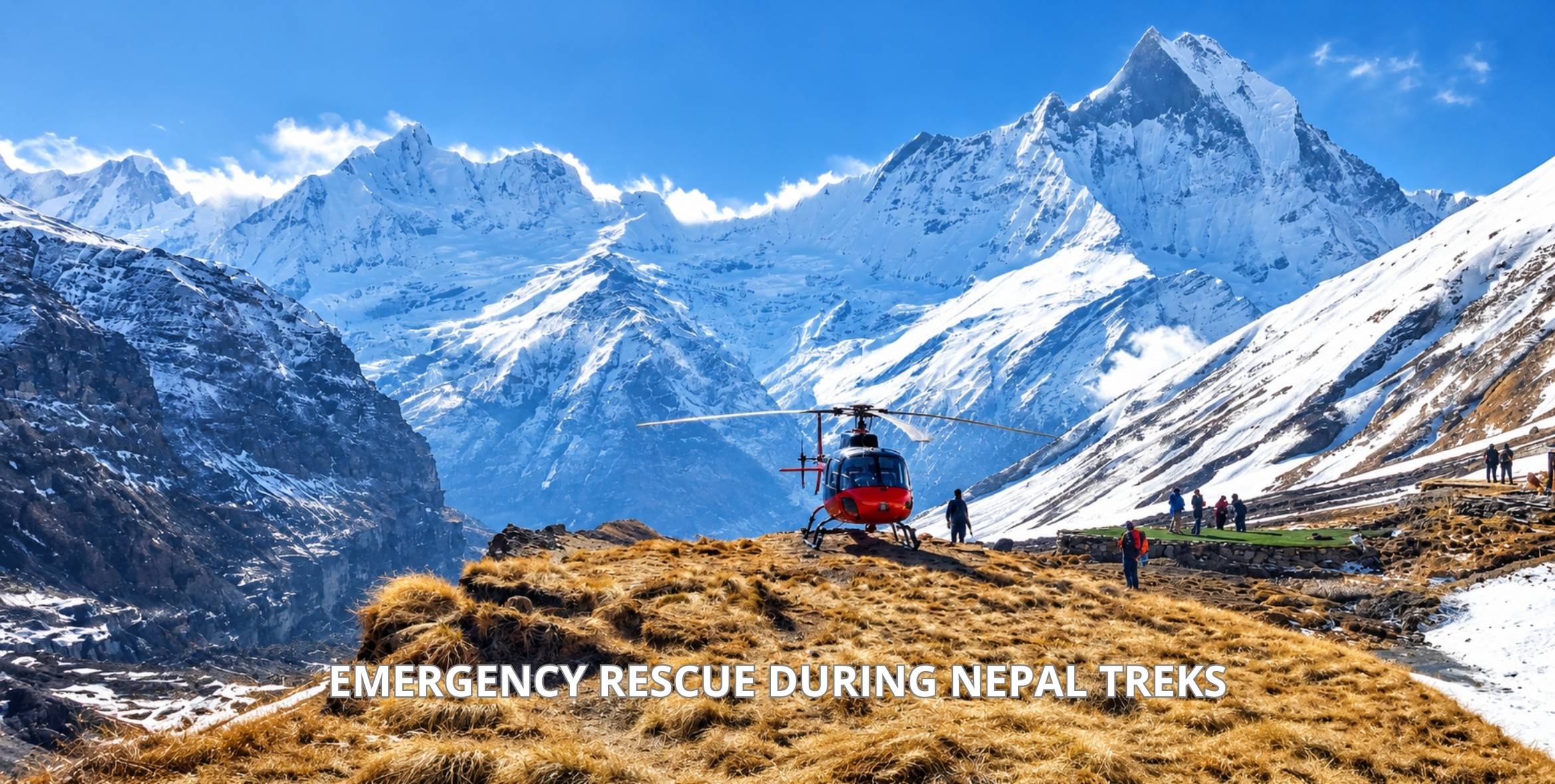
We never know what will happen in the Himalayas, as mountain weather is unpredictable and can change at any time. Emergency rescue is essential support for dealing with health issues, injuries, altitude sickness, or unexpected situations in remote mountain areas. Because most trekking routes are far from roads and medical facilities, helicopter rescue can get you to medical care faster when evacuation is necessary.
Our helicopter rescue services cover major trekking areas including Gorakshep, Langtang Valley, Manaslu, Annapurna Base Camp, and Manang. The service is especially important on high-altitude and remote sections. The availability of helicopter evacuation depends on the location and weather conditions. A helicopter can evacuate trekkers from the route and take them to a suitable medical facility for further treatment.
The Annapurna Region of Nepal, often known as a trekker’s heaven, offers many stunning hiking opportunities. This region is home to some of the most well-known treks in the world, including the Annapurna Base Camp Trek and the Annapurna Circuit Trek. The ABC Helicopter Rescue is mostly involved in these two locations. There are still lots of trekking choices available to you; those are the only two hikes. Trekking these routes is a popular way for people to enjoy the unadulterated beauty and adventure of the area.
In addition, the region is home to several of the highest mountains in the world, including Machhapuchhre, Dhaulagiri, Gangapurna, and Annapurna I.
Many travelers travel to this area to glimpse these peaks. Similarly, nothing compares to the area’s native flora and scenery. Richly verdant forests, endless rivers and streams, immaculate lakes, and profound valleys are all present. If you describe what it’s like to meander around the Annapurna Region, It will require some time. Each of the Annapurna Region Treks is remarkable, stunning, and captivating because of all these events.
However, trekking in the Annapurna Region is more difficult than you may imagine. Trekking in this area presents challenges like high altitude, steep terrain, severe weather, and more. Suppose you are trekking the Annapurna Circuit.
This is a strenuous hike that requires walking a minimum of 160 to 230 kilometers. You will ascend to extremely high heights along the trek, such as Thorong La Pass (5,416m). The terrain is steep and rugged as it continues, making hiking more difficult. You have to deal with mountain sickness in these circumstances. Avoiding contracting the sickness will be your top priority.
If you are trekking in the Annapurna Region, you might require a helicopter rescue! Yes, what you just read is true. Let’s talk about why Annapurna rehabilitation is necessary for you.
On treks, you never know when you can get altitude sickness or other mishaps. That’s why Himalayan Guide Nepal was founded to support you in times like these. You’ll need an immediate rescue under these conditions, and our secure helicopter rescue is here to assist.
Our aircraft team will respond to your rescue call as soon as possible using one of our helicopters to assist you in getting to a safer location.
Helicopter Rescue from ABC Package Includes
Services for Helicopter Evacuations
Various helicopter companies/agencies offer rescue services to suffering climbers and trekkers in the Annapurna base camp trek and other nearby peaks. These services typically entail the deployment of helicopters that are prepared for high-altitude operations, along with skilled pilots who are knowledgeable about the local weather and topography.
Accord with Authorities and Advisors
Coordination between the individuals in trouble, local authorities, and helicopter groups is necessary for helicopter rescues. In the course of rescue operations, guides and Sherpas who accompany climbers frequently serve a crucial role in easing communication and logistics.
Insurance and Cost
Helicopter rescues from remote alpine locations such as Annapurna are frequently quite costly, often involving large amounts of money. Climbers and hikers must have appropriate travel insurance that covers rescue operations and emergency clinical evacuation.
Are you considering hiking to the base of Everest but are worried about the difficulties and dangers? You can experience your adventure with safety and peace of mind when you purchase our “Helicopter Rescue from Gorakshep” package.
The closest stop to Everest Base Camp is Gorakshep or Gorak Shep, which is a famous stop in the Everest region. Unlike other communities in the Everest Region, Gorakshep is a unique settlement rising to a height of 5,154 meters. It resembles a seasonal village, with residents only settling during tolerable seasons like spring and autumn. Due to the intense rain and snowfall, rural life can be particularly challenging during the monsoon and winter. For this reason, the village has more inhabitants during the fall and spring, and fewer during the other seasons.
There are a good number of teahouses along the Everest Base Camp Trek route. These teahouses, or lodges, are managed by locals, mostly Sherpas, who supply food and accommodation to trekkers at Everest Base Camp. Trekkers from Lukla, Namche Bazaar, Tengboche, Pangboche, Dingboche, and Lobuche hike all the way to Gorakshep. The settlement is two to three hours distant from the Everest Base Camp.
Gorakshep is the final destination to reach if they choose to visit Kala Patthar (5,550 m) or any other nearby mountain passes. It is well-known for serving as a rest stop for climbers and descenders of Everest Base Camp. Since Gorakshep is a small settlement, there are basic accommodation options. Most lodges run on solar power, and internet access is also limited. You can take a comfortable break here, whether you are heading toward the base camp or retreating.
But Gorakshep is not an ideal place to be for those prone to altitude sickness. At a height of more than 5000 meters, this village’s oxygen content is significantly lower. Anybody trekking from the lower region is susceptible to the illness’s symptoms. In particular, inexperienced hikers are more susceptible to the sickness than seasoned ones. It is best to receive medical attention as soon as possible in the lower region if a person experiences any altitude-related illness.
A swift helicopter rescue is the only course of action in such a circumstance to provide immediate medical assistance. This is where our Helicopter Rescue from Gorakshep provides a life-saving evacuation. It is possible to do it from Gorakshep, as helicopters regularly land and operate from here.
A great hike for those who are a little pressed for time or uneasy about embarking on one of our longer, higher-altitude trips. Even though it is shorter, the Langtang trip offers breathtaking landscapes and an intriguing culture that encapsulates the essence of hiking in the Himalayas.
From the Kathmandu Valley, this hike in the breathtaking Langtang Valley is the closest you can go to the enormous snow-capped mountains. The northern edge of Kathmandu, near the Tibetan border, is where the Langtang Valley begins. Langtang Lirung, the tallest peak in the region at 7,246 meters, dominates the valley. With some of the most breathtaking landscapes in the entire nation, this is an excellent beginning to trekking in Nepal.
Langtang, a region of Nepal in the Himalayas, borders Tibet and is situated north of the Kathmandu Valley. Additionally, Himalaya Guide Nepal offers helicopter rescue services from the Langtang Valley.
The Langtang National Park is located in this area. About 4,500 people live in the park, and many more depend on it for wood and firewood. Tamang people make up the majority of the population.
Hindus consider the Gosainkunda Lakes in the park to be sacred. In this area, August is the most popular month for pilgrimages. Kyanjin Gompa’s Buddhist monastery is yet another place of worship. Hiking, climbing, and white water rafting are popular tourist activities.
Trekking in the Langtang Valley is a fantastic option for experiencing high-mountain pastures, peak climbing, and breathtaking glacier views. Numerous sacred mountain lakes in the Gosainkunda region provide breathtaking views of the surrounding mountains and the lakeshore. Altitude sickness and other mountain illnesses also afflict a lot of hikers.
We can help you quickly and are simply a phone call away. We’ll finish our objective in under three hours. We will remove you from the situation and take them to the hospital as soon as we receive your permission. After evaluating the patient’s condition, we will select the best hospital. In the event of an emergency, we will promptly land our helicopter at the hospital to deliver prompt medical attention.
In the Langtang Region, we have enumerated several locations that are frequently utilized for rescue operations. Please take a look at these locations as they may be of assistance to you in an emergency.
Our Helicopter Rescue from Langtang Valley Package Includes
Emergency Evacuation Service:
In the time of altitude sickness, injury, or any other emergency, our dedicated helicopter rescue team will be at your service. Equipped with experience, our pilots and rescue personnel swiftly airlift you to the nearest medical facility for prompt treatment.
24/7 Services:
Our rescue team is available round-the-clock to respond to any emergencies or concerns you may have during your trek. Whether it’s monitoring your health, providing medical advice, or coordinating helicopter rescue operations, we’re here to ensure your safety every step of the way.
Insurance Protection:
Our Helicopter Rescue includes full insurance coverage for emergency evacuations and medical expenses. With our insurance policy, you can trek with confidence, knowing that you’re financially protected in case of unforeseen emergencies.
Experienced and Excellent Guides:
Our team of experienced, excellent guides actively recognizes the early signs of altitude sickness and other health issues. They’ll closely monitor your well-being throughout the trek and guide acclimatization, hydration, and safety protocols to minimize the risk of altitude-related illnesses.
Helicopter rescue from Manang, Nepal, is not uncommon, particularly within the context of trekkers and climbers going through altitude sickness, accidents, or different emergencies within the place.
Manang is a popular stopover for trekkers at the Annapurna Circuit, which is thought of for its beautiful landscapes however additionally for its tough terrain and high altitudes.
Helicopter rescues from Manang are commonly coordinated through nearby government, trekking groups, or rescue companies such as the Himalayan Rescue Association. When a rescue is necessary, a helicopter is dispatched to airlift the man or woman in want of assistance to a clinical facility or a safer area wherein they could acquire proper remedy.
These rescues are frequently tough because of the high altitudes and unpredictable climate situations in the Himalayan Region. Pilots should have sizeable skill and experience to navigate the mountainous terrain and properly execute the rescue operation.
The fee of a helicopter rescue in Nepal may be quite high, and it’s typically the responsibility of the person or their travel insurance to cover the costs. However, in some cases, rescue companies or the Nepali authorities may additionally offer assistance or subsidies to individuals in need.
It’s vital for trekkers and climbers journeying Manang and other remote areas in Nepal to be accurately organized and to have travel insurance that covers emergency clinical evacuation, including helicopter rescues, to make certain they can get hold of well-timed help if needed.
How Will a Helicopter Rescue Mission From Manang Carry Out
Prioritizing rescuing a group of hikers exposed on a trail without a permanent shelter, the rescue team moved to the rescuer. It carried out in-extremis planning with the Rescuer.
Using satellite communication gear that was previously provided, the rescuer will stay in regular communication with the exposed tourists. An emergency doctor was included in the planning and communication process to monitor their status and offer direction to the tourists while the rescue team planned a helicopter evacuation.
The first response rescue team set up shop in Manang, kept an eye on the weather from the ground, and helped arrange for the group’s entire helicopter extraction when there was a window of opportunity for the weather.
Challenges Faced by the Rescuers impactung Helicopter Rescue From Manang
Hundreds of travelers are impacted at the same time and location by natural catastrophes and extreme weather. The infrastructure for transportation, communications, and the availability of rescue personnel are all severely strained by this.
Nepal’s weather is very dynamic and subject to sudden changes for the better or worse.
Because of its isolated location, the Manang region of Nepal can only be reached quickly by rotary-wing aircraft, leaving passengers vulnerable to severe weather.
Securing helicopter transportation for large-scale events can be difficult due to its average payload limit of 4–6 passengers, potential financial limits, and movement restrictions caused by fuel limitations.
At 8,163 meters (26,781 feet) above sea level, Manaslu is the eighth-highest peak in the world. It is situated in the Mansiri Himal, in the west-central region of Nepal, which is a component of the Nepalese Himalayas. The Sanskrit word Manasa, which means “intelligence” or “soul,” is the source of the name, which translates to “mountain of the soul.”The highest peak in the Gorkha District, Manaslu, is situated roughly 40 miles (64 km) east of Annapurna. From a distance, the mountain’s broad ridges and valley glaciers offer accessible routes in all directions, culminating in a summit that dominates the surrounding terrain and rises sharply to a summit that towers over it. Key information about helicopter rescue from the Manaslu package is provided here.
The Manaslu region offers many different options for trekking. The favorite Manaslu Circuit Trek course of 177 km (110 mi), skirts the Manaslu massif over the pass down to Annapurna. The Nepalese Government allowed trekking of the circuit only. The trail follows an early route across the Burhi Gandak River. En route, 10 peaks over 6,500 meters (21,300 ft) are visible, including a few over 7,000 meters (23,000 feet ). The maximum point reached along the trek route is the Larkya La at an altitude of 5,106 meters (16,752 feet ). As of May 2008, 297 times have been climbed.
The goal of the Manaslu Conservation Area’s establishment was to accomplish conservation and sustainable management. By the National Parks and Wildlife Conservation Act, the MCA declared itself to be such in December 1998, incorporating Manaslu inside. Trekkers refer to the mountain as Manaslu Himal since it allows for contact and offers vistas of the Himalayan highlands. The path is vulnerable to the effects of landfalls, monsoon rains, and landslides. It’s common to come across yaks, altitude sickness, and fatal hypothermia.
Many hikers become incapacitated due to altitude sickness or mountain sickness; yet, help is just a phone call away. We shall begin our task and bring a patient in less than three hours. We will relocate and acknowledge the patient as soon as we have permission to save them. After assessing the patient’s condition, we will select the appropriate hospital. We will quickly land a helicopter in the hospital so that we may begin treating patients. when a crisis occurs.
Important Info about Helicopter Rescue from Manaslu
Helicopter rescues from Manaslu, the 8th highest mountain in the world located in the Nepalese Himalayas, are regularly crucial due to the intense altitudes and treacherous situations that climbers and trekkers face. Here are a few critical points regarding helicopter rescues from Manaslu:
Altitude and Weather Challenges:
Manaslu reaches an elevation of 8,163 meters (26,781 feet), and the weather situations can change hastily, with excessive winds, snowstorms, and coffee visibility being not unusual. These factors could make it challenging for climbers and trekkers to securely descend in case of emergency.
Risk of Altitude Sickness and Injuries:
Altitude sickness, frostbite, exhaustion, and accidents are commonplace risks for the ones attempting to climb or trek around Manaslu. These conditions can become worse unexpectedly, necessitating prompt scientific attention and evacuation.
Helicopter Evacuation Services:
Several helicopter corporations in Nepal provide rescue services for climbers and trekkers in misery on Manaslu and different peaks in the vicinity. These services usually involve deploying helicopters ready for high-altitude operations and experienced pilots familiar with the terrain and weather patterns.
Coordination with Authorities and Guides:
Helicopter rescues require coordination among the distressed people, neighborhood authorities, trekking corporations, and helicopter organizations. Guides and Sherpas accompanying climbers often play an essential function in facilitating communique and logistics in the course of rescue operations.
Cost and Insurance: Helicopter rescues from faraway mountain places like Manaslu can be expensive, regularly costing heaps of bucks. Climbers and trekkers need to have suitable journey insurance protecting emergency clinical evacuation and rescue operations.
View Trip Detail
When Do You Need Emergency Rescue on a Trek in Nepal?
Emergency rescue is needed when a trekker faces serious issues, suffers an accident, or when continuing the trek is unsafe. It is also needed when immediate medical care is required, and the location is remote or hard to reach.
Severe Altitude Sickness
Altitude sickness is a major issue on any trekking route. It has many stages, starting from AMS and progressing to HACE and HAPE, which can be life-threatening. Emergency evacuation may be required when there are signs of HACE and HAPE such as:
Difficulty breathing, especially at rest.
Severe headache.
Confusion or unusual behavior.
Loss of coordination or difficulty walking.
Persistent vomiting or extreme weakness.
Loss of consciousness.
Serious Injuries or Accidents
While on the trek, accidents can happen on steep, rocky, icy, or slippery sections of a walkway. Helicopter rescue may be necessary when an injury is too serious to manage locally, or the trekker can’t be safely moved on foot.
Major fractures or suspected spinal injuries.
Serious head injuries.
Deep wounds or heavy bleeding.
Severe sprains or injuries that prevent walking.
Injuries caused by falls, rockfalls, or other trail accidents.
Severe Illness or Medical Complications
A sudden illness or medical complications can make it unsafe to continue trekking, especially in remote and high-altitude areas where immediate medical facilities may not be available.
Severe chest pain or breathing problems.
Serious dehydration or continuous vomiting.
Sudden loss of consciousness.
Severe infection or high fever.
Extreme Weather and Natural Hazards
The mountain can sometimes become harsh without any warnings, and sometimes it can be dangerous or impossible to continue walking or reach a safe area. In such situations, rescue is necessary and considered depending on the severity of the circumstances.
Heavy snowfall or blizzards blocking the trail.
Landslides or rockfalls cutting off the route.
Avalanches or avalanche risks.
Storms and extremely poor visibility.
Flooding or route damage caused by heavy rainfall.
How Does Helicopter Rescue Work in Nepal?
The helicopter rescue process usually involves reporting the emergency, assessing the trekker’s medical condition, coordinating the flight, evacuating the patient, and completing the necessary insurance and medical documentation. However, the exact procedure can vary depending on the trekking region, weather, medical condition, and accessibility. Yet, the general process works as follows:
Step 1: Report the Emergency
The first step is to report the emergency as soon as a trekker becomes seriously ill or injured. If you are trekking with a guide, inform your guide immediately. The guide can assess the situation, communicate with the trekking agency, and coordinate with the appropriate rescue or medical support. If the situation is difficult, the trekking agency or guide may contact a helicopter operator, rescue coordinator, insurance assistance provider, or other appropriate emergency support.
Step 2: Medical Assessment
After the emergency is reported, the trekker’s condition is assessed to determine whether helicopter evacuation is actually necessary. The assessment generally considers the severity of the illness or injury, altitude, symptoms, ability to walk or descend safely, available medical facilities, and the risk of remaining at the current location.
Step 3: Rescue Coordination
Once evacuation is considered necessary, the rescue operation must be coordinated. This is particularly important in Nepal’s mountainous areas because helicopters cannot simply land at every trekking location. The rescue team needs to consider several factors, including:
Helicopter availability
Weather conditions
Landing conditions
Location and altitude
Local coordination
Step 4: Evacuation to a Suitable Medical Facility
Once the helicopter reaches the evacuation location and the trekker is safely evacuated, the patient is taken to an appropriate medical facility based on the circumstances. For some emergencies, the trekker may first be taken to the nearest accessible health facility for initial treatment. More serious cases may require transfer to a larger hospital or medical center, including facilities in Kathmandu.
Step 5: Insurance and Documentation
The rescue process does not necessarily end once the trekker reaches a hospital. There may also be important insurance and administrative requirements. If the trekker has travel insurance that covers emergency medical evacuation, the insurer or its assistance provider may need information about the incident and evacuation.
Trekkers should also review their insurance policy before starting a trek, especially for helicopter evacuation, high-altitude trekking, maximum altitude limits, medical treatment, and exclusions. Having travel insurance does not automatically mean every rescue will be covered.
Frequently Asked Questions About Emergency Rescue in Nepal
How do I request a helicopter rescue in Nepal?
To request a helicopter rescue in Nepal, first inform your trekking guide, trekking agency, or local rescue contact about the emergency and your exact location. If you have travel insurance with helicopter evacuation coverage, contact your insurer or assistance company as soon as possible.
How much does helicopter rescue cost in Nepal?
A helicopter rescue in Nepal costs between USD 3,000 and USD 10,000 per mission, depending on the location, altitude, distance, weather, and rescue requirements. For lower trekking areas, rescue costs range from USD 3,000 to USD 5,000. For high-altitude areas like Gorakshep, it ranges from USD 6,000 to USD 8,000–10,000+
Does travel insurance cover helicopter evacuation in Nepal?
Yes, travel insurance can cover helicopter evacuation in Nepal if your policy specifically includes medically necessary emergency evacuation and covers trekking at the altitude of your route.
How long does helicopter rescue take in Nepal?
A helicopter rescue in Nepal generally takes 1 to 3 hours, depending on your location, weather, helicopter availability, and the time needed to arrange the evacuation.
Can helicopters rescue trekkers from high altitudes?
Yes, helicopters can rescue trekkers from high altitudes, including remote trekking routes where road access is unavailable. But the rescue depends on weather conditions, helicopter capability, altitude, and landing conditions.
What happens if weather prevents helicopter rescue?
If weather prevents helicopter rescue, the mission is delayed until conditions become safe. During the wait, the trekking guide will help keep the trekkers safe and monitor their condition.
This site uses cookies to optimize your user experience. By using this site, you are consenting to our use of these cookies. Check out our Privacy Policy.
Chat with our travel expert
Please fill out the form below to initiate a chat on WhatsApp and resolve your queries quickly.