
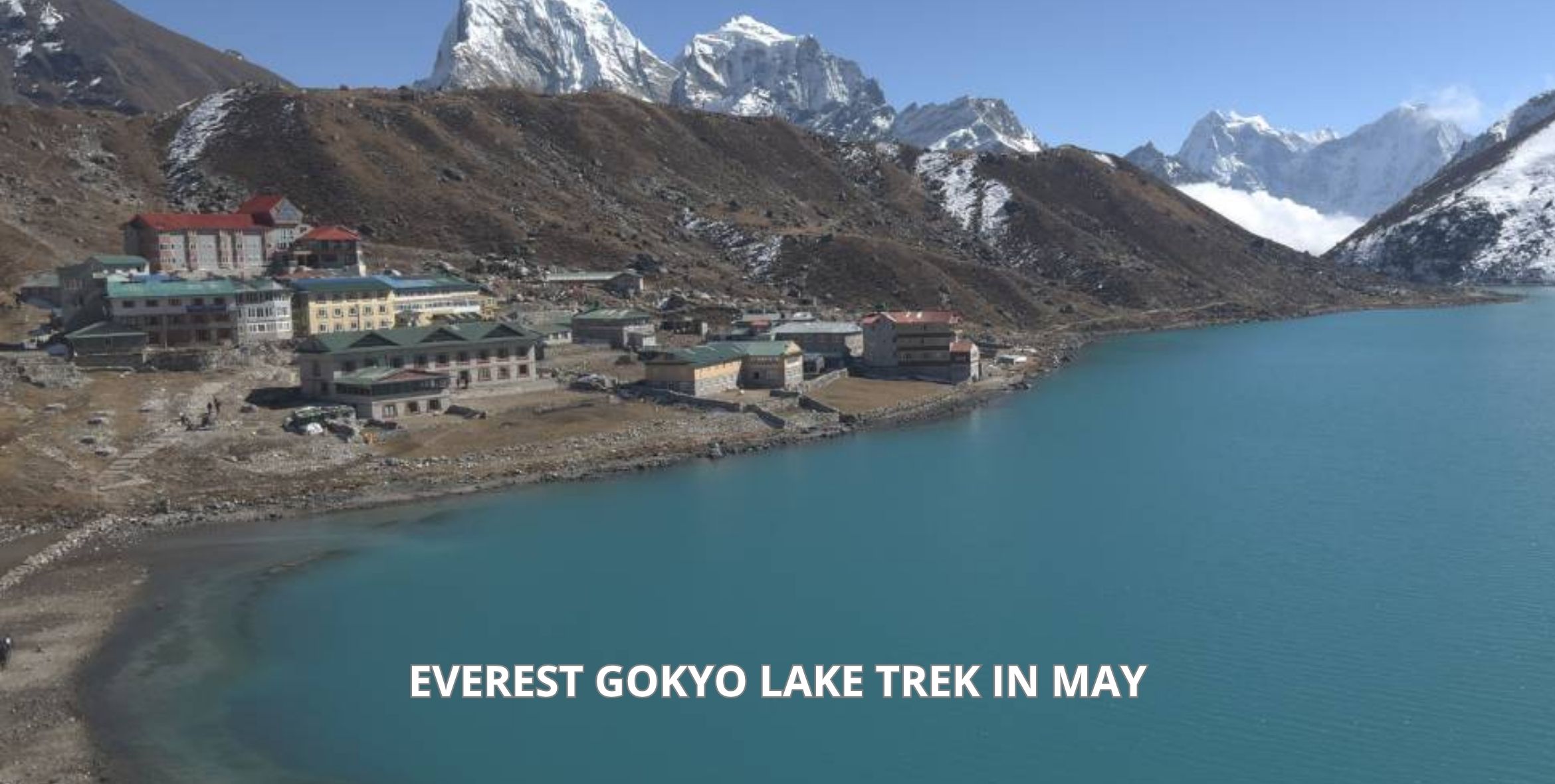
Of course, May is one of the best months to travel to Gokyo Lakes as there will be no snow on the trail, warm weather will allow enjoying long daylight hours. Nevertheless, May is a month of the cloudy sky and pre-monsoon showers, which come at the end of this month. You should start your hiking very early in the morning, and even earlier in the month if possible.
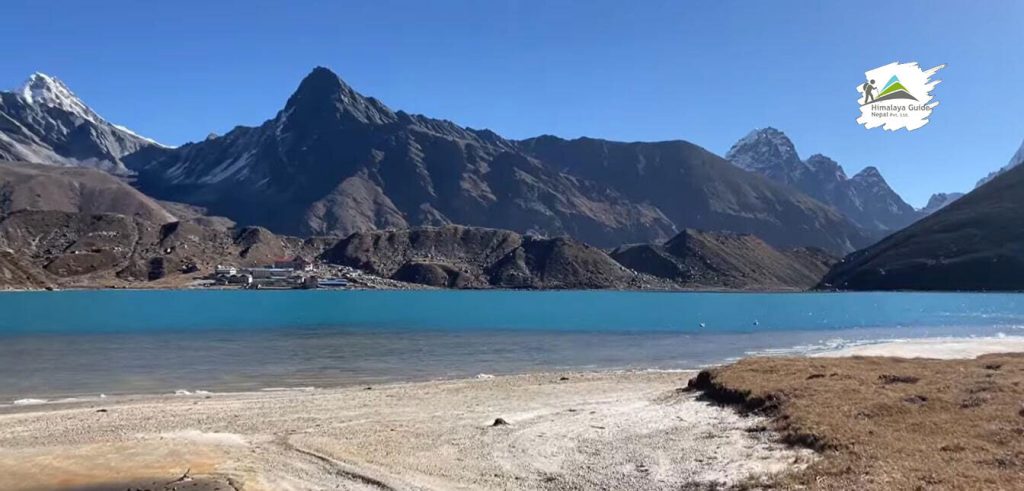
You have surely seen some pictures. Milky blue water of the lake, stone village on the shore of the lake, and majestic Everest rising above the ice ridge behind the village. Now the main question. Is it really so in May?
Frankly speaking, it usually is. However, the month of May has some peculiarities that are not mentioned by Instagram bloggers. There are clouds during the afternoon, and starting hiking to Gokyo Ri in the morning hours will be necessary.
We cover everything in this itinerary. Climate week by week, actual temperature, number of trekkers, Ramechhap flight, 12 days route crossing Renjo La, permit, and cost. It was compiled by those who tread this path every year, so you will get the nuts and bolts of the trip, not what is in your brochure.
Need date and costs for your trek group right away? Then look up our Everest Gokyo Ri Trek package on this web-site and discuss this May trek with our team via WhatsApp.
Is May a Good Time for the Gokyo Lakes Trek?
May comes at the end of spring, which is the second major season for trekking in Nepal. Spring lasts from March to May, while autumn stretches from September to November. Both periods suit trekking since there is no monsoon and the roads remain dry and flight services are more frequent.
However, what makes May better than April or October? The following is a comparative analysis of the three months on various considerations.
| Month | Daytime feel | Night at Gokyo | Morning views | Afternoon cloud | Trail busyness |
|---|---|---|---|---|---|
| April | Cool to mild | Very cold | Very clear | Some | Busy |
| May | Warm in valleys | Cold, below freezing | Clear | Common after 11am | Busy in Namche, quieter on Gokyo side |
| October | Mild | Very cold | Clearest of the year | Rare | Busiest |
As you can see, May trades a bit of afternoon visibility for warmer days. For many first-timers that’s a fair deal. You sweat less over the cold, you sleep a little better, and the lower trail is full of colour.
The honest downside is rain risk at the very end of the month. We’ll get to that next, because timing inside May makes a real difference.
Gokyo Weather in May: Early, Mid and Late May
Early May (1 to 10 May)
This is the ideal time. The morning sky is an intense and harsh blue color, while the winds remain relatively gentle. Most of the snow from winter has already melted off from the path to Dole to Gokyo.
Evening temperatures remain cold around the lake, and hence, you will require your down jacket during dinner. However, by 9am, the sun’s rays hit the rocky walls of the lodge, and you can sit outside enjoying your cup of tea.
Mid-May (11 to 20 May)
Temperatures rise. The valleys around Namche become slightly foggy because of the combination of heat and dust blown in from the plains. Cloud formation starts taking place earlier, usually by 10 or 11am.
Therefore, the mornings become crucial now. You will be walking with the mountains clearly visible during the morning if you leave the lodge at 7am. You may only have a view of the mountains partially if you leave at 9.30am.
Late May (21 to 31 May)
This is when you really need to think ahead. The official start of the monsoon season in Nepal is 13 June, but it does not always adhere to this schedule. The monsoon season started in eastern Nepal on 29 May in 2025, according to the Department of Hydrology and Meteorology. The Everest region is located in this eastern area.
This does not mean daily rain. This means afternoon showers will be common, and flight delays will be more likely. Take a light rain jacket, give yourself an extra day, and you will still have a good trek. Many of our trekkers trek in late May and come back satisfied, just a little wetter.
Gokyo Temperatures in May Based on Altitude Changes
The temperature during this expedition is based on altitude rather than the season. Your starting point is the pine forest at 2,600 meters above sea level and you end at an altitude above 5,300 meters.
These are the average temperatures experienced during May that our guides know about on the trail. Use them when packing, but don’t count on them.
| Place | Altitude | Daytime | Night |
|---|---|---|---|
| Lukla / Phakding | 2,610 to 2,860 m | 15 to 20°C | 5 to 8°C |
| Namche Bazaar | 3,440 m | 10 to 16°C | 0 to 4°C |
| Dole | 4,110 m | 8 to 13°C | -2 to 2°C |
| Machhermo | 4,480 m | 6 to 11°C | -4 to 0°C |
| Gokyo | 4,790 m | 4 to 10°C | -8 to -3°C |
| Gokyo Ri summit (dawn) | 5,357 m | -10 to -5°C with wind | n/a |
Take note of the difference between day and night at Gokyo go out wearing a T-shirt during the afternoon sun but require some gloves when it’s 6pm. This explains why layering clothes is better than carrying just one thick coat.
The lowest temperature felt all throughout the entire trip is on the morning ascent of Gokyo Ri. Although the wind chills down the experience at the peak, you’ll still be back at the restaurant in your lodge with a lemon by 9am.
Mountain Views in May
And here is the important point that no one explains to novices. During May, the mountains are of the mornings. By around 11am, the white clouds form from the valley to cover the major summits.
And thus, our schedule revolves around it. On most trekking days, you will be on your way at around 7am or 7.30am. On the day to Gokyo Ri, however, you will climb to the summit at dawn under a torchlight.
What you actually see from Gokyo Ri
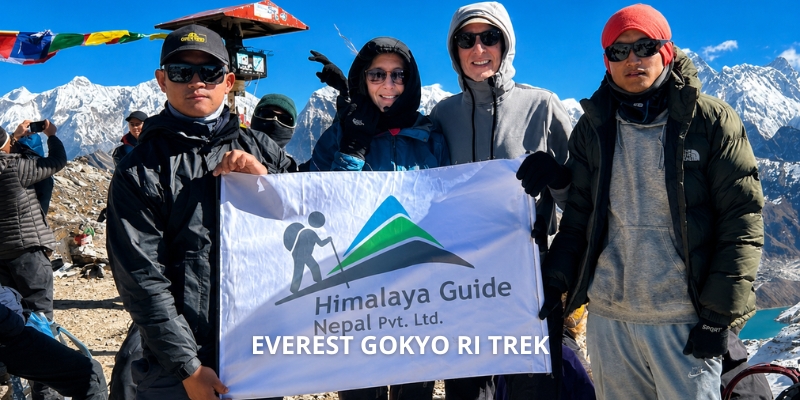
On one side, there are four of the eight thousand meter mountains of the world in front of you. Everest, Lhotse, Makalu, and Cho Oyu. Beneath them are the grey debris of the Ngozumpa Glacier stretching all the way through, and the blue dots of the Gokyo Lakes.
There isn’t another spot where one gets a view of the Everest mountain and the entire series of sacred glacial lakes on the same rock formation as Gokyo Ri. Though Kala Patthar is near Everest, its view is much restricted in comparison.
Why afternoon cloud is not all bad
Cloud makes it cooler during your afternoon stroll. Cloud even makes the sunsets over the lakes mellow and moody as it breaks through. Most of our best pictures taken in May have been taken at 5pm when the cloud rips open for ten minutes over Cho Oyu.
How Busy Is the Everest Gokyo Trail in May?
May is the month when mountaineering expeditions to Everest happen. Expeditions, yaks and porters with supplies go through Lukla and Namche, so for the first three days of your trekking journey you will have to deal with crowds, especially in Namche Bazaar.
But from day five there is a change. Right after Sanasa the path forks; one of the branches leads to Everest Base Camp which is common point in EBC Trek as well, while you will follow the left one, heading to Dole and Gokyo Valley, where there will be fewer people.
Gokyo is visited by several thousand trekkers annually, unlike tens of thousands of tourists on the base camp route. You will still have to share the lodges with other trekkers in May, but you will not have to wait in a queue on a narrow path among fifty people, as it happens on the base camp route in high seasons.
In addition, quiet path will give you friendly lodges. Owners will have time to talk to you, and you will have a company around the yak dung stove every night.
Getting to Lukla in May Through The Ramechhap Flight
This comes as a shock to many. In May, the flight to Lukla does not take off from Kathmandu. Instead, the flight takes off from Manthali Airport, Ramechhap, an airstrip located east of the city.
Since 2019, Nepal’s aviation authority has been shifting the peak season flights to Lukla to Ramechhap. The reason is very obvious. The sole runway at Kathmandu is always congested with international and domestic flights.
What the Ramechhap day looks like
After that, we set out from our Kathmandu hotel at about 2:00 or 3:00 AM. It is approximately a four or five-hour drive through a mountainous terrain. The flight to Lukla then follows suit and lasts about 15 or 20 minutes as it approaches a famous runway.
It will surely be a very long day ahead of us! So, don’t forget to prepare your neck pillow, snacks, and some shut-eye during the travel in the car. Ask about whether the transfer in Ramechhap is already included in the package cost.
Why you need a buffer day
Flights to Lukla rely on good weather conditions at both places. During late May, early morning clouds and rains might force planes to be grounded for several hours or even an entire day. It would be advisable to include some extra days at the end of the trek to account for possible delays.
Our 12-Day Everest Gokyo Lake Trek Route in May
The trek takes us up the Dudh Koshi valley to the lakes and then back over the Renjo La pass. This makes the trek a loop because we never walk the same trail twice from Namche onwards, unlike most May blogs or package trips that go up and down the same route.
| Day | Route | End altitude | Walking time | Distance |
|---|---|---|---|---|
| 1 | Arrive in Kathmandu | 1,350 m | n/a | n/a |
| 2 | Fly to Lukla, trek to Phakding | 2,610 m | 3 to 4 hrs | 8 km |
| 3 | Phakding to Namche Bazaar | 3,440 m | 6 to 7 hrs | 10.9 km |
| 4 | Acclimatization day in Namche | 3,440 m | Short hike | Optional |
| 5 | Namche to Dole | 4,110 m | 6 to 7 hrs | 11 km |
| 6 | Dole to Machhermo | 4,480 m | 3 to 4 hrs | 6 km |
| 7 | Machhermo to Gokyo | 4,790 m | 4 to 5 hrs | 6.8 km |
| 8 | Gokyo Ri sunrise and lakes | 5,357 m | Early start | Round trip |
| 9 | Gokyo to Lumde via Renjo La | 4,368 m | 6 to 7 hrs | About 11 km |
| 10 | Lumde to Namche via Thame | 3,440 m | 5 to 7 hrs | Mostly downhill |
| 11 | Namche to Lukla | 2,860 m | 6 to 7 hrs | 13.5 km |
| 12 | Fly back to Kathmandu | 1,350 m | Short flight | n/a |
In May, days 2 and 3 are flower days. You go over some of the most beautiful swinging suspension bridges crossing the milky Dudh Koshi river, surrounded by rhododendrons that hang over the path. The day 3 is concluded with the long ascent to Namche, and yeah, your legs feel it for sure.
Day 4 is no rest day. You ascend to around 3,880 m in Everest View zone and return in order to sleep. Climb high, sleep low. This is the one thing that you should do if you want your body to be ready for Dole.
From day 6 walking days start to become shorter intentionally. You gain altitude so everything starts slowing down for you. In day 7, you reach Gokyo, drop your backpack and start going towards the third lake. Usually, you simply stand there silently.
Crossing Renjo La Pass in May
Renjo La is situated at 5,360m altitude, almost as high as Gokyo Ri. This is the toughest day of the trek. You hike for approximately 3 hours from Gokyo to Renjo La via a rocky trail, and then descend for several hours along a steep path towards Lumde.
So what makes you take such a tough route? The answer is simple – the view back from the top of Renjo La is one of the most spectacular in the Everest region. You see everything around you – the entire Gokyo Lake, the Ngozumpa Glacier, and Everest towering above it all. Moreover, you descend into the secluded Bhote Koshi valley visited by few trekkers.
Why May is a good month for the pass
May usually has the least snow on Renjo La of the whole spring. In March, snow can make the descent slippery and slow. By May, most of it has melted, so the trail is rock and dirt.
The May rule for Renjo La
Depart early. We depart from Gokyo before dawn, and therefore you get to the summit when the sky is still clear. In case it is not safe to cross due to cloud or heavy snow, your guide may choose to come back the same way via Dole.
It’s going to be a tiring day, but you will feel like royalty once you reach the lodge in Lumde. Hot dal bhat, extra, and bed early.
Altitude Sickness on the Gokyo Trek
Here is the harsh truth: Gokyo is at 4,790 meters. This is higher than any mountain range in the Alps. Almost all the people feel something because of the altitude; they get headaches and bad sleep on the first night.
And here comes the positive part: we have a special route for you. It will include staying in Namche for two nights and going up the mountains very gradually.
A May trap most people fall into
Warm May days make people walk too fast and drink too little. You feel strong in the sun, so you push. Then the headache hits at dinner. Walk slower than you think you need to, and drink 3 to 4 litres of water a day.
When to go down
Headaches and fatigue are expected, but not a headache which won’t stop, vomiting, dizziness or inability to walk straight. The cure here is to descend even at 300 to 500 meters as it will make a great difference. Your licensed guide will always have a first aid kit and check on you daily at evenings. Consult with your doctor regarding the use of Diamox.
Teahouses and Food in May
All teahouses along the Gokyo trek route are operational in May. You will be sleeping in simple twin rooms that have a mattress, pillow, and blanket. The walls are made of thin plywood, hence the need to carry earplugs.
There is no heating in the rooms. The only heated room is the dining hall, where there is a fire burning from the stove and everybody gathers around. It is here that you will be playing cards, drying your socks and telling stories.
The food is better than you may have thought. Dal bhat is your best friend since you can have unlimited supplies of rice and lentils for free. Other foods include noodle soup, fried rice, Sherpa stew, momos, and apple pie. All three meals a day are included in our package.
A few things are not included in the cost of the tour. Wi-Fi, phone charging and hot showers each costs a few hundred rupees and the cost increases as you go higher. Gokyo has hot showers and that is luxury on day seven.
Permits and Cost for a May Gokyo Trek
Two permits are required to visit the Gokyo lakes. The Sagarmatha National Park permit costs NPR 3,000 for foreigners. The other one is the Khumbu Pasang Lhamu Rural Municipality Permit which is paid at Lukla or Monjo. No TIMS card is required for Everest Region.
The best part is that both permits are inclusive of our package which includes Lukla flights, guide services, hotels and all treks meals. Below is our current rate per person.
| Group size | Price per person |
|---|---|
| 1 person | USD 1,545 |
| 2 to 4 people | USD 1,325 |
| 5 to 7 people | USD 1,245 |
| 8 to 10 people | USD 1,195 |
| 11 or more | USD 1,050 |
It goes without saying that by traveling in company, you will save a fair share of money. You can save more than USD 200 per person compared to traveling alone. May is high season, which means all flights and accommodations get booked. Plan ahead of time, two or three months prior to travel date.
Add some money for meals, refreshments, power, showers, travel insurance, and tips. Extra charges of about USD 15 – 25 per day are usually incurred by trekkers.
What to Pack for Gokyo in May
Packing for May is somewhat challenging. One requires equipment that will be suitable for both a warm hike through the forest and a very cold ascent to the peak. And flights from Lukla have a baggage allowance of only 15 kg.
We give you a down jacket and a sleeping bag for the trek, so leave those at home. Here’s what else matters most in May:
- A light waterproof shell or poncho, especially for late May showers
- A sun hat, SPF 50 sunscreen and good sunglasses for the glare at Gokyo Ri
- A warm hat, gloves and a fleece for nights and the dawn summit
- Two quick-dry T-shirts for hot afternoons below Namche
- Broken-in trekking boots, not new ones
- A headlamp for the 4am Gokyo Ri start
- Energy bars and dried fruit, because snacks are pricey up high
- Water purification tablets and a reusable bottle
Pack in a soft duffel, not a hard suitcase. Your porter or the yaks will thank you.
Tips for Trekking to Gokyo in May
Below are the little hints that the guides advise to everyone trekking in May. All these points may seem to be trivial, but in reality, they really matter.
Firstly, choose early May if possible, because that time provides clear weather conditions and minimal probability of rains. Secondly, go hiking early every day because at midday the clouds usually cover all the mountains. Thirdly, leave an extra day in case of Lukla flights, two days if travelling later than 20 May.
Fourthly, plan your flights and trip early because May is the busiest month in the year. Fifthly, don’t forget to have a rest day in Namche even if you feel yourself well enough for more walking. And finally, do not rush. The most beautiful moments will come in the afternoon when sitting outside on the lodge porch in Machhermo and drinking milk tea.
What Trekkers Ask About Everest Gokyo Lake Trek in May
Is May a good month for the Gokyo Lakes trek?
Does it rain on the Gokyo trek in May?
How cold is Gokyo at night in May?
Do Lukla flights leave from Kathmandu or Ramechhap in May?
Can you add Everest Base Camp to this trek in May?


