
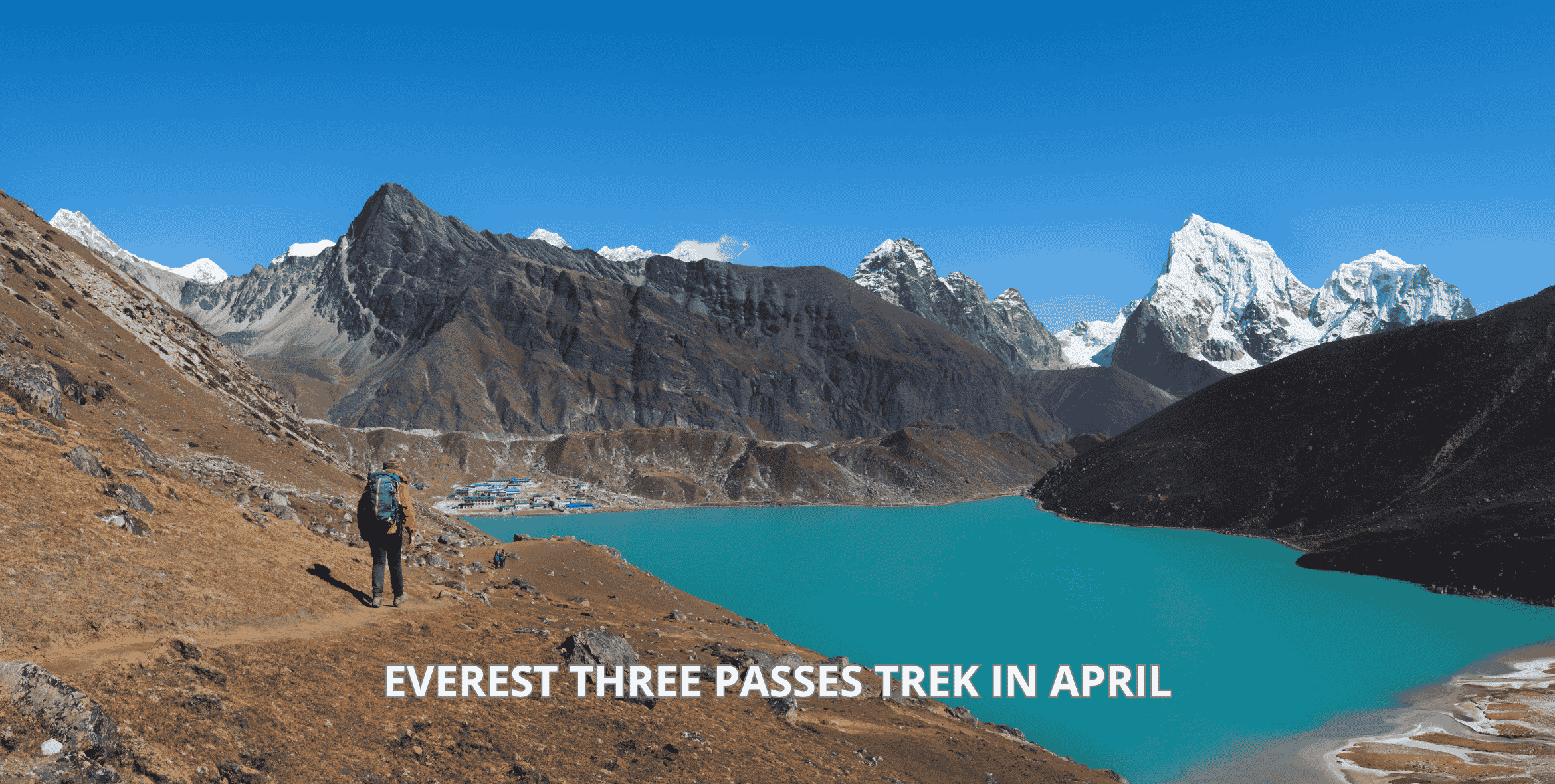
The Everest Three Passes Trek in April crosses Kongma La at 5,535 m, Cho La at 5,420 m, and Renjo La at 5,360 m. It is an 18 day loop out of Lukla, about 166 km long, with roughly 8,100 m of total climbing. April works for all three passes. The first two weeks still hold winter snow up high, and the last ten days are settled but busy, because Everest expedition teams fill Base Camp from mid-month.
When you hike to Everest Three Passes in the first week of April, you may cross old snow on every pass, with a few high lodges only just reopened. Walk it in the last ten days and the trail is dry, the nights are warmer, and Everest Base Camp holds several hundred climbers getting ready for the summit.
Everest Three Passes Trek April Facts
| Fact | Detail |
|---|---|
| Kongma La | 5,535 m, highest of the three |
| Cho La | 5,420 m, the glacier crossing |
| Renjo La | 5,360 m, the Gokyo viewpoint |
| Loop distance | About 166 km from Lukla to Lukla |
| Total climbing | About 8,100 m |
| Crossings above 5,000 m | Six |
| Highest sleeping point | Gorak Shep, 5,164 m |
| Duration | 18 days, Kathmandu to Kathmandu |
| April day temperature, high camps | -5°C to 8°C |
| April night temperature, high camps | -10°C to -18°C |
| Permits | Sagarmatha National Park and Khumbu Pasang Lhamu Rural Municipality |
| Price | From USD 1,734 per person |
Six crossings above 5,000 m is the number worth sitting with. On the Everest Base Camp trek you cross that line twice, and this is the main reason the Three Passes is graded harder. Here you cross it at all three passes, plus Base Camp, Kala Patthar, and Gokyo Ri.
Early April vs Late April in Everest Three Passes Trek
| 1 to 10 April | 11 to 20 April | 21 to 30 April | |
|---|---|---|---|
| Snow on passes | Old snow likely on all three | Patchy, still heavy on Renjo La | Clear, Renjo La patchy |
| Cho La glacier | Hard ice early, needs spikes | Firm, spikes useful | Firm, spikes optional |
| High lodges open | Some still closed | Nearly all open | All open |
| Day temp, passes | -8°C to 4°C | -5°C to 7°C | -2°C to 10°C |
| Night temp, high camps | -15°C to -18°C | -12°C to -15°C | -8°C to -12°C |
| Visibility | Sharpest of the month | Good mornings | Haze builds after midday |
| Trail crowds | Light | Building | Heavy on the Base Camp side |
| Base Camp activity | Teams arriving | Full camp, puja season | Full camp, rope fixed |
| Lukla flights | Kathmandu possible | Manthali likely | Manthali almost certain |
Kongma La Passes in April
Kongma La is the highest at 5,535 m and usually the first pass you cross. The day runs from Chhukung to Lobuche and takes 8 to 10 hours. There is no teahouse and no water source between those two villages. You carry everything, including lunch.

In early April, old snow often fills the upper section. That is easier underfoot than loose rock, but it hides the trail line. The descent is steeper than the climb and partly trail-less, over scree and boulders. Then you cross the Khumbu Glacier, which is slow walking on loose debris after an already long day.
One useful thing about Kongma La: it is the only pass on this loop you can skip. A valley route through Pheriche bypasses it. Cho La and Renjo La Passes have no such option.
Cho La in April
Cho La at 5,420m connects the Khumbu valley to the Gokyo valley. You cross a real glacier here, with crevasses, not just a wide snowfield. The route across is marked with poles and in good conditions it is simple walking.
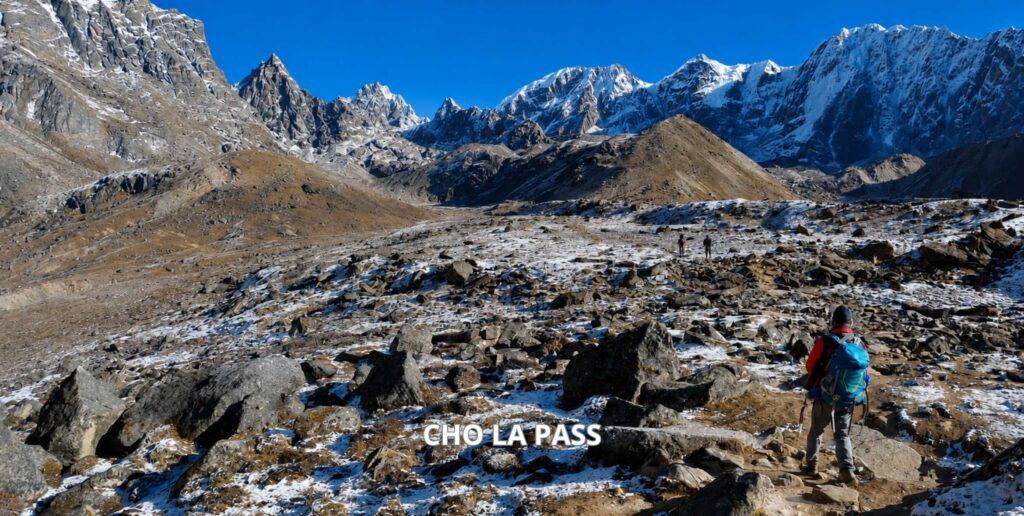
April adds one wrinkle. Meltwater refreezes overnight, so the surface is hard ice on an early start and softens as the morning goes on. That is exactly why you leave early and why you carry microspikes.
The descent from the pass drops through a loose rockfall zone to Thangnak. Take it slowly. You will also see this village written as Dragnag and Thagnak on signs and maps, all for the same place.
Renjo La Passes in April
Renjo La is the lowest of the three at 5,360 m, and it gives the best view on the trek. From the top you look back over the Gokyo lakes with Everest, Lhotse, Makalu and Cho Oyu lined up behind.
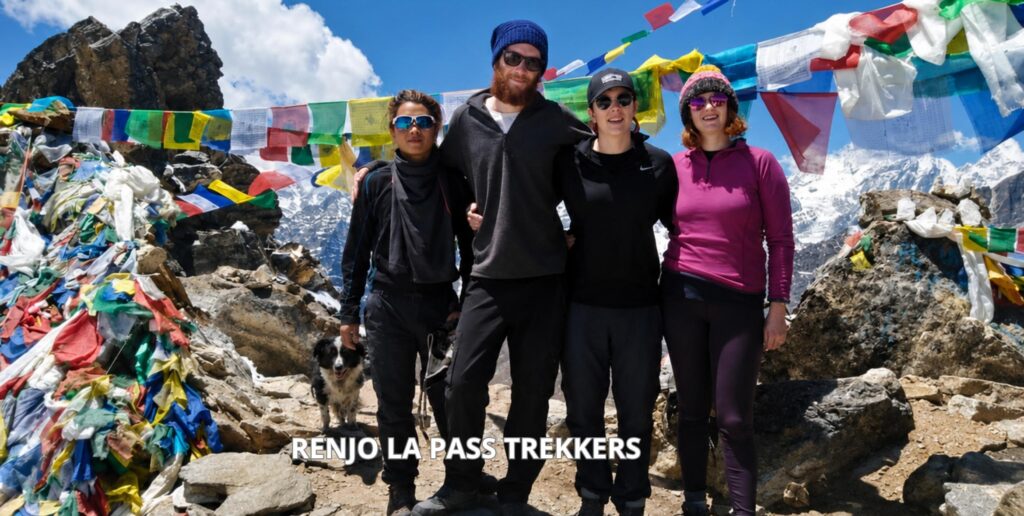
Renjo La can be the snowiest crossing in early April despite being the lowest. The western side faces away from the morning sun, so it holds snow longest. The descent into the Bhotekoshi valley goes down stone staircases that ice over, and those steps are hard on the knees even when dry.
Everest Climbing Season Crowds
In April, Everest Base Camp is not a boulder with prayer flags on it. It is a tent city. Expedition teams move in from the second week. By mid month there are several hundred climbers and support staff living there. The Icefall team have fixed the route through the ice, ropes are running up the mountain, and puja ceremonies are held before teams go higher.
Helicopters work through most mornings, moving loads and people. You hear them long before you see them.
Crowd by Places in Everest Three Passes Trail April
| Section | April traffic |
|---|---|
| Lukla to Namche | Heavy |
| Namche to Dingboche | Heavy |
| Gorak Shep and Base Camp | Heaviest |
| Chhukung and Kongma La | Light |
| Dzongla and Cho La | Light |
| Thangnak and Gokyo | Moderate |
| Lungden, Marlung, Thame | Very light |
Lukla Flights in April
April is peak season, and that changes how you get to Lukla. Kathmandu airport runs at capacity in spring, so most Lukla flights shift to Manthali Airport in Ramechhap. You drive there instead of flying out of Kathmandu.
The jeep leaves Kathmandu between 1:30 and 2:30 in the morning. The drive takes 4 to 6 hours. The flight from Manthali to Lukla is about 20 minutes.
Baggage is limited to 10 kg for your main bag and it is actually weighed at the counter. A few hundred grams over is usually fine. Five kilos over is not.
Build one spare day at each end of your trip. Spring weather closes Lukla for a morning or a day fairly often, and a buffer saves the whole trek. If you would rather skip the flight entirely, our Everest Base Camp trek by drive from Salleri shows how the road approach works.
Our Everest region travel guide covers the flight rules and checkpoints in more detail.
April Temperatures and Weather in Three Passes Everest
| Altitude | Day | Night |
|---|---|---|
| 2,800 to 3,500 m | 10°C to 18°C | 0°C to 5°C |
| 4,000 to 4,500 m | 5°C to 12°C | -5°C to -10°C |
| 5,300 to 5,500 m, passes | -5°C to 8°C | Not applicable |
The pattern to plan around is the afternoon cloud. Mornings in April are usually clear. Cloud builds from the west by early afternoon and the big peaks disappear behind it.
This happens earlier in April than in October. In autumn you often keep your view until four. In April it can close in by one.
Pass Day Timing Rules for Everest Three Passes
Three times to remember on every pass day. Leave your lodge by 7 am, stand on the pass by 11 or 12, and be well into the descent by 2 pm.
Those are not arbitrary. Wind picks up over the passes through the middle of the day, and in April it arrives earlier than in autumn. On Cho La the ice also softens as the sun works on it, so the glacier is at its best early.
We also set a turnaround time on each pass day and tell the group what it is at breakfast. If we are not within reach of the top by then, we go back down and try again the next day.
Anti-clockwise vs Clockwise Everest Three Passes Trek in April
Anti-clockwise means Kongma La first, from Chhukung. You gain sleeping height gradually across the first week. That is why it is the standard direction on the Three Passes and the one our 18 day Everest Three Passes Trek uses.
Clockwise means Renjo La first, out through Thame. It gives slightly better views on the way round, and it costs you in two ways. You cross both the Khumbu and the Ngozumpa glaciers before you reach the passes, and Lobuche to Chhukung has to be done in one push of around 11 hours, because there is nowhere sensible to break it.
April adds a third reason to go anti-clockwise. The western approaches hold snow later, so starting at Renjo La in the first half of the month puts your hardest snow on day six, before you are properly acclimatised.
Gear April Demands
- Microspikes are the first. For Cho La in normal April conditions they are enough, and full crampons and rigid mountaineering boots are not needed on the Three Passes route.
- A sleeping bag rated for comfort to about -10°C is the second. You will see -20°C and -30°C bags recommended for the Three Passes.
- Sun protection is the third, and April is worse than October for this. Snow on the passes throws light straight back at you. Category 4 sunglasses, a brimmed hat and high factor sunscreen on your nose and under your chin.
- A proper windproof shell is the fourth. The cold on these passes is wind cold, not air cold. Our full list sits on the trekking equipment page.
One more item is not gear. Your insurance must cover helicopter rescue to 6,000 m, and you should check the wording rather than the brochure.
Our page on helicopter rescue from Gorakshep explains how an evacuation runs on this side of the Khumbu.
Acclimatization on Everest Three Passes Trek Loop
You sleep above 4,000 m for roughly a week and above 4,700 m for several nights. At 5,500 m each breath gives you about half the oxygen it does at sea level.
Two of those rest days are fixed on the Three Passes itinerary. At Namche we walk up toward the Everest View Hotel and come back down to sleep.
At Dingboche we climb the Nangkartshang ridge to about 5,100 m and sleep at 4,410 m. Climbing high and sleeping low is the whole point of both days.
Every guide on our Everest treks carries an oximeter and a first aid box. Readings get taken each evening, not only when somebody complains. A trekker who says they feel fine and reads low at Lobuche is the one we watch.
Our 18 Day April Itinerary in Everest Three Passes
| Day | Route | Altitude | Hours |
|---|---|---|---|
| 1 | Arrive Kathmandu | 1,300 m | Rest |
| 2 | Fly to Lukla, trek to Phakding | 2,640 m | 3 to 4 |
| 3 | Phakding to Namche Bazaar | 3,440 m | 6 to 7 |
| 4 | Namche, acclimatization day | 3,440 m | Optional hike |
| 5 | Namche to Tengboche | 3,860 m | 5 to 6 |
| 6 | Tengboche to Dingboche | 4,410 m | 5 to 6 |
| 7 | Dingboche, acclimatization day | 4,410 m | Optional hike |
| 8 | Kongma La to Lobuche | 4,910 m | 7 to 8 |
| 9 | Lobuche to Gorak Shep, Base Camp | 5,140 m | 7 to 8 |
| 10 | Kala Patthar, trek to Dzongla | 4,830 m | 7 to 8 |
| 11 | Cho La to Thangnak | 4,700 m | 7 to 8 |
| 12 | Thangnak to Gokyo | 4,790 m | 3 to 4 |
| 13 | Gokyo Ri, rest at Gokyo | 4,790 m | 4 to 5 |
| 14 | Renjo La to Lungden | 4,370 m | 7 to 8 |
| 15 | Lungden to Thame | 3,820 m | 5 to 6 |
| 16 | Thame to Namche, Monjo | 2,835 m | 6 to 7 |
| 17 | Trek to Lukla | 2,840 m | 5 to 6 |
| 18 | Fly to Kathmandu | 1,300 m | Flight |
Permits and April Costs
| Permit | Foreign nationals | SAARC nationals |
|---|---|---|
| Sagarmatha National Park entry | NPR 3,000 | NPR 1,500 |
| Khumbu Pasang Lhamu Rural Municipality | NPR 2,000 | NPR 2,000 |
April vs October Three Pass Trek
| April | October | |
|---|---|---|
| Snow on passes | Early month yes, late month no | Rare |
| Day temperature | Warmer through the month | Cooler, steady |
| Night temperature | Cold early, mild late | Cold, steady |
| Visibility | Sharp mornings, afternoon haze | Clearest of the year |
| Base Camp corridor | Busy | Busiest |
| The three passes | Quiet | Moderate |
| Base Camp atmosphere | Full expedition camp | Empty site |
| Rhododendron | In flower to about 4,000 m | None |
| Flight reliability | Fair, Manthali likely | Good |
| Lodges | All open from mid-month | All open |
See the Everest Three Passes Trek for April group departures and private dates. If you want a summit on top of the loop, there is Island Peak with Everest Three Passes over 19 days, and Lobuche Peak with Everest Three Passes over 21 days.

