

Among the many routes to reach the base Camp of Mount Everest, the Everest Three Pass trek is one of the best. It covers approximately 160 to 170KM (100-105.6 miles). It follows a loop through the remote, less-traveled parts of the Khumbu region. Consisting of not one, not two, but three major high passes: Kongma La, Cho La, and Renjo La, it is quite demanding. That said, it can be done both clockwise and anticlockwise. Thus, it offers a more comprehensive Himalayan experience in the Everest region than the standard Everest Base Camp trek.
Here’s a guide to help you understand the standard and combined Everest Three Passes Trek Distance as well as essential tips for managing the trek’s difficulty. Make sure you read till the end.
Popular Trekking Route Of Everest Three Passes With Distance
The Everest Three High Pass trek route itself can be done in different ways, rather than just clockwise and anticlockwise. Some of the most popular trekking routes are:

Standard Everest Three Passes Trek Distance
Our standard itinerary for the 18-day Everest Three Passes Trek follows an anticlockwise route with no shortcuts or comfort routes. It starts with a classic flight to Lukla and covers roughly 160-170 km within the Sagarmatha National Park. Hence, it is known for being one of the longest and toughest circuits in the Everest region. It links the three major 5,000-meter passes: Kongma La (5,528 m), Cho La (5,368 m), and Renjo La (5,360 m).
These passes form a loop connecting four valleys in order: Imja Khola Valley (near Chhukung), the Khumbu Valley (near Lobuche/Gorak Shep), the Gokyo Valley, and the remote Bhote Koshi Valley (near Thame). So, you can visit Everest Base Camp, Kala Patthar, and the Gokyo Lakes. Since it covers lots of regions, you also reach untouched places like Nangpa La Valley, the friendly Sherpa village of Marlung, and the serene monastery village of Thame.
Hiking the three passes is difficult for many and also carries the risk of altitude sickness. Thus, the trek is rated strenuous. You have to walk for long hours, climb steep hills and descents, and frequently trek to altitudes above 5,000 meters. Moreover, the passes demand a good level of fitness, steady acclimatization, and flexibility due to unpredictable mountain weather. Even so, the path is well-established, with teahouses available throughout and enough places to rest when needed.
Overall, the standard Everest 3 passes trek blends remote landscapes, high-altitude challenges, and some of the most unique views of Everest in the Khumbu.
| Days | Trek Section Covered | Approx. Distance |
|---|---|---|
| 1-3 | Kathmandu arrival → Lukla → Phakding → Namche Bazaar | 28-30KM |
| 4-5 | Namche (acclimatization) → Tengboche | 24-26KM |
| 6-8 | Tengboche → Dingboche (acclimatization) → Lobuche via Kongma La Pass | 30-32KM |
| 9-11 | Gorakshep → Everest Base Camp → Kalapathar → Dzonglha → Dragnag via Cho La Pass | 30-32KM |
| 12-14 | Dragnag → Gokyo (Gokyo Ri) → Lumde via Renjo La Pass | 22-23KM |
| 15-18 | Lumde → Thame → Monjo → Lukla → fly to Kathmandu | 26-27KM |
Lobuche Peak with Everest Three Passes Trek Distance

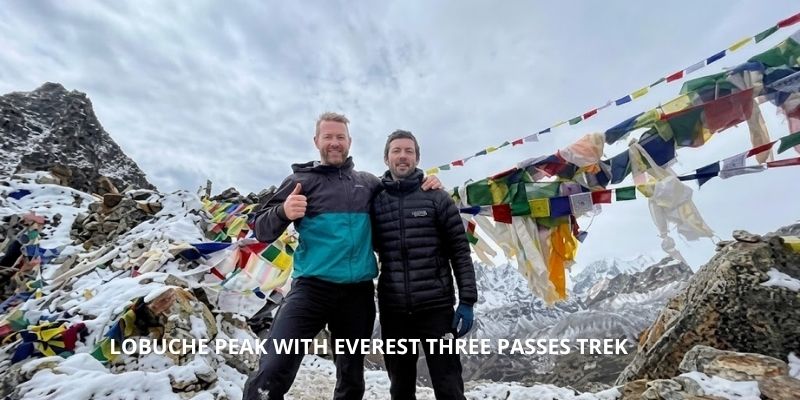
For those who want a complete Himalayan trekking and mountaineering journey, you can combine the 21-day Lobuche Peak with the Everest Three Passes Trek. It builds on the standard Three Passes route but adds a climb to the Lobuche East (6,119 m), which becomes the main highlight of the itinerary.
With the Lobuche Peak extension, the Everest Three Passes trek distance increases slightly, from 165 to 180KM. You trek up to Lobuche High Camp (5,600 m) and take more challenging acclimatization hikes to Nangkartshang Peak and the Everest View Hotel. These extra ascents provide warm-ups and prepare your body for the thinner air, longer days, and the physical push required for the summit.
Lobuche East is labeled a PD+ (Peu Difficile Plus) trekking peak. It means the climb is technical and requires intermediate-level mountaineering skills. On the summit day, you have to use fixed ropes and crampons to move on steep snow slopes and navigate glacier sections. It’s a controlled environment designed for beginners, but still challenging enough to give you a taste of true alpine climbing.
Reaching the top of Lobuche rewards you with sweeping views of the Himalayas: Everest, Makalu, Ama Dablam, Nuptse, and the entire Khumbu skyline. It seems far broader than what you see from typical trekking viewpoints. After the climb, the descending route reconnects with the Three Passes trail and continues through Cho La, Gokyo, and Renjo La. While the passes remain demanding, the focus here shifts to completing the circuit rather than introducing new technical challenges.
Only choose this itinerary if you want something more than the usual high-altitude circuit and have good physical fitness, prior high-altitude experience, and basic mountaineering skills. Lobuche Peak adds extra difficulty to the already strenuous Everest 3 High Pass trek, so it’s best suited for experienced trekkers.
| Days | Trek Section Covered | Approx. Distance |
|---|---|---|
| 1-3 | Kathmandu arrival → Fly to Lukla → Phakding → Namche Bazaar | 22-24KM |
| 4-6 | Namche acclimatization (Everest View Hotel) → Tengboche → Dingboche | 20-22KM |
| 7-9 | Dingboche rest (Nangkartshang Peak) → Chhukung → Kongma La Pass → Lobuche | 24-26KM |
| 10-12 | Gorakshep → Everest Base Camp → Kala Patthar → Lobuche → High Camp | 25-28KM |
| 13-15 | Summit Lobuche Peak → descend to High Camp → Dzongla → Dragnag via Cho La Pass | 24-26KM |
| 16-18 | Gokyo (half-day rest) → Gokyo Ri → Lumde via Renjo La Pass | 25-27KM |
| 19-21 | Lumde → Marlung → Namche → Lukla → flight to Ramechhap → drive to Kathmandu | 25-27KM |
Island Peak with Everest Three Passes Trek Distance

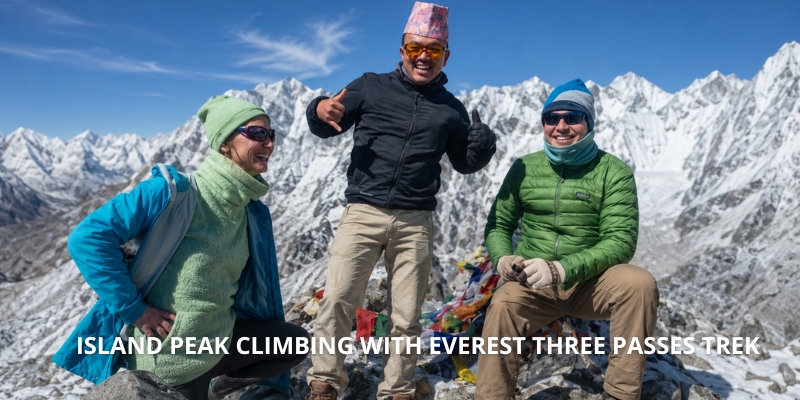
If Lobuche East feels too technical to combine with the Three High Passes Trek, you can opt for Island Peak (6,189 m) instead. This way, you still get the three-pass experience without giving up the mountaineering element. The full trek covers approximately 170 to 185KM and takes 20 days to complete. It follows the standard pass sequence and the same optional acclimatization hike to Nangkartshang Peak.
The route changes from Dingboche to Lobuche. Island Peak Base Camp is accessible only from Chhukung and the Imja Valley, so you have to get there first. Island Peak is one of Nepal’s most popular entry-level climbing peaks and is often graded PD. It doesn’t require advanced technical skills, but it is still demanding. You’ll use fixed ropes and crampons, cross glaciers, and climb a steep headwall leading to a narrow summit ridge.
Once the climb is completed, you rejoin the Three Passes circuit and cross Kongma La, Cho La, and Renjo La, while also visiting Everest Base Camp, Kala Patthar, Gokyo, and Gokyo Ri along the way. The passes remain physically challenging, but after the ascent to Island Peak, the remaining trek becomes more about endurance than climbing.
Thus, Island Peak with the Everest Three Passes Trek can be the best choice for intermediate trekkers and even beginners with good physical fitness. It offers both glacier mountaineering and one of the region’s most scenic trekking circuits.
| Days | Trek Section Covered | Approx. Distance |
|---|---|---|
| 1-3 | Kathmandu → Ramechhap → Lukla → Phakding → Namche Bazaar | 24-26KM |
| 4-6 | Namche acclimatization → Tengboche → Dingboche | 22-24KM |
| 7-9 | Dingboche acclimatization → Chhukung → Island Peak Base Camp | 18-20KM |
| 10-11 | Island Peak High Camp → Summit → return to Chhukung | 14-16KM |
| 12-14 | Chhukung → Kongma La Pass → Lobuche → Gorakshep → Everest Base Camp | 26-29KM |
| 15-17 | Kala Patthar → Dzongla → Cho La Pass → Dragnag → Gokyo (rest) | 28-30KM |
| 18-20 | Gokyo Ri → Renjo La Pass → Lumde → Marlung → Namche → Lukla → return to Kathmandu | 38-40KM |

What Makes the Everest Three-pass Trek difficult?
Here’s a difficulty breakdown of each pass to help you understand why the three passes trek in Nepal is considered challenging by many trekkers and trekking agencies:

Challenges of Kongma La Pass (5,528 m)
Kongma La is widely considered the most challenging and most exhausting of the three passes. It’s the highest, the most remote, and the most physically demanding because of the following reasons:
- You climb 700–900 m from Chhukung, which feels intense because the air gets thinner fast at this altitude.
- The trail is filled with big rocks, loose scree, and uneven ridges, so you have to watch every step.
- There are no teahouses or water points along the entire crossing, so you carry all your food and water for the day.
- Weather changes quickly at this height, and strong winds or sudden cold can hit even in peak trekking months.
- The climb is long, the descent is steep, and the exposure is constant, making this the most tiring of the three passes.
Challenges of Cho La Pass (5,368 m)
The second pass, Cho La, is known as the most technical pass of the three. Even though it’s slightly lower than Kongma La, it is potentially hazardous in the following ways:
- The route to Cho La pass has a glacier crossing. You have to use crampons or microspikes to tackle icy and slippery surfaces.
- You may encounter hard-packed snow or small crevasses, so balance and careful steps are important.
- The final ascent is a narrow climb of 500–600 m that gets much harder if fresh snow covers the rocks.
- The descent to Dragnag can be risky because snow or wind can erase the trail and make it hard to navigate.
- After a storm, snow and meltwater on the glacier and upper slopes can turn into hard ice. This makes the trail slippery and more dangerous, so you may have to wait for safer conditions before crossing.
Challenges of Renjo La Pass (5,360 m)

Renjo La is generally considered the easiest and safest of the three passes, but “easy” at 5,000+ meters is still serious. The trail is more stable and less technical, yet it includes challenges like:
- You gain 650–800 m in thin air, so you feel the altitude quickly, even though the trail is more stable.
- Long stone steps on the Gokyo side require endurance for a relentless, stair-like climb at high altitude.
- Temperatures can drop sharply due to strong winds, and wind chill can be high in the upper section.
- You need to be acclimatized adequately before attempting this pass to avoid breathlessness or AMS symptoms.
- It’s considered the easiest of the three, but the altitude and exposure still require steady pacing and readiness for weather changes.
Tips For Successful Everest Three Passes Trekking
No matter which variation you choose, the Everest Three High Passes Trek route demands steady pacing, good acclimatization, and a smart approach to long days at altitude. The tips below help make each section of this high-altitude circuit safer and more manageable.
- Start early on pass days for better visibility, firmer snow, and safer crossings.
- Maintain a steady pace at high altitude to conserve energy for long climbs and descents.
- Use acclimatization or rest days wisely by taking short hikes such as Nangkartshang, Chhukung Ri, or Gokyo Ri.
- Drink plenty of water and eat small, frequent meals to maintain energy and also prevent altitude sickness.
- Carry microspikes or trekking poles for added stability on icy or uneven terrain.
- Check weather forecasts since snow and wind can change conditions quickly.
- Wear layered clothing to protect against wind chill and sudden temperature drops.
- Rest well between major crossings, using sleep and nutrition to support recovery.
- Ask your guide and porter for their suggestions. They know the trail, the conditions, and the safe timing better than anyone.
- Add extra days if you feel unwell or notice altitude symptoms. Giving your body is more important than completing the trek.
In this way, you can cross three high mountain passes with more confidence and fewer surprises. If you have any queries regarding the trek, contact us for support and guidance.


