

The journey from Dingboche to Lobuche marks one of the most exhilarating stages of the Everest Three Passes Trek. It pushes you deeper into the heart of the Khumbu Valley as you leave the stone-walled fields of Dingboche behind. The landscape transforms dramatically into a more barren, high-altitude terrain where every step brings you closer to the towering giants of the Himalayas.
On this trail section, you can view breathtaking Ama Dablam dominating the southern skyline, while the massive forms of Pumori, Nuptse, and Lhotse begin to emerge ahead. Your anticipation builds up with each passing hour. As you continue, the iconic peaks grow larger, reminding you that you’re walking through one of the most spectacular mountain regions on Earth.
This route represents a crucial segment not only for the Three Passes Trek but also serves as a shared pathway for trekkers on the classic Everest Base Camp Trek and adventurers attempting the Island Peak Climb.
Dingboche To Lobuche Route Highlights

On the way to Lobuche from Dingboche, you experience some of the most memorable features of the entire Everest region trek. You walk alongside the dramatic Khumbu Glacier, witnessing its massive lateral moraines and the distant Khumbu Icefall. Then you also cross the high-altitude Thukla Pass (also known as Dughla Pass), marked by memorial stupas honoring climbers who perished on Everest.
You can witness panoramic mountain views continuously unfold throughout the day. During the initial sections, Ama Dablam provides a stunning backdrop. Then the landscape opens to reveal the nearby peaks surrounding the Everest Base Camp Trek.
Dingboche to Dughla
The first section of the day involves a relatively gentle ascent from Dingboche at 4,410 meters. From here, you trek to the small settlement of Dughla, situated at 4,620 meters. This portion of the trail winds through open yak pastures where you can see Yaks, Dzos, and Himalayan Pika grazing on the sparse vegetation that manages to survive at this altitude.
You follow the valley floor and gradually gain elevation. The magnificent south face of Ama Dablam serves as a constant companion throughout this segment. After trekking for a few hours through this comparatively easier terrain, you’ll arrive at Dughla. It is a tiny village with just a handful of teahouses.
This settlement serves as the last major rest stop before the challenging climb to the Thukla Pass at 4,830 meters. So, you can refuel here with hot tea and gather energy for the steep ascent. Here, you’ll see many trekkers put on more layers of clothing. We recommend that you do the same as temperatures drop with increasing altitude.
Thukla Pass

From Dughla village, the trail abruptly changes into a steep, demanding climb up to Thukla/Dughla Pass. This section is short but still one of the most physically challenging of the entire day’s trek. You face a rocky, zigzag path that tests both stamina and determination. The thin air makes even slow progress feel strenuous.
After some gruesome hours, you finally reach the top of the pass. Here, you’ll encounter dozens of memorial stupas and stone monuments dedicated to climbers and Sherpas who lost their lives on Everest and neighboring peaks. This somber collection of memorials creates a powerful moment of reflection. It reminds you of the real dangers that mountaineers face in the extreme Himalayas.
The site honors legendary climbers and local heroes alike. Prayer flags believed to carry prayers across the mountain flutter in the constant wind. Despite the emotional weight of this location, it also offers trekkers their first clear views toward the upper Khumbu region and the route ahead to Lobuche.
Khumbu Glacier

After crossing Thukla Pass, the trail remains at a consistent elevation as it follows the lateral moraine of the massive Khumbu Glacier. Here, you can witness a fascinating close-up encounter with glacial landscapes. You literally walk alongside piles of rock and debris that have been pushed aside by the slow-moving river of ice.
Even though the massive Khumbu Glacier is hidden under a thick layer of dirt and rocks rather than clear ice, you can truly see how enormous it is as you walk alongside its edge. In the distance, you can spot the famous Khumbu Icefall. It resembles a giant, frozen waterfall made of massive chunks of jagged ice and deep, dangerous cracks. It forms the first major obstacle for Everest climbers ascending via the South Col route.
You can feel the harsh reality of high-altitude environments as you walk across this barren section, where vegetation survives only in a few places. As you progress along the moraine, the small settlement of Lobuche gradually comes into view, situated at the base of Lobuche Peak.

Dingboche to Lobuche Distance
Distance-wise, Lobuche is not that far from Dingboche. This part of the trek only covers approximately 8 to 9KM. Most trekkers complete this section in five to six hours. While the distance itself may seem short compared to lower-altitude trekking days, this route involves a significant elevation gain. You start from 4,410 meters in Dingboche to approximately 4,910 meters in Lobuche.
This 500-meter elevation increase, combined with the progressively thinner air, makes the day considerably more tiring. Additionally, the route is predominantly uphill. It involves the steepest and most challenging section as you climb from Dughla to Thukla Pass. After that, the remaining trail follows the Khumbu Glacier moraine. It is more gradual, but you still consistently gain elevation. Notable landmarks along the way include Dughla, the memorial site at Thukla Pass, and the Khumbu Glacier area.
Note: As you walk, the high altitude significantly affects breathing and pace. You should take frequent rest stops, even if you’re a fit trekker.
Difficulty of Dingboche To Lobuche Route

This trek section is widely considered one of the more challenging days on the Everest region trails. It involves a significant altitude gain of 500 meters plus, the demanding climb up Thukla Pass. The reduced oxygen levels in the atmosphere here make it considerably more tiring for you. Even experienced trekkers tend to slow their pace dramatically, according to our experienced guide.
The steep, rocky ascent from Dughla to Thukla Pass is the most strenuous subsection. You will need frequent rest breaks as the heart rate increases and breathing becomes labored. To handle the thin mountain air, use a “slow-and-steady” walking style with tiny steps and deep breaths to keep your energy up. Drink plenty of water to prevent dehydration caused by the dry mountain air and increased respiration, and take as many breaks as you need.
The acclimatization day spent in Dingboche before this section will play a vital role here. It reduces the risk of Acute Mountain Sickness (AMS), simply known as altitude sickness. Despite the physical demands, you will find the effort is worthwhile at Lobuche. Here, you suddenly come face-to-face with the towering, dramatic north face of Mount Lobuche East, while the magnificent peak of Pumori dominates the horizon further ahead.
Treks That Feature Dingboche To Lobuche Trek Route
The trek from Dingboche to Lobuche is a shared section used by trekkers on the classic Everest Base Camp route, the challenging Everest Three Passes Trek, and the Island Peak climbing expedition. Even though everyone follows the same path, each group is on a different mission. Some head toward base camp, some push for high passes, while others prepare for a summit climb. Thus, this stretch is a mix of goals, energy, and adventure.
Everest Base Camp Trek
The classic Everest Base Camp trek is the most famous high-altitude adventure in Nepal. It follows the historic 1953 route of Sir Edmund Hillary and Tenzing Norgay. Thus, the trails are well-marked with comfortable teahouses along the way. It covers a 130-KM round trip over 13 days, with the prestige of standing at the foot of the world’s highest peak, Mount Everest, and the famous Kala Patthar (5,545m).
It is rated moderate to challenging rather than simply moderate due to the extreme altitude. It starts from Lukla. Then, you pass through key villages like Phakding, Namche Bazaar, and Tengboche, finally reaching Dingboche on day 6. After that, you trek to Lobuche on day 8 via the Thukla Pass and then to Gorakshep. From here, you make your way to the high points of Everest Base Camp and Kala Patthar, before following the same path back down to Lukla.
You don’t need to do technical climbing on any section of the trek. The classic Everest Base Camp trek is a simple in-and-out trek to Everest Base Camp that offers a life-changing sense of achievement. It also allows you to foster a deep connection to the history and spiritual culture of the Sherpa people.
Everest Three Passes Trek
The Dingboche to Lobuche section also connects seamlessly with the Three Passes Circuit route. This extended journey takes 18 days to complete and covers about 130-170KM. It is rated strenuous to very challenging. Thus, it is ideal only for seasoned trekkers and adventurers seeking a quieter, more authentic experience in the Khumbu region.
It follows the standard EBC trail up to Lobuche, but after that, the Three Passes Trek takes you to Gokyo Valley, instead of the EBC. You witness the tranquil turquoise Gokyo Lakes, climb up to Gokyo Ri, and conquer three spectacular mountain passes: Kongma La, Cho La, and Renjo La. Thus, the variety of scenery on this route is exceptional.
If you can’t decide between the two treks, read our detailed comparison: Everest Base Camp Trek vs Three Passes Trek.
Island Peak Climbing

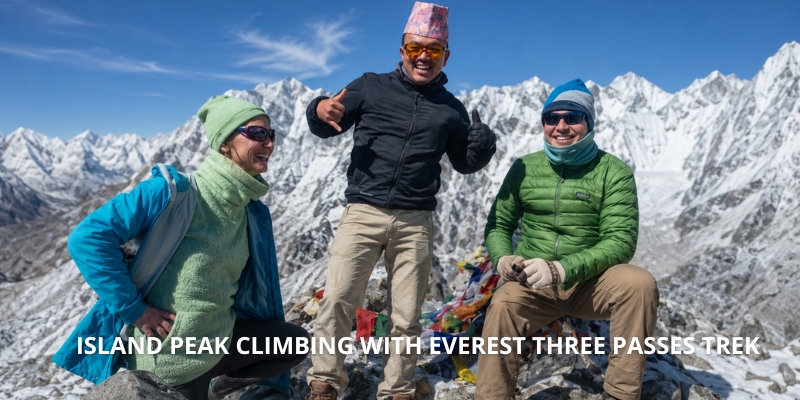
Mountaineers preparing to summit Island Peak (Imja Tse, 6,189 meters) also follow this exact trail from Dingboche to Lobuche as part of their Island Peak Climbing expedition. It also covers 120-130KM and can be completed over 18 days. The itinerary follows the standard Everest Base Camp trail to EBC (5,364 m) and Kala Patthar (5,545 m), then attempts the summit of Island Peak.
It is rated challenging. Hence, it is best suited for trekkers seeking adventure, thrill, and a sense of accomplishment rather than just the physical climb. You acclimatize steadily along the way and practice climbing techniques so that you’re ready to summit the peak successfully by the time you reach the lodge at Chhukung (4,730m), from where you trek to Island Peak High Camp, then summit the peak.

